


Red Turkish Prayer Mat
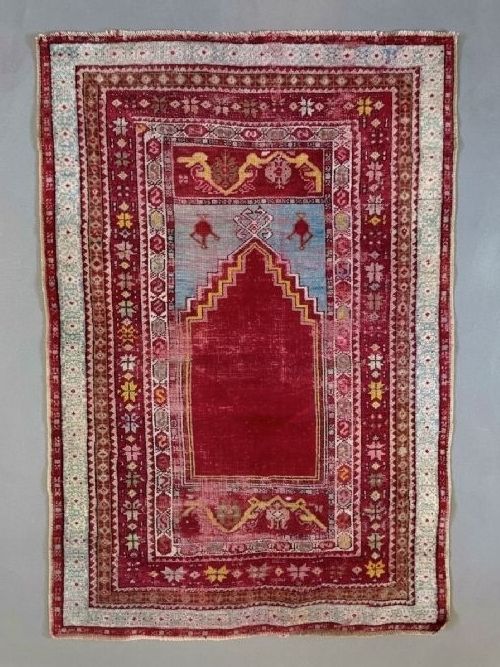
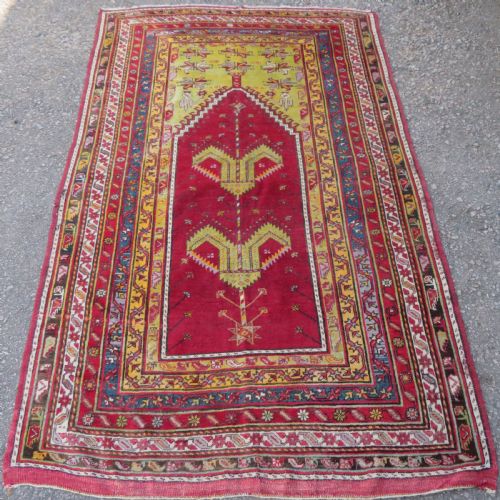
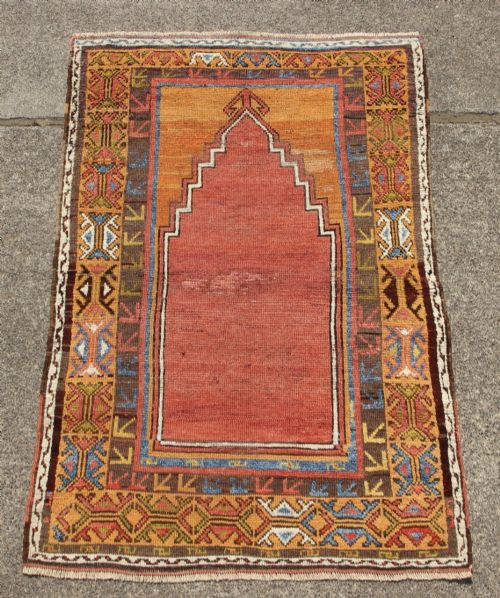
A red turkish prayer mat brings centuries of Anatolian weaving tradition into a room through distinct architectural mihrab arches and rich natural dyes.
Red Turkish Prayer Mat
A red turkish prayer mat is a woven textile featuring a central niche designed to direct the placement of the head during daily worship. These pieces originate from historic weaving centres across Anatolia, including Konya, Kirsehir, Ghiordes, and Ladik.
The selections available here span from the eighteenth century into the early twentieth century, encompassing both village productions and urban workshop pieces. Buyers will frequently encounter examples characterised by deep madder red fields, wool foundations, and distinctive multi-tiered prayer arches.
Regional variations display remarkable individuality, ranging from the geometric field patterns of central Anatolian village rugs to the fine silk construction associated with Kayseri weaving. Each piece reflects the specific aesthetic traditions of the district where it was knotted.
Materials and construction methods
Weavers relied primarily on wool and hand-spun wool for the pile and foundation, occasionally incorporating cotton or silk for finer structural detail. Natural dyes and vegetable dye sources provided the characteristic deep red tones, yellows, and blues seen across the inventory.
The construction involves hand-knotting techniques executed on vertical looms, creating dense pile fabrics designed to withstand regular domestic use. Village workshops and nomadic weavers utilised locally sourced materials that patinate richly over decades of handling.
Several pieces preserve the quiet record of village looms where weavers subtly altered border motifs mid-row.
Judging quality and execution
Quality in these textiles rests upon the precision of the knotting, the depth and saturation of the natural dyes, and the integrity of the wool foundation. Finer knot counts allow for sharper delineation of the architectural motifs within the prayer arch.
The handling of secondary borders and the purity of the red ground field distinguish exemplary village pieces from standard commercial work. A harmonious balance of proportions and well-preserved original edge finishes elevate the status of an antique textile.
Tuduc
The Red Turkish Prayer Mat Glossary
- Mihrab
- The arched architectural niche depicted at one end of the rug, symbolising a prayer alcove or doorway pointing toward Mecca. This feature defines the primary orientation of the textile.
- Madder
- A natural red dye derived from the root of the Rubia plant, widely used in Anatolian weaving to achieve durable and variable crimson hues. It produces the warm terracotta and deep red grounds typical of these rugs.
- Saf
- A multiple-niche prayer rug featuring a sequence of several arches joined in a row, allowing multiple individuals to pray simultaneously. These expansive formats are exceptionally uncommon.
- Kilim
- A flat-woven textile produced without a pile by tightly interweaving warp and weft threads. Certain regional pieces adopt this lighter structure for prayer formats.
- Ghiordes knot
- A symmetrical knotting technique utilised by Turkish weavers to secure the wool pile firmly to the warp threads. This method contributes to the structural durability of the rug.
Red Turkish Prayer Mat: Frequently Asked Questions
How are prayer rugs used?
These textiles were traditionally laid upon the floor to provide a clean surface for daily Islamic prayer, with the pointed arch oriented toward Mecca. In modern settings, they function effectively as small decorative floor coverings or wall hangings.
Because of their distinct format and historic character, collectors frequently place them in studies, hallways, or low-traffic areas to preserve the pile.
How do I identify regional Anatolian types?
Regional attribution relies on examining the specific geometry of the mihrab, the palette of the natural dyes, and the organisation of the border stripes. Towns such as Konya, Ladik, and Kirsehir each developed distinct design vocabularies.
Consulting the structural characteristics and knot density further assists in separating central Anatolian village pieces from western workshops.
Are these textiles made with natural dyes?
The majority of nineteenth-century pieces utilise natural and vegetable dyes extracted from plants and insects, yielding rich madder reds and subtle tonal variations. These dyes interact with the wool over time to develop a characteristic patina.
Closer examination often reveals abrash, which is a subtle shift in colour shade caused by changes in dye batches during the weaving process.
How should I care for an antique rug?
Preserving an antique textile requires gentle vacuuming without a beater bar and protection from direct, prolonged sunlight to prevent dye fading. Professional textile conservation cleaning should be employed when necessary.
Using a breathable underlay helps keep the rug stable on the floor and reduces friction between the wool foundation and the ground.