


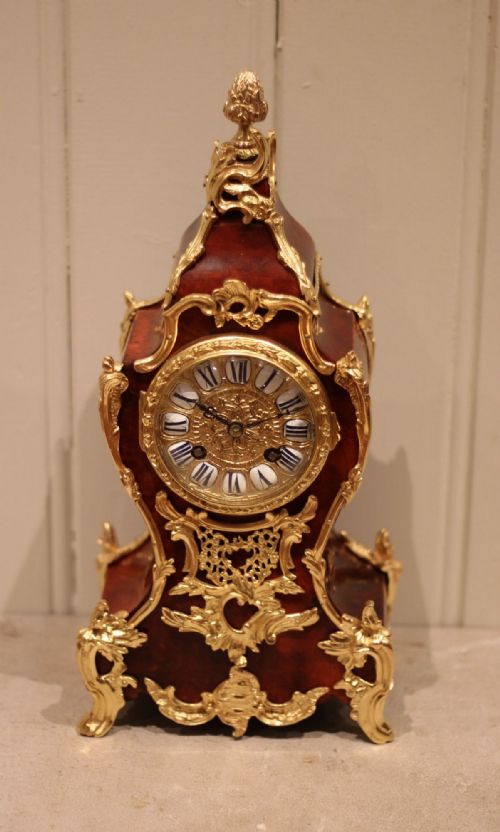


Red Tortoiseshell Mantel Clock
A red tortoiseshell mantel clock brings rich colour and striking French style to a room, combining warm organic shell with bright metallic inlay.
Red Tortoiseshell Mantel Clock
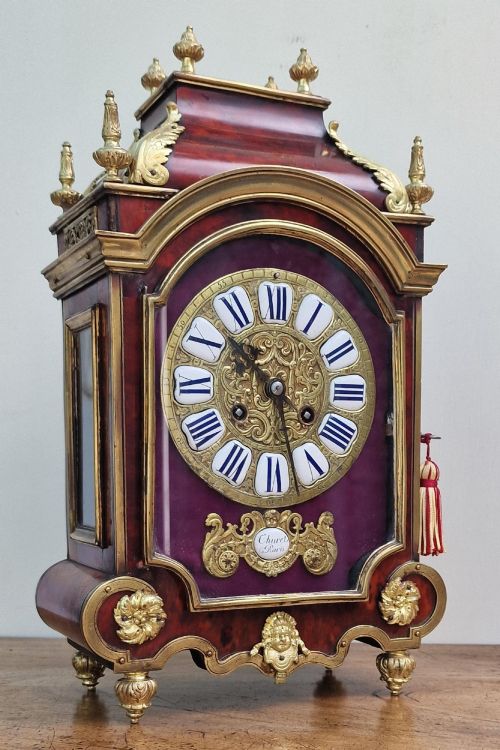
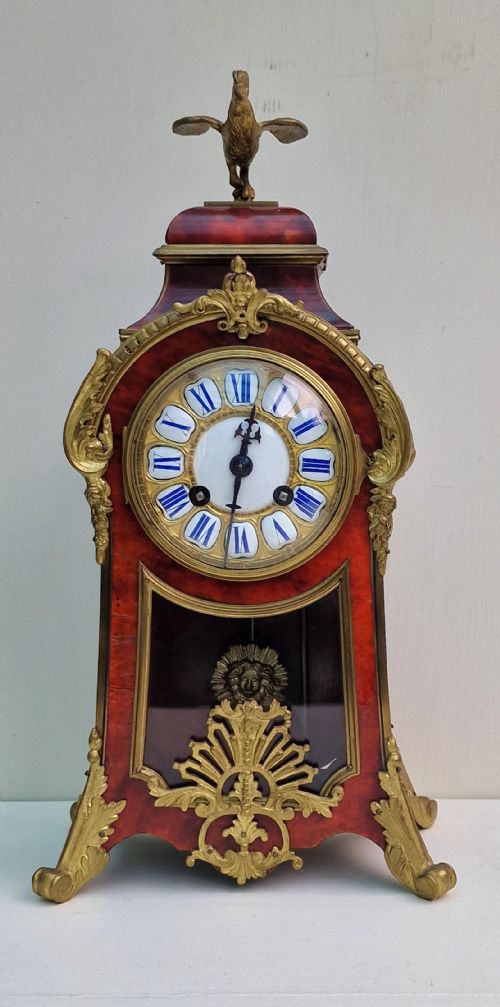
When you search for a red tortoiseshell mantel clock, you are looking at decorative timepieces defined by distinctive reddish-brown mottled shell panels paired with intricate metalwork. These clocks originate primarily from nineteenth-century France, spanning periods from the Victorian era back to the Regency and featuring revivalist design movements.
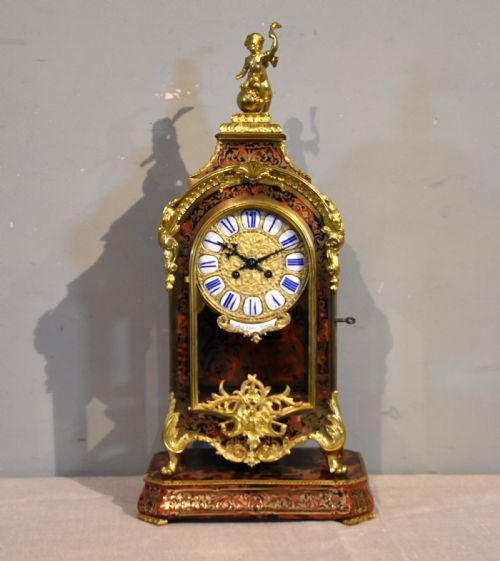
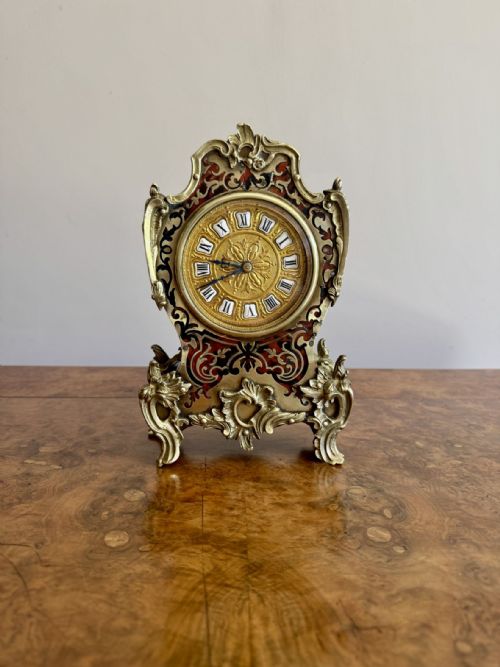
The objects on this page appear in various forms, most commonly as classic mantel clocks alongside taller bracket clocks, pedestal clocks, and miniature pieces. The visual character relies heavily on Boulle work techniques, where brass and tortoiseshell are cut together and applied to wooden carcasses.
Most examples you will meet date from the late nineteenth century, reflecting Victorian tastes for elaborate French stylistic revivals. Alongside genuine tortoiseshell, the selection includes faux tortoiseshell finishes achieved through painted or treated surfaces.
Judging Quality and Craftsmanship
The standard of the brass inlay work and the depth of the red tortoiseshell ground largely determine the quality of the piece. Finer examples display precise cutting where the metal and shell fit seamlessly together without visible gaps or excessive filler.
The casting and chasing of the ormolu and gilt bronze mounts also separate superior pieces from simpler productions. Crisp, sharply defined foliage and figural mounts indicate skilled artisan work compared to soft, worn castings.
The presence of matching components, such as original wall brackets or pedestals, adds significantly to the integrity of the object. Furthermore, the fidelity to historical French styles like Louis XIV or Rococo Revival influences how successfully the design holds together.
Some bracket clocks come with their original wall brackets, proving that even clocks liked to hang out on their own dedicated shelves.
Thuret·A.D. Mougin
The Red Tortoiseshell Mantel Clock Glossary
- Boulle work
- A marquetry technique using brass and tortoiseshell developed in France and named after cabinetmaker André-Charles Boulle. The method involves cutting contrasting sheets together to create matching positive and negative designs.
- Ormolu
- Gilded bronze used extensively for decorative mounts on nineteenth-century French clocks. The technique involves applying a gold amalgam to a bronze base and heating it.
- Bracket clock
- A portable clock originally designed to sit upon a wall bracket or furniture piece. Many examples in this selection include their original matching support brackets.
- Waisted mantel clock
- A clock case featuring an inward-curving profile along the middle section. This silhouette is frequently observed in nineteenth-century French designs.
- Quarter striking
- A clock movement mechanism that chimes on the quarter-hours in addition to sounding the full hours. These movements require more complex gear trains than simple hourly strikers.
Red Tortoiseshell Mantel Clock: Frequently Asked Questions
What is a red tortoiseshell mantel clock?
These pieces are decorative timepieces featuring rich red organic shell veneers paired with intricate brass inlay. They are typically nineteenth-century French creations reflecting Louis XIV or Rococo revival styles.
Most examples operate on eight-day mechanical movements and are housed in wooden cases adorned with gilt bronze mounts.
How do I identify the period?
Dating relies on stylistic clues such as the specific revival movement, the design of the bronze mounts, and the construction methods used on the wooden case. Victorian and late nineteenth-century pieces dominate this category.
Examining the clock face, the type of enamel numerals, and the backplate of the movement can also help narrow down the decade of production.
What is faux tortoiseshell?
Faux tortoiseshell is a simulated finish created to mimic the mottled appearance of genuine shell using alternative materials. Makers achieved this effect through painted or treated surfaces on wood.
These alternative versions offered the decorative warmth of tortoiseshell at a different production level while maintaining the same French mantel clock forms.