



Red Painted Accent Table
A red painted accent table brings a striking punch of colour and historical character to a room.
Red Painted Accent Table
When you search for a red painted accent table, you find a diverse group of occasional furniture spanning multiple centuries and global design traditions. These pieces function primarily as decorative side tables, lamp tables, and lowboys that introduce bold pigment into an interior scheme.
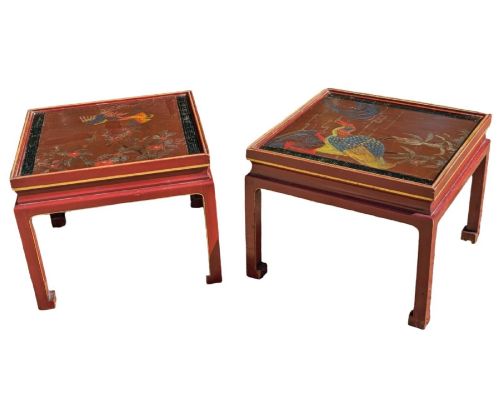
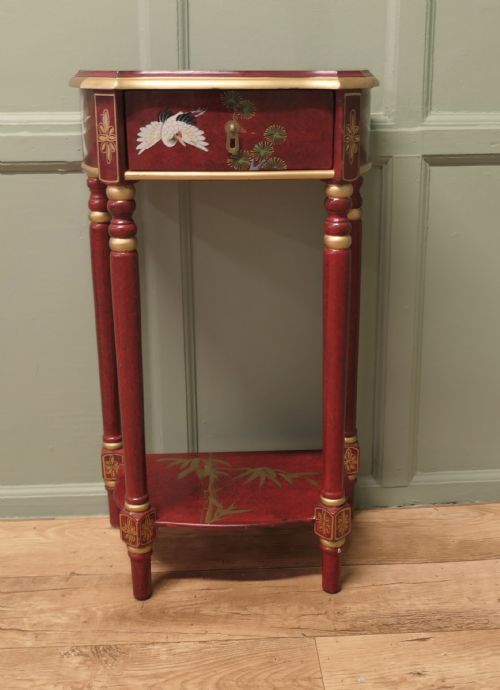
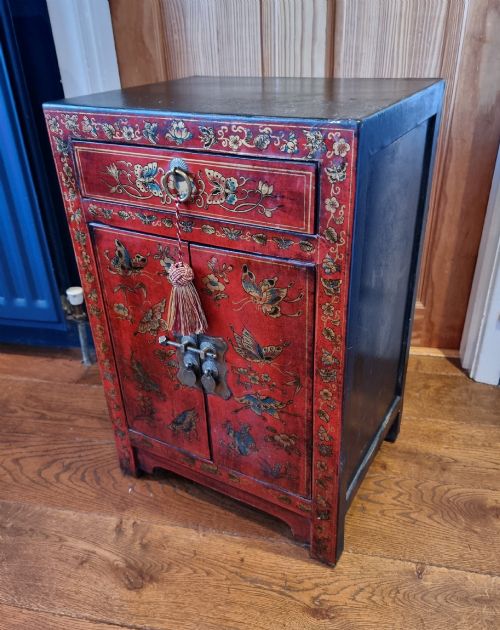
The selections on this page are most commonly represented by Chinoiserie lacquer work from the early twentieth century and nineteenth century polychrome or painted surfaces. Buyers encounter forms ranging from demi-lune consoles to compact occasional tables originating from English, Italian, Burmese, and Chinese workshops.
How they were made
The construction of these pieces relies heavily on traditional timber frames finished with layers of paint, gesso, or lacquer pigment. Artisans applied successive coats of colour to wood substrates, frequently building up polished lacquer surfaces or detailed polychrome decorations.
Many examples incorporate hand painted details, metallic pigments, or specialist finishes that define their distinct stylistic identity, such as Asian Chinoiserie motifs or Italian revival polychromy.
Listings feature pieces spanning from the 18th Century through the Art Deco era of the 1930s.
What varies in quality
Quality in these pieces rests upon the integrity of the original painted or lacquered surface and the fineness of the hand applied detail. Superior examples display depth in the pigment layer and carefully preserved decorative motifs rather than flat, uniform modern repainting.
The underlying cabinetmaking also dictates worth, separating robust period timber construction and balanced proportions from simpler utilitarian builds.
Bruno Zach
The Red Painted Accent Table Glossary
- Polychrome
- Decorated in multiple colours. This technique appears on Italian revival and nineteenth century occasional tables.
- Demi-lune
- Half moon shape. This term describes console and side tables designed to sit flush against a wall.
- Lacquer
- A durable finish applied in thin coats and polished to a hard sheen. Burmese and Chinese examples utilise this traditional technique.
- Lowboy
- A small table with drawers, standing on relatively short legs. They often serve as side tables or dressing surfaces.
Red Painted Accent Table: Frequently Asked Questions
Where should I place a red accent table?
These tables work best as functional statement pieces in living rooms, hallways, or bedrooms where a splash of colour elevates the surrounding decor. Their compact scale allows them to sit beside seating or beneath lamps easily.
Consider pairing them with neutral walls to let the red pigment stand out as a primary focal point in the interior scheme.
How do I identify Chinoiserie style?
Chinoiserie pieces typically feature distinct Asian inspired motifs, including painted figures, landscapes, and floral patterns executed on a lacquered background. The decoration often employs contrasting colours like gold against red or black.
This aesthetic gained popularity across various periods, notably in early twentieth century interpretations and earlier revival pieces.
Are these tables suitable for daily use?
Most antique and vintage painted tables handle normal daily use, such as holding lamps or small decorative objects, perfectly well. Care should be taken with moisture and heat to protect historic painted or lacquered finishes.
Using coasters and placing them away from direct sunlight preserves the original pigment and timber integrity over time.
What is the difference between lacquer and paint?
Paint is typically applied as a liquid coating that dries to a solid matte or satin finish on wood. Lacquer involves specialised resin or sap based layers built up over the timber and polished to a hard, glossy sheen.
Both techniques appear across the listed pieces, contributing different surface textures and visual depths to the red colouration.