




Red Garnet Dress Ring
A red garnet dress ring brings deep, wine-red fire to the hand, drawing the eye with clusters and cabochons set in gold.
Red Garnet Dress Ring
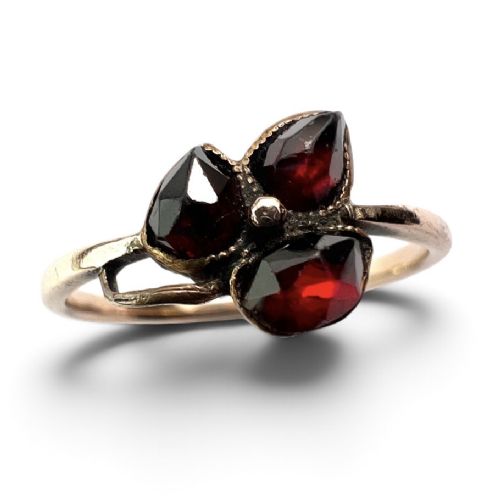
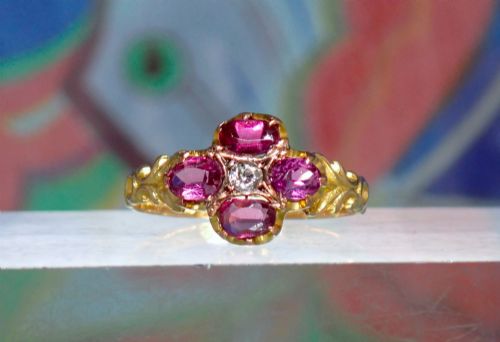
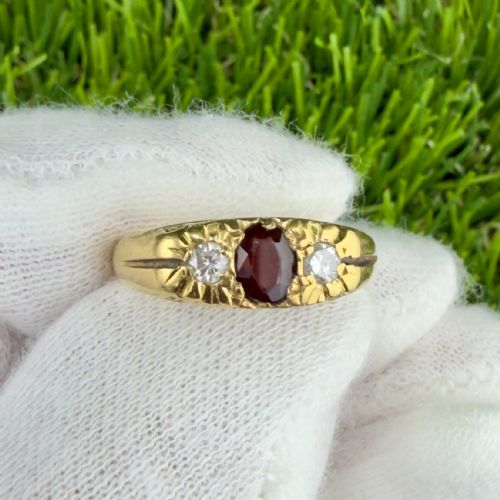
A red garnet dress ring combines deep red garnets with precious metals, spanning Victorian, Edwardian, and mid-century periods. These rings appear in various forms, from floral clusters to simple cabochons and diamond-accented trilogy settings.
Victorian and Edwardian examples often feature rich almandine garnets paired with seed pearls or small diamonds in yellow gold. Mid-century pieces from the 1940s and 1960s introduce heavier gold mountings, white gold, and distinct cluster arrangements.
Buyers encounter diverse styles ranging from strict Victorian work to vintage 1940s designs and 1960s cocktail rings. The primary focus remains the striking red stone, whether faceted for brilliance or polished smooth as a cabochon.
Materials and construction
Makers set garnets into varying purities of gold, including nine-carat, fifteen-carat, and eighteen-carat yellow gold, alongside eighteen-carat white gold and platinum. These metals provide the structural support and colour contrast for the deep red stones.
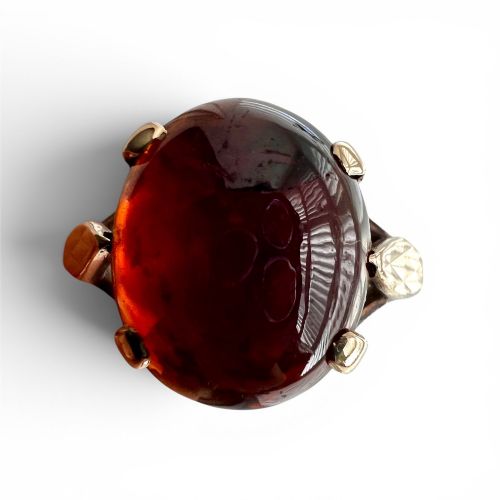
Cluster formations frequently combine central garnets with supporting diamonds or seed pearls to enhance the visual depth of the face. Cabochon cutting shapes the garnet into smooth, rounded domes rather than faceted angles, highlighting the natural stone.
A smooth cabochon garnet glows like a drop of port wine trapped in gold.
Distinguishing quality
Quality rests in the depth and saturation of the garnet colour, alongside the precision of the setting work. Stones with a lively, deep red flash separate finer examples from duller specimens.
The choice of surrounding gems, such as well-matched seed pearls or old-cut diamonds, elevates a piece. Heavier gold weights and sophisticated cluster geometry also distinguish superior rings from simpler commercial outputs.
The Red Garnet Dress Ring Glossary
- Almandine garnet
- A dense, deep red variety of garnet rich in iron and aluminium, frequently seen in antique jewellery.
- Cabochon
- A gemstone shaped and polished with a smooth, convex dome rather than faceted surfaces.
- Cluster ring
- A ring featuring a central stone encircled by a group of smaller supporting gemstones.
- Seed pearl
- A very small, naturally occurring pearl used to frame larger centre stones in antique settings.
- Trilogy ring
- A ring set with three stones, traditionally symbolising the past, present, and future.
Red Garnet Dress Ring: Frequently Asked Questions
How do I date a red garnet dress ring?
Dating relies on examining the metal purity marks, the cut of the stones, and the overall mounting style. Victorian and Edwardian pieces often use lower-carat yellow gold or fifteen-carat gold with intricate floral cluster designs.
Later mid-century pieces from the nineteen-forties and nineteen-sixties introduce heavier yellow gold or white gold settings. Comparing the specific stone cuts and cluster arrangements against known period styles clarifies the era of manufacture.
What is an almandine garnet?
An almandine garnet is a specific variety of garnet known for its deep, rich red hue with occasional brownish or purplish undertones. It forms a primary component in many nineteenth-century cluster rings.
The high iron content gives these stones their characteristic dark, saturated colour. Jewelers favoured almandines for their durability and striking contrast against yellow gold.
Are these rings suitable for daily wear?
Garnet is a relatively durable gemstone that withstands regular daily wear when mounted securely in gold or platinum settings. Care should still be taken with antique claws and delicate seed pearl accents.
Removing the ring during manual labour or heavy household tasks prevents unnecessary strain on the metalwork. Regular checks by a jeweller ensure the stones remain tight in their mounts.