

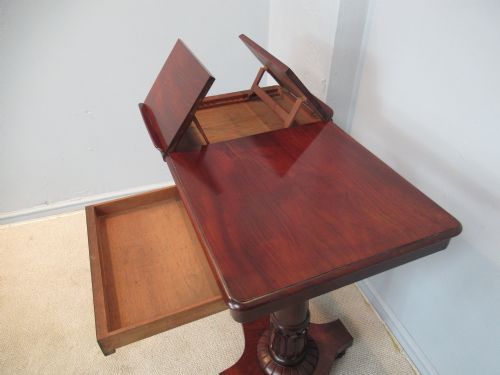


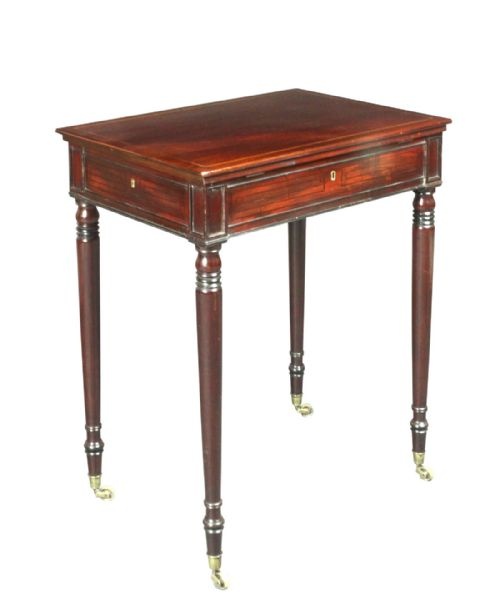


Ratchet Reading Desk
A ratchet reading desk is a mechanical writing and drafting surface that adjusts to your exact angle, offering a sturdy workspace for study and sketching.
Ratchet Reading Desk
A ratchet reading desk is primarily designed for study, drafting, and reading, utilising a mechanical ratchet mechanism underneath the top to alter the slope. You will most frequently encounter mahogany examples dating from the Regency and Victorian periods, often configured as compact occasional tables or larger architect's desks.
The form spans several variations, including music stands, lecterns, and double-sided library tables. Makers of the nineteenth century adapted the mechanism for diverse purposes, producing military pieces, cartographer's desks, and occasional tables with adjustable surfaces.
How they were made
Makers constructed these pieces predominantly using solid timbers and veneers of mahogany, walnut, and rosewood, frequently incorporating contrasting stringing such as boxwood and ebony. The supporting ratchets and adjustable brackets are forged from brass or metal, ensuring smooth operation of the inclined surfaces over generations of use.
Leather inserts frequently surface on the writing and drafting panels, providing a durable and textured surface for writing or drawing. Joinery standards reflect the high craftsmanship of the Georgian, Regency, and Victorian eras, combining robust internal framing with refined exterior finishes.
Ratchet Reading Desk Retail Price Guide 2026
Typical asking prices for ratchet reading desk among the pieces listed under this phrase on Sellingantiques today, from the lower quarter to the upper quarter. They describe what is for sale here now, not the wider market.
Recorded forms range from music stands and occasional tables to double-sided library desks and architect's tables.
What varies in quality
Quality rests upon the precision and complexity of the mechanical action and the selection of timber used in the construction. Pieces attributed to distinguished workshops display finer secondary woods, crisper brass ratchets, and more sophisticated metamorphic engineering that conceals the moving parts.
Proportion and secondary details also dictate distinction, such as the inclusion of fine boxwood or ebony inlay and well-figured grain across the mahogany or rosewood surfaces. Simpler occasional tables contrast with elaborate double-sided library desks that demand greater technical skill from the cabinetmaker.
Gillow·Marsh & Tatham·Carter
The Ratchet Reading Desk Glossary
- Ratchet
- A mechanism comprising a gear wheel and pawl that allows linear or rotary motion in only one direction. It is the core component that holds the desk top at your chosen angle.
- Metamorphic
- Furniture designed to transform from one form or use into another. These desks often conceal reading slopes or extending ledges within standard table frames.
- Campaign
- Portable furniture made for military officers or travel. These items often feature brass corners and compact designs suitable for movement.
- Stringing
- Thin strips of contrasting wood inlaid into grooves in the surface of a piece. It outlines panels and drawers on finer Regency and Georgian tables.
Ratchet Reading Desk: Frequently Asked Questions
How do I operate the mechanism?
You lift the reading surface to your preferred angle, engaging the internal brass or metal rack with the supporting arm. The ratchet teeth catch securely to hold the weight of a heavy book or drafting board.
To lower the surface again, you lift the top past its highest point to release the pawl, then guide the board back down to a flat position.
Can I use it as a normal desk?
Many examples function perfectly well as conventional writing tables when the top is left in the flat position. The adjustable section often forms only part of the surface, leaving space for other items.
Dedicated lecterns and music stands are less suited for general writing because their entire surface is angled, but they accommodate books and papers securely.
How do I date these pieces?
Dating relies on stylistic clues and timber choices typical of the Georgian, Regency, and Victorian eras. Regency and George III pieces often show cleaner classical lines and rich mahogany, whilst Victorian versions may incorporate heavier turnings or patent mechanisms.
Makers' marks or patent stamps occasionally appear on the metal hardware, providing a more precise point of origin.
How do I care for the leather top?
Leather inserts require minimal moisture and protection from direct sunlight to prevent drying and cracking. Dust them gently with a dry cloth rather than using liquid polishes.
Occasional application of specialist leather balm helps maintain the suppleness of the material without damaging the surrounding wood.