
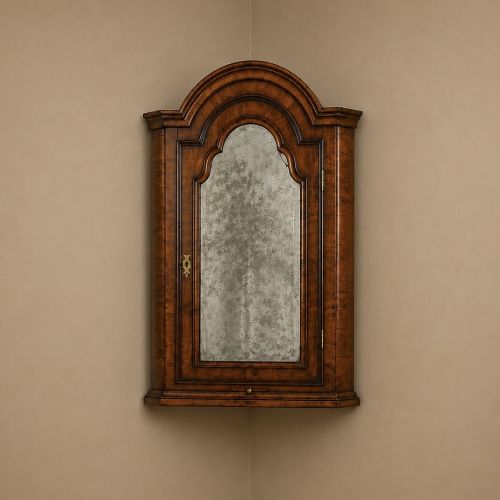
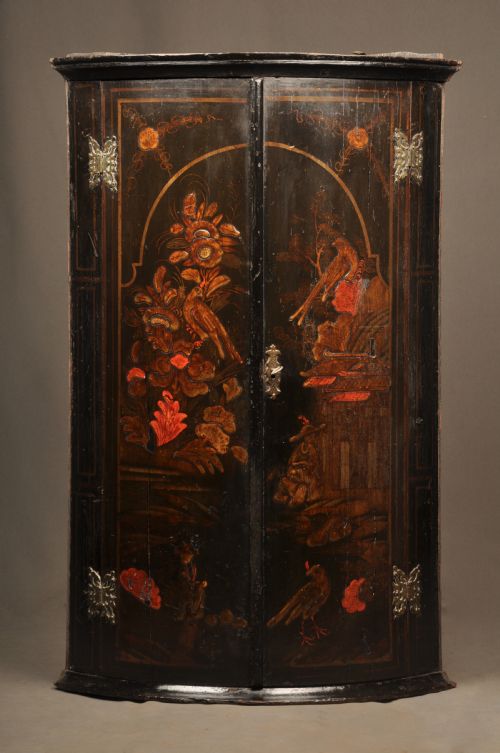


Queen Anne Corner Cupboard
A queen anne corner cupboard makes clever use of overlooked room, bringing warm walnut grain and refined proportions directly to an idle corner.
Queen Anne Corner Cupboard
A queen anne corner cupboard is a fitted or hanging corner cabinet designed to utilise dead space in a room while displaying or concealing prized household items. These pieces frequently appear from the eighteenth century, alongside later revival iterations produced in the nineteenth and twentieth centuries.
The version most commonly met on this page is the hanging corner cupboard, fashioned in walnut or burr walnut with a single fielded or glazed door. Examples span from genuine period walnut construction to George I style interpretations and early twentieth century cabinetmaking.
Makers designed these compact storage units to fit snugly into room angles, employing brass hinges and escutcheons to secure doors that open to reveal shelving. The form bridges the gap between utilitarian storage and elegant interior decoration.
How they were made
Cabinetmakers utilised figured walnut and burr walnut veneers applied to secondary woods, creating rich, highly patterned surfaces on the prominent door panels. Selected pieces incorporate intricate marquetry, inlay wood, and exotic japanned lacquer finishes executed in the eighteenth century manner.
Brass hardware including butterfly hinges, H-hinges, and key escutcheons punctuate the timber facades, whilst internal candle slides and glass panes add functional complexity. Joinery relies on traditional pegged and dovetailed construction to maintain structural integrity within the angled carcase.
Listings feature walnut, burr walnut, and oak materials spanning the eighteenth century, 1880, 1910, and 1920 periods.
What varies in quality
The sophistication of the timber veneer and the depth of the grain selection determine the visual hierarchy amongst these cupboards. Rich burr walnut and complex marquetry command greater appreciation than plain timber surfaces.
Original brass fixings, intact glass panes, and surviving internal candle slides separate utilitarian storage from superior examples of period craftsmanship. The crispness of the mouldings and the fidelity of the revival styles against eighteenth century prototypes further define the tier of the piece.
The Queen Anne Corner Cupboard Glossary
- Burr walnut
- Timber taken from the warted growth on a walnut tree, yielding highly twisted, ornamental grain patterns that were prized for cabinet veneers.
- Japanned
- European imitation of East Asian lacquerwork, created through layered varnishes and raised metallic decoration popular in the eighteenth century.
- Candle slide
- A pull-out wooden ledge placed beneath the door, originally used to hold a taper while inspecting the contents of the cupboard.
- Marquetry
- The art of applying decorative pieces of veneer to a structure to form intricate geometric or floral pictorial designs.
- Hanging corner cupboard
- A wall-mounted cabinet specifically constructed with a triangular plan to fit neatly into the ninety-degree angle of a room.
Queen Anne Corner Cupboard: Frequently Asked Questions
Where should I hang a corner cupboard?
These cabinets suit empty wall angles in dining rooms, hallways, or drawing rooms where floor space remains at a premium.
Ensure the wall construction can support the weight of the timber carcase and its internal contents securely.
How do I distinguish eighteenth century from revival pieces?
Eighteenth century examples display period construction methods, hand-cut dovetails, and genuine timber ageing beneath the finish.
Revival pieces from the nineteenth and twentieth centuries often utilise heavier secondary woods and machine-made elements alongside period styling cues.
What items were stored inside originally?
Households utilised these cupboards to store fine porcelain, tea caddies, glassware, and small silver items away from dust.
The internal shelving often featured shaped or shaped-fronted tiers specifically sized for display.
Do all these cupboards hang on walls?
The majority of the listings consist of wall-hanging formats designed to be secured directly through the backboards into wall studs.
Floor-standing variants or two-part display cabinets also appear among the twentieth century options.