
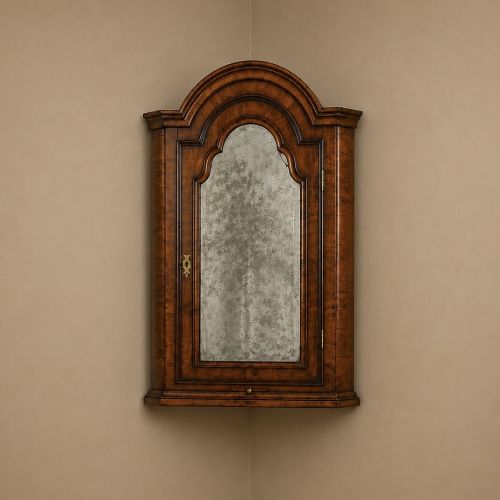
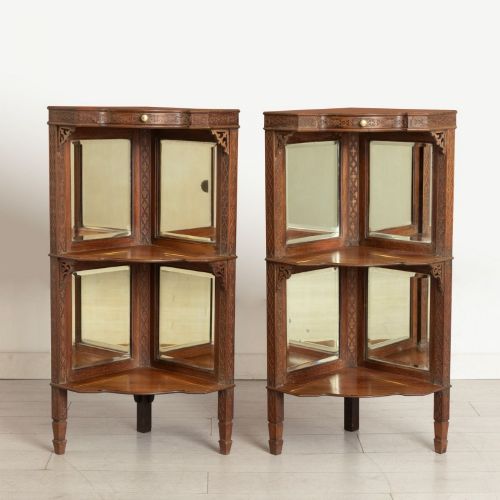
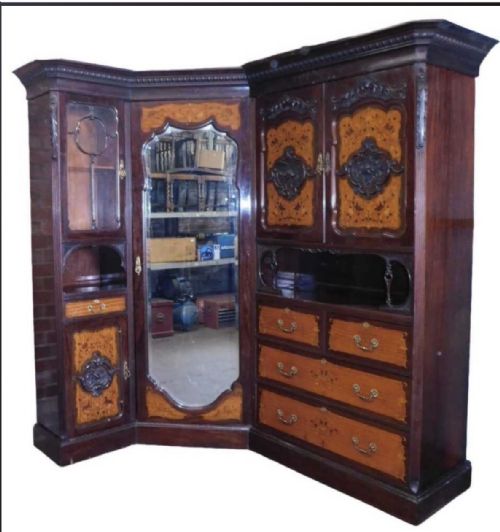


Mirrored Corner Cabinet
These mirrored corner cabinets turn neglected angles into focal points with glass, mirror, walnut, and rosewood.

What mirrored corner cabinets are
A mirrored corner cabinet transforms empty wall junctions into display space through angled construction. The form suits rooms where floor space is limited, fitting cleanly into ninety-degree angles while offering storage or display behind glazed or mirrored doors.
Examples on this page span the eighteenth century up to the Edwardian period and nineteen hundred, with Queen Anne, late Victorian, and Edwardian styles represented. Pieces range from hanging cupboards with original mirror plates to freestanding display cabinets utilising mahogany, rosewood, and walnut.
How they were made
Cabinet makers utilised dense hardwoods including mahogany, rosewood, and walnut, often applying satinwood inlay to enrich the corner cabinet facades. These woods provided the structural stability needed for heavy doors and internal shelving.
Glazing bars hold individual glass panes, while internal mirrors reflect light through the cabinet. Brass fittings such as hinges, sliding candle slides, and locks complete the construction of these period pieces.
Retail Price Guide 2026
Typical UK retail prices for mirrored corner cabinet, calculated from the Sellingantiques database of over a million retail prices indexed since 2003. This retail price guide relies exclusively on Sellingantiques data; no external sources or auction records are used, so the figures do not describe the wider market.
Listings span the eighteenth century, the Victorian era, and nineteen hundred, constructed from walnut, mahogany, and rosewood.
What varies in quality
Quality rests in the selection of timber veneers, the crispness of satinwood inlay, and the retention of original mirror plates. Finer corner cabinets display careful grain matching and precise joinery around the difficult internal angles.
The Mirrored Corner Cabinet Glossary
- Queen Anne
- A style spanning the early eighteenth century characterised by graceful curves, walnut timber, and restrained ornamentation. It precedes heavier Georgian furniture designs.
- Satinwood Inlay
- Contrasting light wood inserted into darker timber surfaces to create decorative patterns and borders. It was particularly popular during the Edwardian era.
- Candle Slide
- A pull-out wooden shelf positioned beneath a cupboard door to hold a taper for illumination. They are found on earlier eighteenth-century wall-hanging pieces.
- Glazing Bar
- A narrow wooden strip holding separate panes of glass within a cabinet door. Earlier bars tend to be finer and more slender than later Victorian equivalents.
Frequently Asked Questions
How do I hang a wall cabinet?
Hanging corner cupboards require secure fixing to solid masonry or internal wall studs using heavy-duty brackets. The weight of timber and glass demands proper load-bearing support.
Professional installation ensures the cabinet stays level and safe, protecting both the antique frame and the items stored inside.
What rooms suit a corner cabinet?
Dining rooms, drawing rooms, and hallways benefit most from corner furniture. They utilise unused angles without obstructing the main flow of traffic through the space.
The mirrored backs and glass panels also help bounce natural light into darker corners of smaller reception rooms.
How do I date an antique cabinet?
Dating relies on examining construction methods, timber choice, and hardware. Eighteenth-century pieces often feature walnut and candle slides, while Edwardian examples favour mahogany and rosewood with satinwood inlay.
Secondary woods inside the carcass and the type of mirror glass also offer clues to the exact period of manufacture.
Are mirror plates original?
Original mirror glass frequently shows subtle silver loss, tiny foxing spots, or slight distortion. Modern replacements appear completely uniform and lack historical depth.
Inspecting the backing boards and the way the glass is secured in the rebate helps confirm whether the mirror plate dates to the construction of the cabinet.