


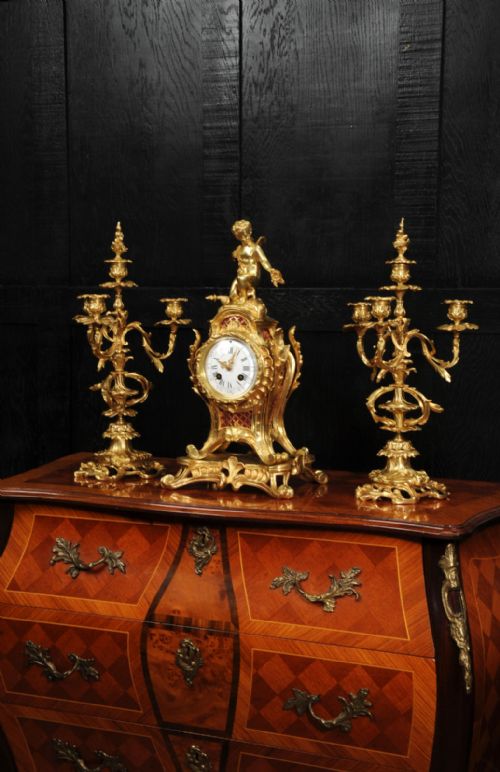


Putti Brass Clock
These putti brass clock examples capture cherubic figures in metalwork, offering decorative timepieces that enrich a period interior.
Putti Brass Clock
A putti brass clock brings together sculptural cherubic figures and mechanical timekeeping, mostly originating from nineteenth century workshops. These pieces appear as mantel clocks, wall clocks, and complete garniture sets flanked by matching candelabras.
The aesthetic draws heavily on French Rococo Revival, Louis XVI style, and Victorian interpretations of classical themes. Figures of Cupid and cherubs sit atop or beside the dial, interacting with elements like bronze plinths and marble bases.
Materials and construction
Makers utilised cast gilt bronze, ormolu, and brass to build the structural cases and decorative mounts. Patinated bronze often provides contrast against the brighter gilded surfaces of the figures.
Dials frequently feature hand-painted details or enamel numerals, housing movements driven by brass mechanisms. Marble and glass elements complete the housings, creating substantial objects designed for prominent display.
Listings demonstrate a strong preference for nineteenth century French design, featuring materials such as marble, gilt bronze, and enamel alongside movement makers from Paris and London.
Assessing quality and finish
The integration of the movement with the case, alongside the presence of signed markers on the dial or mechanism, separates standard production from finer horological work.
Le Roy Paris·John Bennett London·Henry Berkeley London·F Marti·Japy Freres
The Putti Brass Clock Glossary
- Ormolu
- Finely chopped high-karat gold applied to a bronze base using a mercury amalgamation technique. This process creates a durable, warm metallic finish characteristic of French decorative arts.
- Putto
- A plump, naked male child figure frequently depicted in classical art and architectural decoration. In horology, these figures appear as sculptural additions interacting with the clock case.
- Garniture
- A set of matching decorative objects designed to be displayed together on a mantelpiece. Typically, this includes a central clock accompanied by matching candelabras or urns.
- Cartel clock
- A wall-mounted clock housed in an ornate frame made of metal or carved wood. These pieces use a secure wall fixing rather than resting on a mantel or table.
- Fusee
- A conical pulley used in clock movements to maintain even force as the mainspring unwinds. This mechanism improves the timekeeping accuracy of the movement.
Putti Brass Clock: Frequently Asked Questions
How do I wind my clock?
Most nineteenth century mechanical clocks require a key to wind the spring barrels through holes on the dial face. Care must be taken not to overwind the mechanism.
Consulting a professional horologist for initial setup ensures the pendulum is set correctly and the beat is even.
Where should I place a clock set?
These heavy metal and marble objects require a stable, level surface such as a mantelpiece or a sturdy sideboard. Keeping them away from direct sunlight and drafts protects the delicate gilding and internal oils.
Garniture sets look best when the central clock is flanked symmetrically by the matching candelabras.
How do I clean gilt bronze?
Dusting gently with a soft, dry brush removes surface particles without harming the delicate metallic finish. Water and chemical polishes strip the original mercury gilding.
Professional conservation is recommended for removing tarnish or deep grime from antique ormolu.