
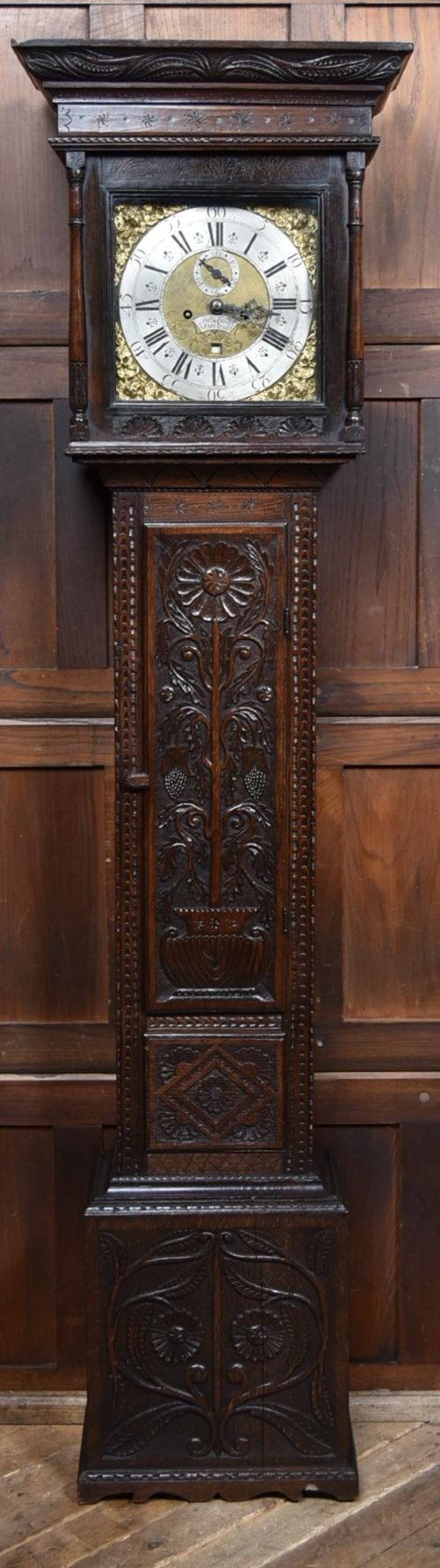


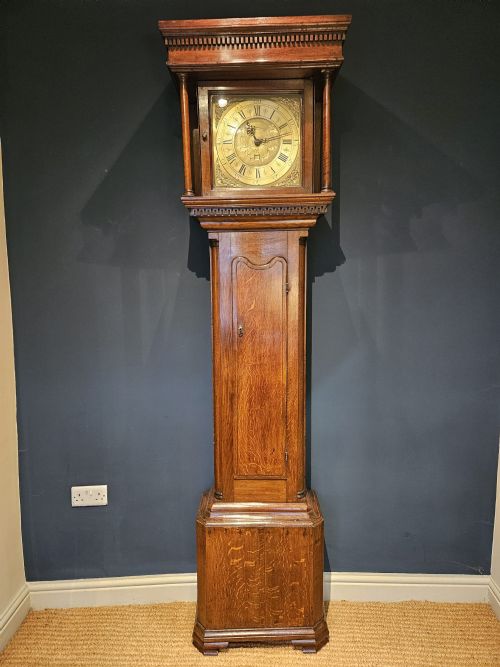


Provincial Grandfather Clock
These provincial grandfather clock examples bring the measured rhythm of regional British and French workshops into a room.
Provincial Grandfather Clock
A provincial grandfather clock is a tall floor-standing timepiece housed in a fitted wooden case, designed to measure hours through a swinging pendulum and descending weights. When searching for a provincial grandfather clock, buyers encounter robust regional forms spanning the seventeenth, eighteenth, and nineteenth centuries, alongside French provincial variations.
The pieces listed on this page favour sturdy domestic timbers and traditional regional cabinet-making over metropolitan refinement. They originate from various British localities and periods, ranging from early examples through the Georgian era and into the nineteenth century.
Forms include slim proportions, rolling moon dials, and thirty-hour or eight-day movements signed by provincial makers. These clocks served as the dependable heart of a household, combining mechanical utility with the distinct local character of their maker's district.
How they were made
Cabinet makers built the tall protective housings primarily using solid oak and mahogany, occasionally employing pine or general wood with painted finishes. These timbers were joined to create a sturdy trunk and hood capable of housing heavy mechanical movements.
The timekeeping mechanisms rely on brass components, iron, and glass panels to protect the dial while allowing the pendulum and weights to operate uninterrupted. Dials frequently feature applied enamel and hand-applied paintwork to display the hours and local signatures.
Listings feature Georgian, 18th Century, and 19th Century periods alongside materials including oak, mahogany, brass, and painted enamel.
What varies in quality
The standard of a provincial grandfather clock rests on the crispness of the cabinet work and the fidelity of the timber selection. Finer examples display well-figured mahogany or richly patinated oak with harmonious proportions, whereas simpler pieces utilise plain pine with utilitarian painted surfaces.
Dial execution distinguishes workshop output, particularly where detailed rolling moon displays or careful hand-painted numerals appear alongside legible maker signatures. The integration of movement and case demonstrates the skill invested by regional horologists operating outside the capital.
Jn° Smith Macclesfd·Ninian Davidson of Dunse·Haythornwaite Kirkby Lonsdale·John Salmon Nantwich·Stanyer Nantwich·Samuel Buxton Diss·James Draycot Wells·Herbert of Haversham·Richard Midgley of Halifax·John Welsh Luton Bedfordshire·Vale of Coleshill
The Provincial Grandfather Clock Glossary
- Longcase clock
- The formal term for a grandfather clock, describing the tall wooden case enclosing the weights and pendulum.
- Thirty-hour movement
- A clock mechanism designed to run for just over a single day before requiring manual winding via the drop of its weights.
- Eight-day movement
- A clock mechanism engineered to operate for slightly more than a week between winding intervals.
- Rolling moon
- A painted dial mechanism tracking the phases of the lunar cycle behind an arched aperture.
- Dial
- The face of the clock displaying hours, minutes, and often the signature of the regional maker.
Provincial Grandfather Clock: Frequently Asked Questions
How do thirty-hour and eight-day clocks differ?
Thirty-hour movements require winding daily or very nearly so, using simpler internal gear trains suited to modest households. Eight-day movements utilise heavier or additional gear arrangements to run for over a week.
This distinction affects the internal weight configuration and how often the owner interacts with the mechanism.
Where were these clocks made?
These timepieces originated in regional workshops across Britain and France, bearing the names of local watch and clock makers. Towns from Cheshire to Scotland produced clocks suited to rural and provincial tastes.
The materials and regional cabinet styles often reflect the local timber supplies available to the maker.
How do you date a longcase clock?
Dating relies on stylistic shifts in the timber case, dial construction, and the format of the maker's signature. Georgian and eighteenth-century examples exhibit different proportioning compared to later nineteenth-century pieces.
Details such as painted enamel dials and rolling moon mechanisms also provide clues to the period of production.