


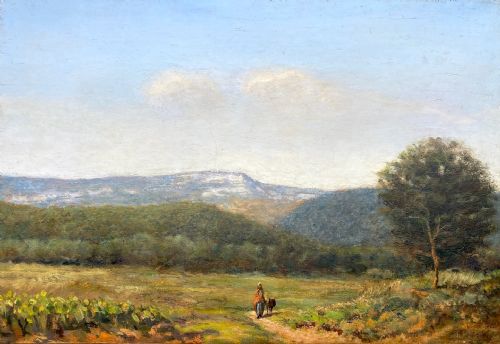


Provence Landscape Oil Painting
These provence landscape oil painting works capture the luminous southern light and rugged terrain of the Mediterranean coast.
Provence Landscape Oil Painting
A provence landscape oil painting brings the distinct warmth and atmosphere of the South of France directly into a room. The selections on this page span the nineteenth and twentieth centuries, capturing coastal ports, rural farmhouses, and olive groves.
The prevailing styles range from nineteenth-century French realism and post-impressionism to French modernism and art deco. Viewers will encounter depictions of the Alpilles, Toulon harbour, and quiet Mediterranean jetties rendered with expressive brushwork.
Works appear in various formats, predominantly oils on canvas alongside examples on wooden panels and paper laid to canvas. Each piece reflects the enduring artistic allure of the Provencal countryside and its luminous southern coastal setting.
How They Were Made
Artists working in the region relied principally on oil paint applied to woven canvas stretched over wooden frames, or occasionally direct to wooden panels and heavy paper. The medium allowed for rich layering of pigment to build up the sun-drenched textures of craggy stone and olive leaves.
Brushwork varies from tight nineteenth-century academic precision to the looser, expressive strokes characteristic of post-impressionism and mid-century modernism. Painters captured the brilliant southern light through deliberate colour harmonies and impasto application.
The listings span from the 1870s through the 1950s, utilising canvas, wooden panels, and paper supports.
What Varies in Quality
The strength of a composition and the confidence of the brushwork define the upper tier of these paintings. Superior examples demonstrate a sure handling of light and shadow that convincingly evokes the intense atmosphere of the Mediterranean.
Condition and originality also separate standard works from exceptional ones. Intact original surfaces, stable grounds on canvas or panel, and period framing significantly enhance the historical integrity of the piece.
The Provence Landscape Oil Painting Glossary
- Impasto
- Paint applied thickly to a canvas, standing out in relief from the surface. This technique allows the artist to capture the tactile quality of rough stone walls or sunlit foliage.
- Post-Impressionism
- A predominantly French art movement developing roughly from the late nineteenth century that extended impressionism while rejecting its limitations. Artists focused on heavier symbolic content and expressive use of colour.
- Panel
- A rigid support for painting, typically made of wood. Wooden panels provide a smooth, stable ground that prevents the flexing associated with stretched canvas.
- Mischtechnik
- A complex layered painting technique combining tempera and oil media. It permits luminous depth and precise detail within landscape compositions.
Provence Landscape Oil Painting: Frequently Asked Questions
Where were these painted?
These works originate from the South of France, specifically depicting locations across Provence, the Cote d'Azur, and coastal ports such as Toulon.
Artists found endless inspiration in the distinctive local scenery, ranging from craggy inland hills to coastal jetties and olive groves.
How do I date a painting?
Dating relies on stylistic evidence, material supports, and period framing conventions. Post-impressionist and modernist brushwork typically points to the early decades of the twentieth century.
Nineteenth-century pieces often display tighter academic realism and distinct preparation layers on the reverse of the canvas.
What framing is appropriate?
Many examples retain their period frames, which often complement the aesthetic of the canvas. Art deco and mid-century pieces look best in simple profiles or period mouldings appropriate to their decade.
Avoid overly ornate modern reproductions that can clash with the authentic age of the oil painting.