

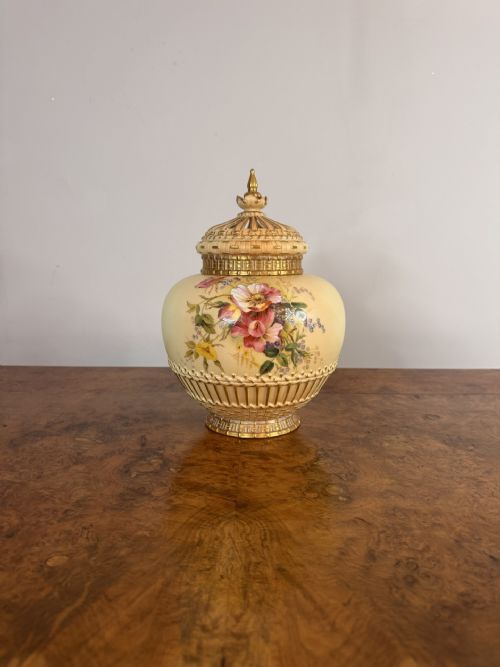
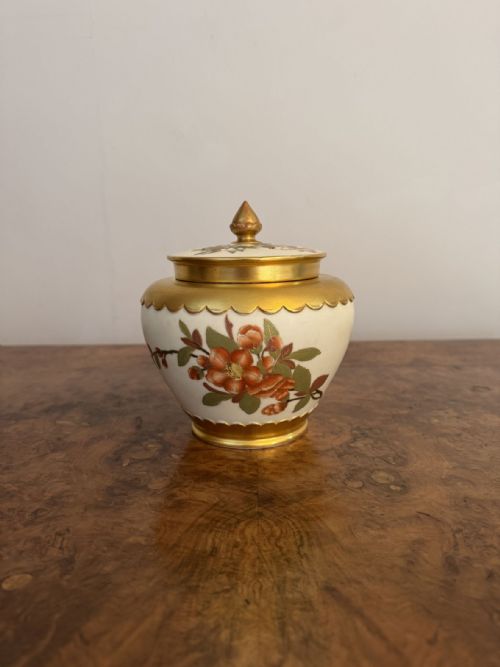


Potpourri Lidded Jar
These potpourri lidded jar pieces are scented ceramic vessels designed to diffuse fragrance while gracing a room with period elegance.
Potpourri Lidded Jar
A potpourri lidded jar brings together decorative ceramic craftsmanship and aromatic function, serving as both an ornamental urn and a container for dried flower petals and spices. When searching for a potpourri lidded jar, buyers encounter a range of nineteenth-century English porcelain and ironstone alongside continental European examples.
The pieces listed here span the Georgian and Victorian eras up to the twentieth century, taking the form of lidded vases, ginger jars, and bowls with pierced or crown covers. Victorian Royal Worcester and Mason's ironstone pieces represent the most frequent domestic styles found in this selection.
Makers such as Royal Worcester, Dresden factories, and Spode dominate the offerings, showcasing styles from Rococo Revival to Victorian Chinoiserie. Buyers often find these vessels presented as single decorative urns or matched pairs intended for a mantelpiece.
Materials and manufacture
Potters shaped these vessels using fine porcelain, ceramic, and durable ironstone, finishing the bodies with hand-painted glazes and detailed moulding. Many examples incorporate gilding, gold leaf, and enamel work to highlight the relief decoration on the shoulders and lids.
The characteristic pierced covers or crown lids were engineered to release dried floral fragrance while keeping the botanical contents contained. Firing techniques evolved across the eighteenth and nineteenth centuries, moving from early earthenware bodies to refined porcelain formulas.
Potpourri Lidded Jar Retail Price Guide 2026
Typical asking prices for potpourri lidded jar among the pieces listed under this phrase on Sellingantiques today, from the lower quarter to the upper quarter. They describe what is for sale here now, not the wider market.
Listings feature nineteenth-century porcelain and ironstone vessels, spanning Victorian, Georgian, and twentieth-century production periods.
Assessing quality and craftsmanship
Quality in a potpourri lidded jar rests upon the crispness of the moulding, the precision of the pierced lid work, and the skill evident in the hand-painted enamel or gilding. Superior examples display clean, unbroken pierced patterns designed to allow scent dispersal without structural weakness.
The richness of the gilding and the depth of the cobalt or blush ivory glaze separate standard production wares from the finest factory pieces. Maker attribution and well-preserved surface decoration further distinguish the upper tier of these vessels.
Royal Worcester·Mason's Ironstone·Wolfsohn Dresden·Sitzendorf Porcelain·Herend
The Potpourri Lidded Jar Glossary
- Ironstone
- A heavy, durable type of ceramic patented in the nineteenth century. It offered a robust alternative to porcelain while accepting bright enamel colours.
- Gilding
- The application of gold leaf or gold paint to ceramic surfaces. This technique accentuates handles, rims, and moulded floral details.
- Chinoiserie
- European decorative style reflecting Chinese artistic motifs. Victorian makers often applied these colourful orientalist scenes to vases and jars.
- Blush Ivory
- A specific creamy ceramic finish developed by Royal Worcester in the late nineteenth century. It provided a soft background for delicate floral hand-painting.
Potpourri Lidded Jar: Frequently Asked Questions
What is a potpourri lidded jar?
A potpourri lidded jar is an ornamental ceramic vessel featuring a pierced or openwork cover designed to hold and diffuse dried scented botanical mixtures.
These pieces combine decorative painting and moulding with a practical function that was central to historic domestic interiors.
How were potpourri jars used?
Historically, households placed these lidded vessels in principal rooms to freshen the air and mask odours before modern ventilation.
The pierced lids allowed the natural fragrance of dried rose petals, spices, and oils to circulate through the parlour or drawing room.
How do I date a porcelain jar?
Dating relies on factory registry marks, base stamps, stylistic periods such as the Georgian or Victorian eras, and manufacturing materials like ironstone or blush ivory porcelain.
Examining the application of enamel colours and the style of gilding also helps place a vessel within its nineteenth or twentieth-century context.
How should I display these jars?
These decorative urns suit prominent display locations such as mantelpieces, sideboards, or console tables where their form and hand-painted details can be appreciated.
Pairing matching vases or placing a single large jar as a focal point works well within traditional interior schemes.