



Post War Oil Artwork
Post war oil artwork brings together mid-century modern canvases and boards capturing the varied moods of the mid-twentieth century.
Post War Oil Artwork
Post war oil artwork spans paintings created across the 1940s, 1950s, and 1960s, capturing the diverse artistic expressions of the period. Buyers examining this page will find oil paintings ranging from coastal landscapes and industrial scenes to intimate portraits and abstract compositions.
The most common formats on this page are oil paintings executed on canvas or board, reflecting mid-century modernism, post-war British realism, and constructivism. These pieces record subjects from serene country rivers and maritime harbours to dynamic cityscapes and studio interiors.
Originating from British, French, and wider European traditions, these works showcase the transition from post-impressionist sensibilities towards bolder modernist abstraction and avant-garde figuration. The selection offers a direct window into the varied aesthetic concerns of artists working immediately after the conflict years.
How they were made
Artists of this era applied oil paint directly to prepared canvas, wooden board, or panel supports, often building up rich textures with the brush or palette knife. The physical support frequently dictates the character of the piece, with rigid boards allowing for brisk, direct marks and stretched canvases accommodating larger gestural sweeps.
Pigments were worked in mediums that retain their density and matte or satin finish over decades, sometimes enhanced with gilt frames or metal details. The interplay between the oil medium and the underlying support defines the material longevity and surface quality of each surviving painting.
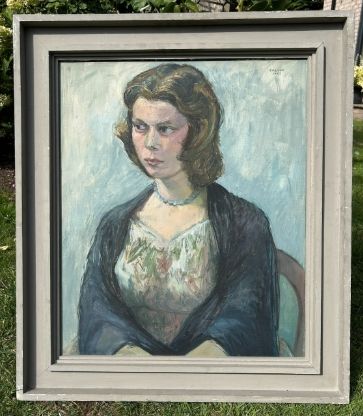
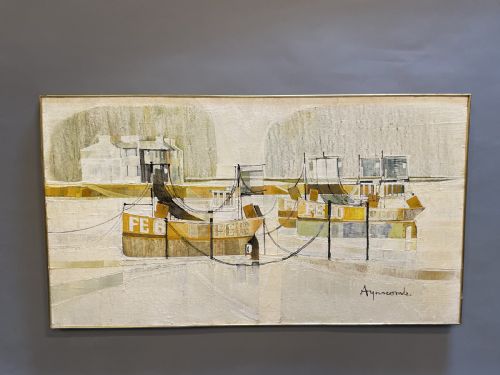
The selection includes various subject types such as maritime landscapes, industrial factory scenes, floral still lifes, and characterful head and shoulder portraits.
What varies in quality
Quality in post war oil artwork rests upon the surety of the painter's brush and the clarity of the composition, distinguishing confident studio pieces from routine commercial output. The authority with which an artist handles form and colour, whether in a detailed portrait or a flattened abstract landscape, determines the visual impact.
The integrity of the surface and the preservation of the original pigment layers also shape the standing of a work. Examples that maintain their intended saturation without disruptive craquelure or heavy overpainting reward closer study.
Kenneth Cozens·Paul-Jean Anderbouhr·Denis Mitchell·William McCance·Richards Rubin·John Osborn·John Gilroy
The Post War Oil Artwork Glossary
- Oil on board
- A painting technique where oil pigments are applied directly to a rigid wooden or composite panel rather than stretched fabric.
- Constructivism
- An artistic style originating in the early twentieth century that emphasises abstract geometric forms, industrial themes, and structured spatial arrangements.
- Post-War British Realism
- A movement focusing on representational depictions of everyday life, landscapes, and figures in Britain during the decades following the mid-century.
- Mid-Century Modern
- A broad design and art movement spanning the middle decades of the twentieth century, characterised by simplified forms and a departure from traditional ornamentation.
Post War Oil Artwork: Frequently Asked Questions
What periods do these paintings cover?
The works listed here primarily date from the 1940s, 1950s, and 1960s, capturing the artistic output immediately following the Second World War.
A few earlier examples from the 1910s also appear, providing a broader context for the development of twentieth-century painting.
What surfaces were used for these artworks?
Artists of this era predominantly painted using oil mediums on stretched canvas or rigid wooden boards and panels.
These varied supports allow for different surface textures, from smooth panel studies to heavily worked canvas compositions.
How do I identify mid-century modern paintings?
Mid-century modern pieces often feature simplified forms, abstract compositions, and a strong emphasis on texture and modern subject matter.
They frequently depart from strict academic realism in favour of expressive brushwork and innovative spatial arrangements.
Where do these paintings originate?
The collection includes works created across Britain and continental Europe, reflecting regional movements such as the St Ives school and French avant-garde circles.
Subjects range from local British landscapes and coastal scenes to European cityscapes and still life studies.
How should I care for an oil painting?
Oil paintings benefit from stable indoor environments away from direct sunlight, excessive humidity, and rapid temperature fluctuations.
Dust should be removed gently from the surface with a soft, dry brush without applying pressure or cleaning agents.