




Polished Brass Church Lighting
Polished brass church lighting brings weight and sacred architecture into a room through surviving floor and table candlesticks.
Polished Brass Church Lighting
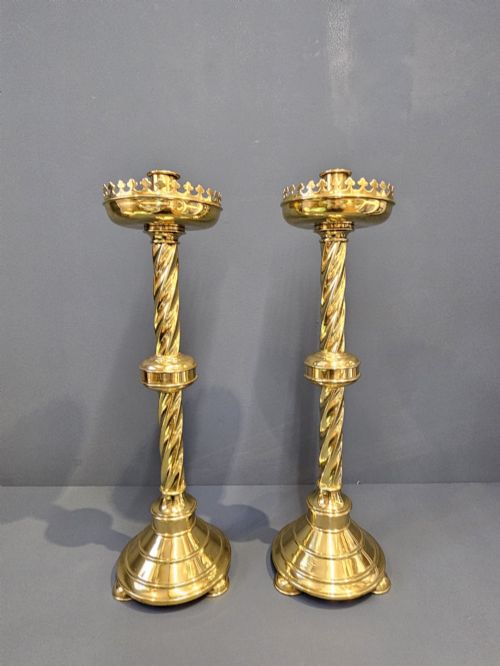
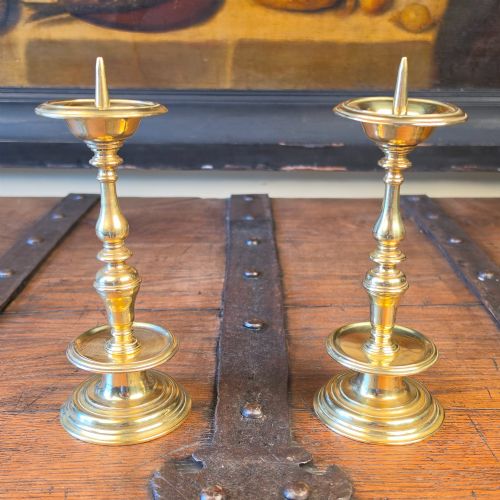
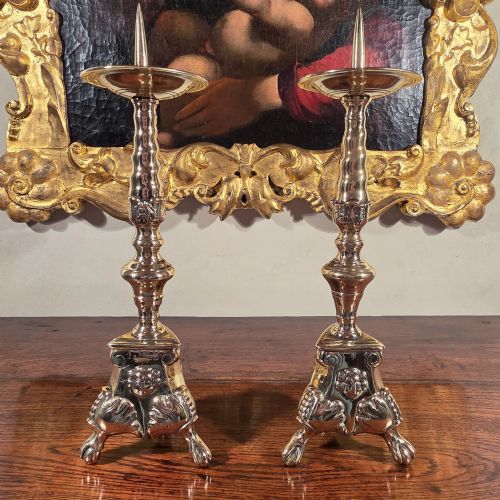
Polished brass church lighting comprises tall candlesticks and pricket stands designed for ecclesiastical use, surviving from the Victorian period, the nineteenth century, and into the twentieth century. These objects include pairs of large altar sticks alongside floor-standing candle holders produced in brass, occasionally combined with iron or hardwood.
The versions most commonly met on this page are pairs of tall brass candlesticks and heavy pricket candlesticks spanning the Gothic Revival and Victorian styles, plus occasional seventeenth-century style interpretations and Art Deco examples.
Buyers seek these pieces for their commanding height, warm metal surfaces, and the solemn character they introduce to domestic interiors.
How they were made
The pieces are constructed predominantly from heavy cast and turned brass, often complemented by iron supports and hardwood elements in larger floor-standing formats.
Surface treatments range from bright polished finishes to retained enamel details, reflecting the diverse manufacturing techniques of nineteenth-century workshops and ecclesiastical metalworkers.
The listings on this site span materials including brass, enamel, iron, and hardwood across Victorian, Baroque, and Art Deco styles.
What varies in quality
Quality rests in the heft of the metal casting and the crispness of the turned sections, distinguishing solid ecclesiastical commissions from lighter domestic reproductions.
Proportion and scale dictate distinction, where exceptionally tall floor-standing or heavy pricket examples demonstrate superior design ambition compared to standard table pairs.
T Thomason & Co
The Polished Brass Church Lighting Glossary
- Pricket
- A sharp metal spike on a candlestick designed to secure the base of a wax candle rather than a socket. This form is traditional in ecclesiastical settings.
- Gothic Revival
- An architectural and decorative style popular during the nineteenth century that revived medieval forms, pointed arches, and heavy ecclesiastical ornamentation.
- Ecclesiastical
- Relating to the Christian Church or its clergy, defining items originally manufactured for use within religious buildings and chapels.
- Turned
- Shaped on a lathe by rotating the metal or wood against a cutting tool, creating symmetrical mouldings and columns on candlestick shafts.
Polished Brass Church Lighting: Frequently Asked Questions
How do I use church candlesticks at home?
These tall pieces suit placement on large dining tables, sideboards, or directly on the floor beside a fireplace where their height creates a strong vertical accent.
Pair them with thick pillar candles or use pricket versions with fitted candle followers to catch dripping wax safely.
What periods do these candlesticks come from?
The listings span the eighteenth, nineteenth, and early twentieth centuries, with a strong representation of Victorian production and Gothic Revival designs.
Dates range from specific decades like the eighteen-sixties and eighteen-nineties up to nineteen-forty.
Are these pieces made of solid brass?
The construction relies heavily on cast and turned brass, sometimes paired with iron structural components and hardwood elements in floor-standing models.
Enamel and other secondary materials appear on specific decorative examples from the period.