




Traditional Brass Altar Lights
Traditional brass altar lights bring solemn ecclesiastical gravity and warm metal tones into a room, offering striking vertical presence for a mantel or sideboard.
Traditional Brass Altar Lights
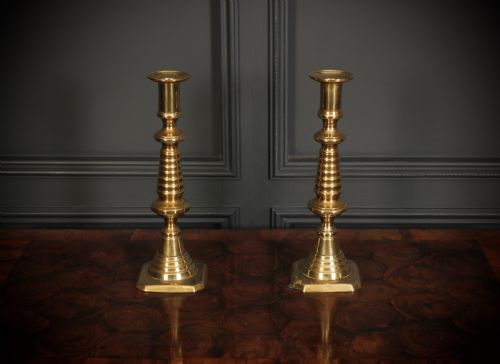
Traditional brass altar lights comprise candlesticks and table lamps created in church and chapel aesthetics, spanning the Victorian and Edwardian eras alongside seventeenth-century revival designs.
The selection ranges from small pairs to tall church candlesticks, occasionally accompanied by unexpected domestic forms like sideboards originating from the nineteenth century.
Most examples lean heavily into Gothic Revival and Baroque Revival styles, bringing historical ecclesiastical ornamentation directly into domestic interiors.
How traditional brass altar lights were made
These pieces rely primarily on cast and turned brass, utilising the substantial weight and ductile nature of the metal to achieve soaring vertical stems and stable weighted bases.
Makers occasionally combined brass with timber elements such as elm, integrating contrasting organic textures into the structural design of the furniture pieces.
What varies in quality
The distinction between ordinary and superior pieces rests on the crispness of the casting and the proportional balance of the turned components, where sharper moulded details indicate superior workshop practices.
Substantial gauge brass and heavier overall weight generally separate robust ecclesiastical metalwork from lighter domestic adaptations produced in later periods.
The Traditional Brass Altar Lights Glossary
- Pricket candlestick
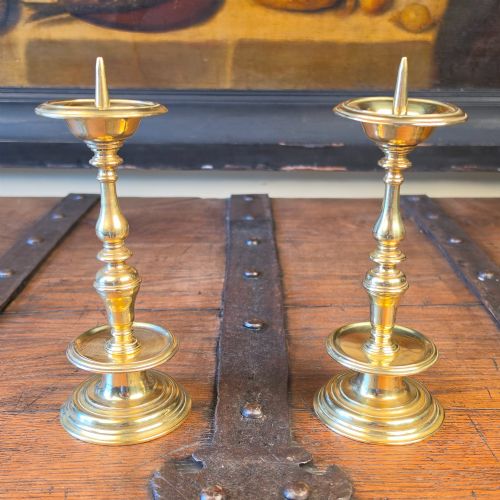
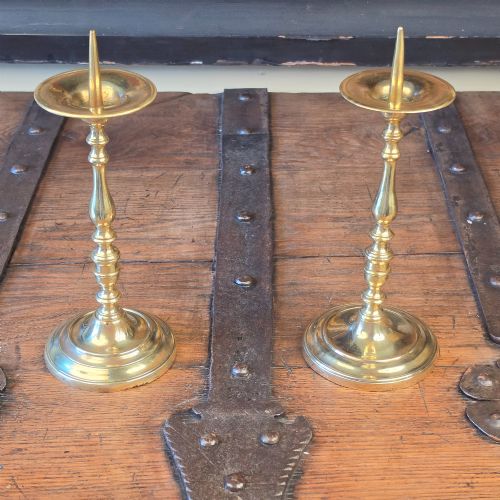
- A candlestick featuring a sharp central spike designed to hold a candle with a base socket, commonly found on church altars. This form provides a secure mounting for large ceremonial wax candles.
- Gothic Revival
- An architectural and decorative style drawing inspiration from medieval forms, prevalent across nineteenth-century ecclesiastical metalwork. It incorporates pointed arches, trefoils, and heavy vertical emphasis.
- Baroque Revival
- A theatrical design movement reviving the ornate scrolls and exuberant flourishes of the seventeenth century. Pieces in this style display dramatic contours and rich surface ornamentation.
- Elm
- A tough domestic hardwood utilised in period furniture construction, known for its interlocking grain and resistance to splitting. It provides sturdy structural integrity for supporting surfaces.
Traditional Brass Altar Lights: Frequently Asked Questions
How do I date these candlesticks?
Dating relies on stylistic clues, comparing Victorian and Edwardian revival motifs with nineteenth-century manufacturing techniques and base construction.
Examine the casting seams and wear patterns underneath to distinguish nineteenth-century production from later twentieth-century interpretations.
Can these be wired for electricity?
Many tall candlesticks and related church pieces are adapted into table lamps during the twentieth century while retaining their original metalwork.
Inspect the stem for discreet channels or threaded cord exits that indicate past electrical conversion.
Are pricket candlesticks practical for home use?
Pricket sticks require candles with a pre-drilled base or follower plates to sit securely on the vertical spike.
They function best as decorative display items or with properly fitted church candles rather than standard tapered household candles.
What is the difference between Gothic and Baroque styles?
Gothic Revival metalwork emphasises stern vertical lines, pointed arches, and restrained medieval geometric tracery.
Baroque Revival pieces favour swirling acanthus leaves, twisting columns, and elaborate volumetric curves.