


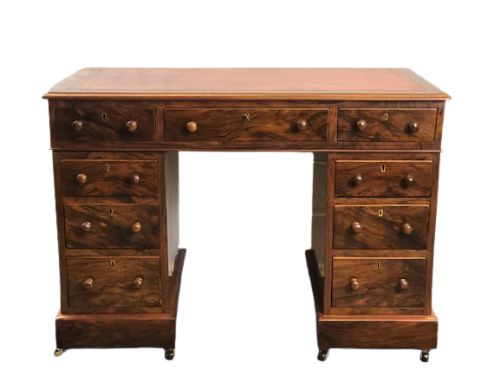
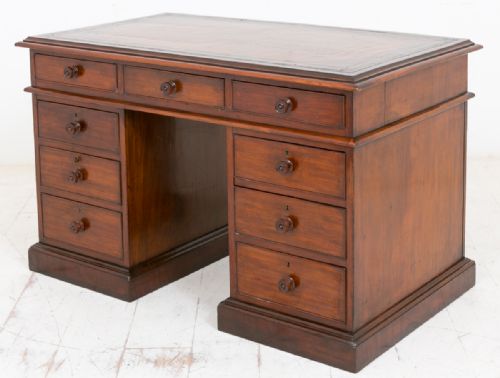
Plinth Base Writing Desk
These plinth base writing desk examples are robust Victorian pieces designed to anchor a study and provide a durable surface for daily correspondence.
Plinth Base Writing Desk
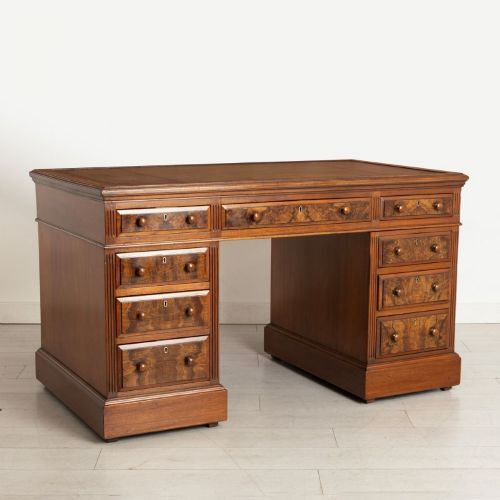
When you search for a plinth base writing desk, you are looking at substantial pedestal forms designed to sit firmly on the floor rather than upon slender legs. These substantial pieces typically emerge from the Victorian era, spanning decades from eighteen fifty to eighteen ninety.
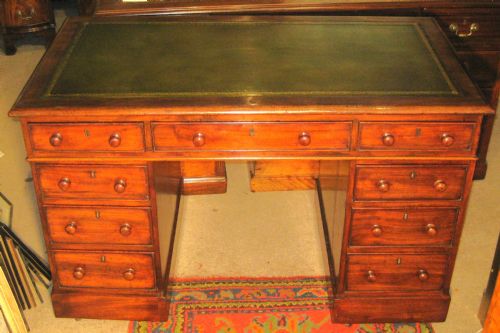
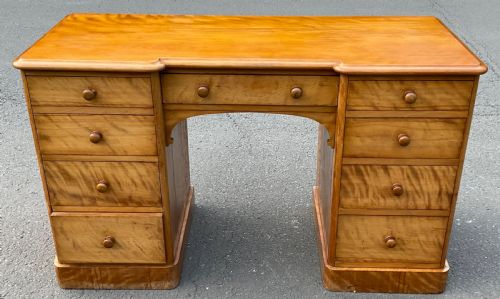
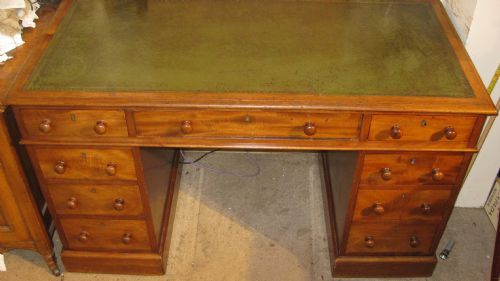
The dominant forms you will encounter on this page are pedestal desks and kneehole writing tables. They frequently combine a central workspace with flanking banks of drawers, anchored by solid plinth bases rather than castors.
Makers of the period adopted both Victorian and Georgian style influences for these desks. Woods selected ranged from traditional mahogany and oak to more decorative veneers like burr walnut and satin birch.
How They Were Made
Cabinet makers constructed these desks using dense timbers such as mahogany, oak, and walnut, often applying burr walnut or satin birch veneers to primary visual surfaces. These woods provided the structural integrity necessary for heavy daily use in nineteenth-century offices and libraries.
Working surfaces were routinely inset with contrasting leather panels, bordered by decorative brass hardware on the drawers. Joinery relied on traditional techniques to house multiple drawers within the pedestal columns above the solid plinth bases.
Current listings demonstrate a strong Victorian presence, spanning specific decades from eighteen fifty to eighteen ninety across mahogany, oak, and walnut.
What Varies in Quality
Distinctions in quality often rest upon the choice of timber and the sophistication of the secondary veneers employed across the pedestal and drawer fronts. Pieces utilising figured burr walnut or satin birch sit differently in the range compared to standard mahogany or plain oak versions.
The refinement of the brass hardware and the crispness of the timber mouldings around the plinth base separate standard workshop output from finer cabinet work. Original fitted leather writing surfaces also influence the overall character of the surviving desk.
Deighton And Dunthorne Holborn London
The Plinth Base Writing Desk Glossary
- Plinth base
- A heavy, solid block or low platform upon which the pedestal columns of the desk rest directly. This construction gives the furniture a grounded, architectural profile.
- Pedestal desk
- A form comprising two separate banks of drawers that support the main writing top. The user sits in the central kneehole space between them.
- Burr walnut
- A highly prized wood veneer showing intricate, swirling patterns formed from tree growths. It was selected for its decorative impact on drawer fronts.
- Satin birch
- A pale, light-reflecting timber utilised during the Victorian period for writing furniture. It offers a distinct grain compared to darker hardwoods.
- Kneehole
- The central recess beneath the writing surface designed to accommodate the user's legs. It is flanked by vertical stacks of drawers.
Plinth Base Writing Desk: Frequently Asked Questions
What is a plinth base writing desk?
A plinth base writing desk is a nineteenth-century pedestal form that rests directly on a solid wooden platform rather than on legs or castors. These substantial pieces provide a fixed, stable workspace with built-in storage.
They reflect Victorian cabinet making traditions and appear in woods like mahogany, oak, and walnut. The design prioritises durability and ample drawer capacity.
How do I date a Victorian pedestal desk?
Dating these desks involves examining the timber selection, construction methods, and stylistic cues present in the piece. Victorian examples on this page span from eighteen fifty to eighteen ninety.
Lighter woods like satin birch or decorative veneers such as burr walnut often point to specific decades within the Victorian era. Examining the drawer linings and hardware offers further chronological context.
Where were these desks used?
These desks were primarily built for studies, libraries, and administrative offices during the nineteenth century. Their heavy pedestal construction suited formal domestic and professional interiors.
The large surface area and multiple drawers provided practical organisation for correspondence and bookkeeping. Today, they serve a similar functional role in home offices.
How do I care for the leather top?
Leather writing surfaces require gentle cleaning with a slightly damp cloth and protection from direct sunlight. Avoid harsh chemical cleaners that can dry out the historic material.
Applying a specialist leather balsam periodically helps maintain the suppleness of the inset panel. Care should also be taken to avoid placing sharp objects directly on the leather.
What wood types are most common?
Mahogany is the most frequent timber encountered in these desks, appearing in various tones from golden to deep red. Oak is also common, particularly in robust pedestal formats.
More decorative options include burr walnut and satin birch veneers. These varied timbers allowed makers to cater to different Victorian interior aesthetics.