
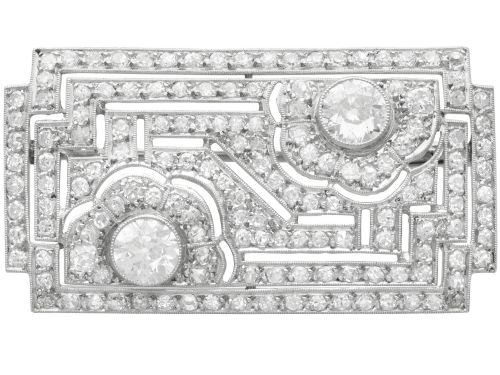
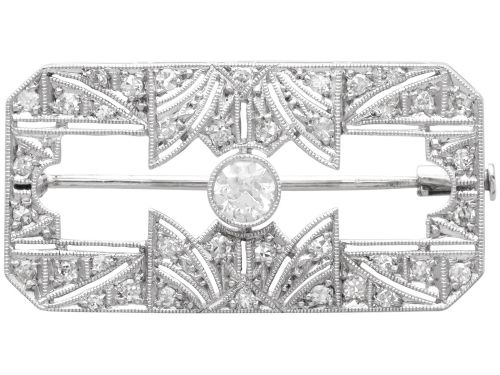
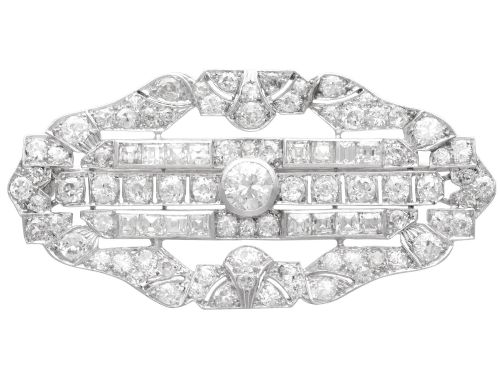
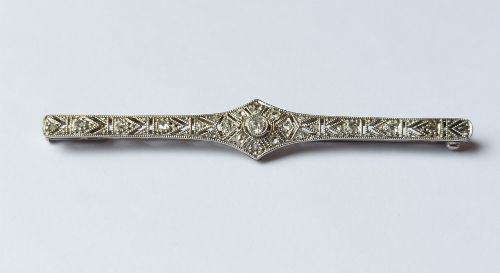


Platinum Geometric Brooch
A platinum geometric brooch brings sharp lines and brilliant stones from the early twentieth century straight to a modern lapel.
Platinum Geometric Brooch
A platinum geometric brooch is a structured ornament, most frequently found in the Art Deco style from the nineteen twenties, though examples stretch from nineteen ten through to nineteen sixty. These pieces take the form of bar brooches, pins, clip brooch pendants, and even ladies fob watches, utilising strict linear paths rather than flowing curves.
The aesthetic relies on precise angles, repeating motifs, and stark contrasts between clear stones and dark settings. You will encounter many diamond-heavy designs alongside pieces that introduce contrasting elements such as onyx or emerald.
How they were made
Makers built these pieces primarily in platinum, a metal chosen for its strength that allowed for exceptionally fine wirework and secure prong settings without bulk. Gold in fourteen carat, eighteen carat, and nine carat yellows also appears as a base or backing material in specific pieces.
The metalwork frequently houses old cut diamonds alongside carved onyx and emeralds, arranged in deliberate, repeating geometric patterns. Glass appears in certain iterations, while French origins indicate specialised European workshop techniques of the period.
Timekeeping met jewellery when makers transformed geometric platinum brooch settings into tiny ladies fob watches ready to pin to a lapel.
What varies in quality
The standard of a platinum geometric brooch rests on the architectural ambition of the metalwork and the integration of the stones. Finer pieces demonstrate meticulous piercing and symmetry in the platinum framework, holding larger carat weights of old cut diamonds with absolute stability.
Material selection dictates the upper tier of these items, particularly where flawless onyx sections or substantial emeralds punctuate the diamond pavé. Lesser examples rely on simpler bar formats with reduced stone counts and less intricate piercing in the metal.
The Platinum Geometric Brooch Glossary
- Art Deco
- A design style from the nineteen twenties and thirties characterised by symmetry, straight lines, and geometric abstraction. It dominates the appearance of these brooches.
- Old cut
- A diamond cutting style typical of antique and vintage jewellery prior to modern brilliant standards. These stones feature smaller tables and higher crowns.
- Bar brooch
- A horizontal pin format featuring gems or metalwork centred along a linear bar. This shape is common among early twentieth century examples.
- Clip brooch pendant
- A versatile piece designed to function either as a dress clip or suspended from a chain as a pendant. It represents a more complex construction type.
- Onyx
- A banded chalcedony gemstone utilised in deep black for strong graphic contrast against white diamonds and platinum. It defines many geometric colour schemes.
Platinum Geometric Brooch: Frequently Asked Questions
How do I wear a geometric brooch?
Pin these pieces firmly to heavy lapels, coats, or structured scarves where the weight of the platinum and diamonds finds adequate support. They also sit effectively on the fastening of a winter cloak or the centre of a structured collar.
Ensure the pin mechanism fastens securely through dense fabric to prevent the piece from tilting under its own weight. Avoid delicate silks that might pucker under the combined heft of platinum and stones.
What is the difference between Art Deco and Edwardian styles?
Edwardian jewellery from around nineteen ten favours delicate garland motifs, lace-like platinum work, and softer floral curves. Art Deco pieces from the nineteen twenties shift decisively toward rigid geometry, sharp angles, and stark contrasts.
When examining a brooch, look for the transition from flowing organic grace to strict parallel lines and repeated squares or triangles.
Are these brooches heavy to wear?
Many of these pieces carry significant carat weights of diamonds and dense platinum frames, giving them a noticeable heft. This substance requires thick, stable fabrics to hold the design straight throughout the day.
Lighter bar formats with minimal stone settings offer an easier weight for everyday wear on softer woollens or heavier cottons.
Can a brooch be worn as a pendant?
Certain designs incorporate integrated loops or specialised fittings that allow the piece to transition from a pin to a pendant on a chain. Convertible items offer versatility for different necklines and outfits.
Check the reverse of the setting for hinged bails or loops designed to accommodate a sturdy chain securely.
How do I date a platinum brooch?
Dating relies heavily on the stylistic markers of the metalwork and the cut of the diamonds, moving from Edwardian garland work into strict Art Deco geometry. The presence of mid century design cues points toward later iterations from the nineteen sixties.
Examine the construction of the pin stem and clasp as well, as manufacturing methods evolved noticeably between eighteen ninety and nineteen sixty.