
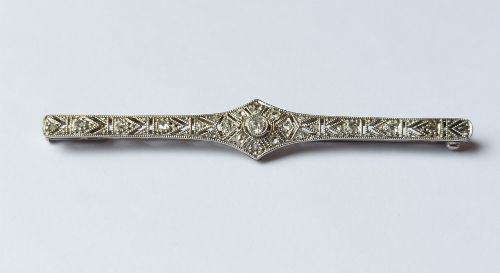
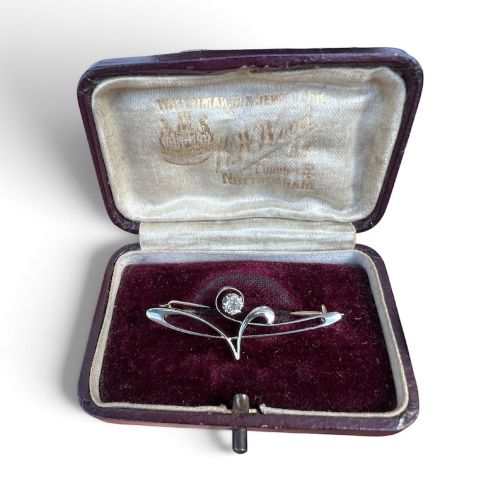
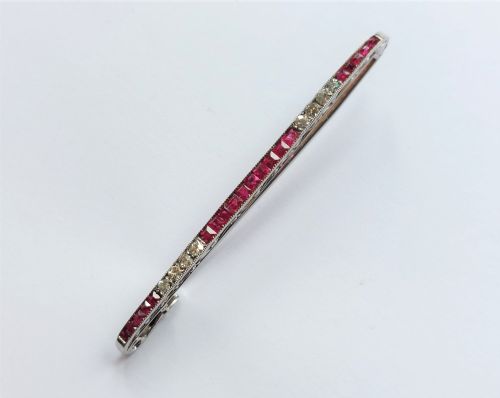


Platinum Diamond Pin
When you search for a platinum diamond pin, you are looking at intricate jewels designed to fasten clothing with enduring elegance.
Platinum Diamond Pin
A platinum diamond pin encompasses a range of jewelled fasteners, including bar brooches, stickpins, jabot pins, and convertible pendant brooches. These items typically emerge from periods spanning the late Victorian era through the Edwardian years and deep into the Art Deco epoch.
The Art Deco examples dominate the selection, bringing geometric layouts, clean lines, and crisp contrasts between white metal and dark stones. Alongside these, earlier Edwardian and Victorian designs offer softer organic shapes, floral motifs, and delicate milgrain details.
Makers utilised platinum to create strong yet remarkably fine settings that could hold numerous diamonds alongside coloured gems like sapphires, rubies, and onyx. Buyers frequently encounter pieces that combine this dense white metal with yellow gold or white gold elements in the foundational structure.
How they were made
Jewellers worked extensively with platinum during the early twentieth century because its tensile strength allowed for featherlight galleries and knife-edge bars. This material permitted complex openwork wire structures that would have snapped if rendered in traditional gold alone.
Diamonds were predominantly set by hand using grain setting and bezel techniques, securing old cut stones, rose cuts, and baguette cuts tightly into the platinum framework. Many pieces integrated dual-metal construction, pairing a durable platinum top face with an 18ct gold or yellow gold reverse.
Animals make charming appearances here, preserved in platinum and diamonds as owls, ducks, butterflies, and ram heads.
What varies in quality
The sophistication of the lapidary work and stone matching defines the upper tier of these pieces. Superior examples feature uniformly matched old cut diamonds and calibré-cut accent stones such as onyx, emerald, or ruby that fit their channels without visible gaps.
Construction intricacy also sets finer items apart, evident in hand-pierced piercing work, precise milgrain edge rolling, and robust pin mechanisms that maintain tension over decades of use.
Cartier Paris·Liberty London
The Platinum Diamond Pin Glossary
- Bar brooch
- A slender horizontal metal rod decorated with gemstones across its span. It fastens garments using a pin stem and safety catch.
- Jabot pin
- An ornamental pin historically used to secure a jabot cravat, featuring a decorative top face and a lower finial.
- Old cut
- A vintage diamond cutting style characterised by a high crown, small table, and deep pavilion that creates broad facet flashes under candlelight.
- Milgrain
- A decorative edging technique consisting of a row of tiny raised metal beads along the borders of a platinum setting.
- Calibré cut
- Small gemstones precision-cut into specific geometric shapes to fit tightly into channel settings within a structured design.
Platinum Diamond Pin: Frequently Asked Questions
What is a platinum diamond pin used for?
These pieces function primarily as decorative fasteners for lapels, scarves, hats, and heavy fabrics. Historically, they secured specialised garments and cravats while signalling social status through precious materials.
Today, collectors wear them as versatile brooches or adapt them into pendants using hidden loops. They remain practical accessories that add historic character to modern attire.
How can I tell an Art Deco pin from an Edwardian one?
Art Deco pieces rely on strict geometry, symmetrical layouts, and sharp contrasts involving black onyx or calibre-cut rubies alongside diamonds. Platinum dominates these linear compositions.
Edwardian items favour softer floral motifs, garlands, bows, and natural pearls set against delicate white metal lace work. The overall aesthetic feels lighter and more fluid than the later Deco style.
Why is platinum used instead of gold in these pins?
Platinum possesses exceptional strength and density, allowing jewellers to fashion ultra-thin claws and intricate wirework without risking stone loss. This durability made it the preferred metal for securing dense pavé diamond fields.
Its naturally bright white colour also does not tarnish and complements the icy sparkle of old cut diamonds perfectly.
Can these pins be worn every day?
Most antique platinum pins withstand regular wear provided the pin stem, hinge, and safety clasp remain secure. The inherent toughness of platinum protects the structural integrity of the delicate settings.
Owners should handle pieces with delicate openwork or natural pearls with care to avoid bending the fine metal bridges during fastening.