
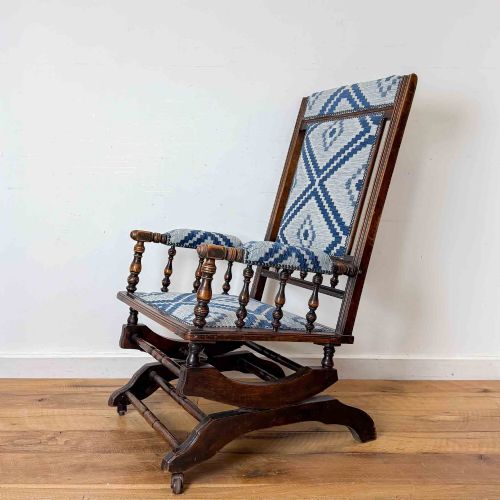
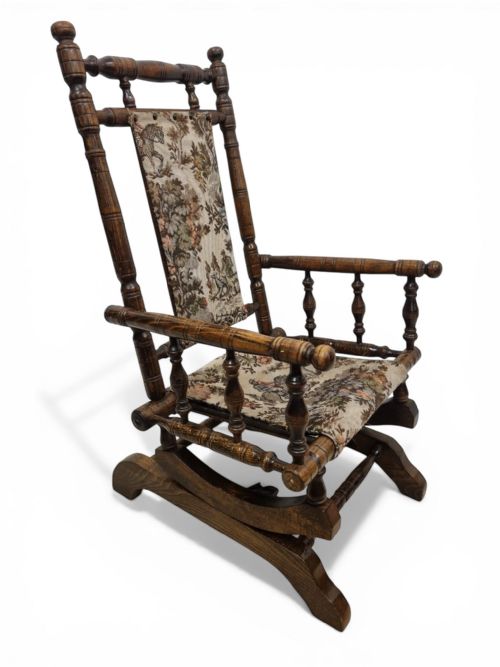


Platform Rocking Chair
A platform rocking chair offers a steady, enclosed movement that defines comfortable seating across multiple periods.
Platform Rocking Chair
A platform rocking chair sits upon a stationary base rather than rocking directly on curved floor runners, providing a controlled and even motion. When searching for a platform rocking chair, buyers encounter examples originating from the nineteenth century up through the nineteen-twenties.
The selections span standard armchairs alongside smaller children variants and low nursing seats. Woods such as oak, walnut, beech, mahogany and fruitwood form the primary structures of these chairs.
Victorian and Edwardian pieces frequently appear alongside items built in traditional American styles. Upholstery finishes range from patterned fabric and tapestry to button-backed leather.
How they were made
Makers constructed the frames using solid timbers including oak, walnut, beech and mahogany, often shaping the timber into moulded panelled seats and backs. Metal components such as steel and brass appear within the concealed platform mechanisms that enable the rocking action.
Upholstery techniques involve stretched fabric, tapestry and button-backed leather secured across sprung or padded frames. Bentwood methods also feature in specific armchair designs created by Thonet around nineteen hundred.
Some miniature chairs were built for children who insisted on rocking their dolls right alongside the adults.
What varies in quality
The sophistication of the timber frame and the execution of the woodturning dictate the distinction between ordinary production and finer work. Chairs featuring solid moulded panels and select hardwoods display greater joinery skill than simpler builds.
The integrity of the internal platform mechanism determines how smoothly the chair operates during movement. Furthermore, the quality of original textiles, tapestry or leather upholstery alters the overall character and finish of the piece.
Thonet
The Platform Rocking Chair Glossary
- Platform base
- A stationary wooden or metal chassis that supports the rocking mechanism above the floor. This assembly keeps the chair from travelling across the room while in motion.
- Bentwood
- Wood steamed and bent into curved structural shapes without traditional joints. This method creates continuous rounded arms and backs.
- Button back
- An upholstery style where buttons are pulled deep into the padding at regular intervals. This technique creates a tufted surface that holds the filling securely in place.
- Moulded panel
- A wooden board shaped with concave or convex profiles to fit human contours. These panels provide ergonomic support for the back and seat.
- Tapestry
- Heavy woven textile featuring decorative patterns used for heavy-duty upholstery. It offers a dense, durable surface designed to withstand regular friction.
Platform Rocking Chair: Frequently Asked Questions
What is a platform rocking chair?
A platform rocking chair is a seating design that rests on a fixed base rather than traditional curved runners. The internal mechanism allows the upper chair portion to rock smoothly while the base remains entirely still on the floor.
This construction prevents the chair from creeping across carpets or damaging floorboards during use. The listings include examples ranging from nineteenth century Victorian pieces to nineteen-twenties American style variants.
How do I identify an Edwardian rocking chair?
Edwardian rocking chairs typically date from the early twentieth century and often utilise mahogany or walnut timbers. They frequently incorporate refined details such as button-backed leather upholstery or low seating profiles intended for nursing.
The woodwork tends to display lighter tones and sleeker proportions compared to heavier mid-Victorian designs. These chairs bridge nineteenth century comfort with early twentieth century domestic styling.
Were children rocking chairs common?
Makers produced smaller rocking chairs specifically for children alongside full-sized household furniture during the nineteenth and early twentieth centuries. These miniature pieces mirror the construction methods and upholstery styles of adult chairs.
Examples seen on this page feature solid wood frames combined with tapestry or fabric seating. They served as functional household items for nurseries and parlours.
How does bentwood differ from standard wood framing?
Bentwood construction involves exposing timber to steam until it becomes pliable enough to bend into curves. This technique eliminates the need for complex corner joints and produces strong, flowing structural lines.
Thonet famously utilised this method to create lightweight rocking armchairs around nineteen hundred. The resulting frames combine resilience with distinctive rounded silhouettes.