

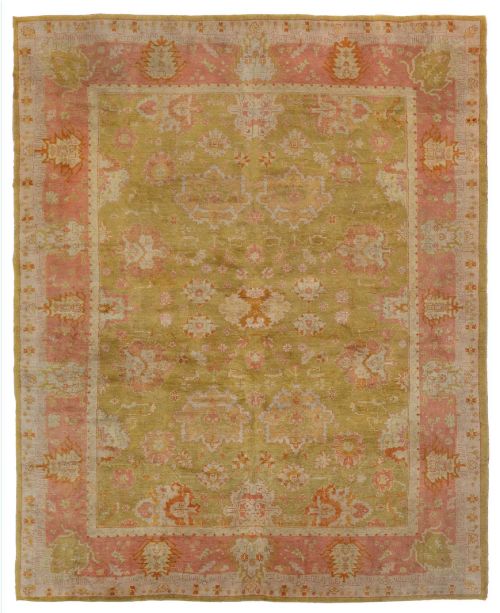


Pink Ushak Carpet
A pink ushak carpet brings soft warmth and grand Anatolian scale to a room.
Pink Ushak Carpet
When you search for a pink ushak carpet, you are looking at large, hand-knotted floor coverings originating from the traditional weaving centres of Anatolia. These pieces bring gentle, faded tones and expansive floral or geometric motifs that anchor a large living space or drawing room.
The examples gathered here date from the late nineteenth century through to the early twentieth century, spanning the eighteen-eighties to nineteen-twenty. They represent the classic Ottoman and Turkish Oushak traditions, featuring generous dimensions such as the large format measuring over four hundred centimetres.
You are most likely to meet antique Ushak rugs displaying muted rose and pink colour palettes achieved through natural dyeing traditions. Their worn surfaces and grand scale reflect centuries of design heritage adapted for elegant domestic interiors.
How they were made
These carpets are constructed with wool pile hand-knotted onto sturdy cotton foundations. The wool provides a thick, resilient surface that softens gracefully over decades of use.
Weavers utilised traditional Turkish knotting techniques on upright looms, working from established Anatolian design repertoires. The structural cotton warps and wefts ensure stability across substantial room-sized formats.
Pink Ushak Carpet Retail Price Guide 2026
Typical asking prices for pink ushak carpet among the pieces listed under this phrase on Sellingantiques today, from the lower quarter to the upper quarter. They describe what is for sale here now, not the wider market.
These grand antique carpets spent decades travelling across continents before finally deciding to retire on a modern wooden floor.
What varies in quality
The fineness of the knotting and the density of the wool pile separate the finer examples from standard production. A more tightly packed foundation creates a sharper definition in the large-scale floral and medallion motifs.
The nuance and depth of the pink dye shades also distinguish superior pieces. Even fading across the wool pile indicates harmonious ageing from natural light and wear.
The Pink Ushak Carpet Glossary
- Ushak
- A traditional style of Turkish carpet originating from the town of Usak in western Anatolia. These pieces are known for large floral designs and soft, muted colour palettes.
- Anatolian
- Pertaining to the geographic region of Asia Minor that forms the bulk of modern Turkey. This term covers historic weaving traditions rooted in the region.
- Pile
- The upright yarn loops that form the functional surface of a carpet. In these rugs, the wool pile provides texture and warmth underfoot.
- Warp
- The vertical foundation threads stretched tightly on the loom before knotting begins. Cotton is typically used for these structural elements in Turkish carpets.
Pink Ushak Carpet: Frequently Asked Questions
How do I place a large ushak carpet?
A large room-sized carpet anchors the central seating area of a drawing room or dining space. Allow sufficient floor perimeter to show the surrounding timber.
Keep heavy furniture legs positioned either entirely on the rug or off it to balance the room composition.
What period do these carpets come from?
The pieces listed originate from the late nineteenth century and early twentieth century. This era spans from eighteen-eighty through to nineteen-twenty.
Such dates place them firmly within the late Ottoman decorative arts tradition.
How should I care for antique wool rugs?
Vacuum the carpet gently using a suction-only attachment without a rotating brush roll. This protects the delicate wool pile from unnecessary friction and fibre loss.
Professional specialist cleaning is recommended every few years to remove embedded dust safely.
What materials make up an antique ushak?
The soft surface pile is spun entirely from sheep wool. This material absorbs dye deeply and wears down to a soft patina over generations.
The underlying structural grid consists of cotton threads that hold the knots firmly in place.