


Pink Porcelain Table Clock
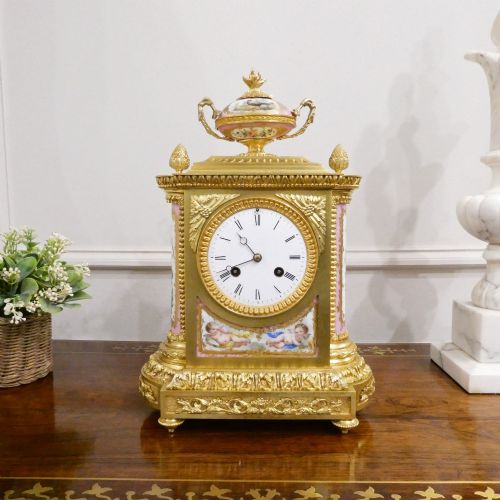
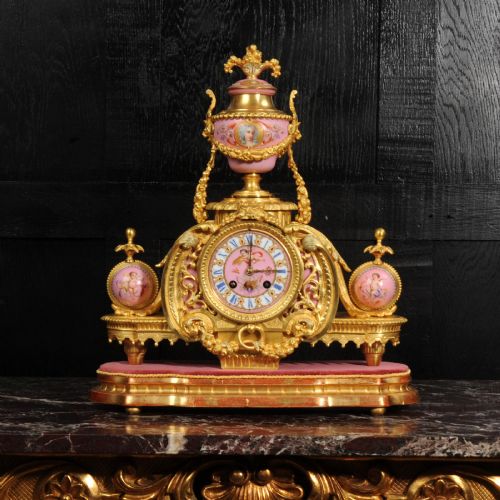
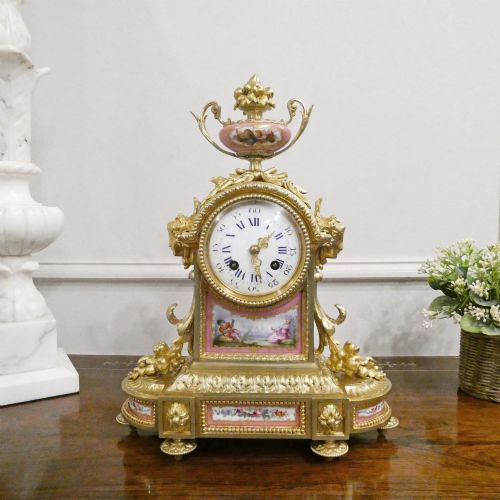
A pink porcelain table clock brings vibrant nineteenth-century French elegance and decorative porcelain panels into a room.

Pink Porcelain Table Clock
A pink porcelain table clock is typically a nineteenth-century French mantel clock combining glazed ceramic panels with gilt bronze, ormolu, or gilt metal mounts. These decorative timepieces emerge during the Victorian era and adopt Louis XVI Revival or French Rococo Revival styles.
Most examples you encounter on this page date from the middle to the late nineteenth century, specifically around eighteen seventy to eighteen eighty. They often take the form of substantial mantel clocks designed to sit prominently on a shelf or fireplace mantel.
Makers such as Jean-Baptiste Delettrez, Achille Brocot, Japy Freres, and P.H. Mourey produced these sophisticated works. The combination of pink porcelain and ornate metallic framing defines the visual character of the pieces listed.
Materials and construction
These clocks are constructed using porcelain components paired with gilt bronze or ormolu mounts, frequently supported by brass and glass elements. The porcelain panels and dials are painted and glazed, often incorporating pink colour schemes influenced by Sèvres designs.
Foundry work in gilt bronze and ormolu involves casting and chasing metallic frames that house the porcelain panels and clock movements. Velvet and glass components frequently supplement the primary metal and ceramic structures.
Several makers of these pink clocks relied on Japy Freres movements, meaning identical machinery ticks behind entirely different porcelain faces.
Evaluating quality and craftsmanship
The refinement of the gilt bronze or ormolu chasing separates superior examples from simpler ones, with sharper cast details and deeper gilding indicating higher workshop standards. The intricacy of the Louis XVI or Rococo Revival ornamentation dictates the overall artistic success of the piece.
The execution and hand-painting of the porcelain panels also influence the character of the clock. Finer pieces demonstrate superior ceramic firing and enamel dial work by established makers rather than mass-produced decoration.
Jean-Baptiste Delettrez·Achille Brocot·Japy Freres·P.H Mourey
The Pink Porcelain Table Clock Glossary
- Ormolu
- Gilt bronze produced by applying a mercury and gold amalgam to a bronze base, creating a rich golden surface finish. This technique was widely utilised by French nineteenth-century clockmakers.
- Louis XVI Revival
- A decorative style referencing the neoclassical tastes of the eighteenth-century French court, marked by symmetry and restrained classical motifs. It frequently appears in Victorian mantel clock designs.
- Rococo Revival
- An exuberant design movement favouring asymmetrical scrolls, floral elements, and naturalistic curves. This style dominates many nineteenth-century French clock cases.
- Mantel clock
- A household timepiece designed to stand upon a fireplace mantel or shelf. These objects combine timekeeping mechanisms with decorative sculpture and cabinetry.
Pink Porcelain Table Clock: Frequently Asked Questions
How do I wind a pink porcelain table clock?
Use the appropriate winding key inserted into the dial holes to tension the springs gently. Turn the key slowly until you feel resistance.
Avoid overwinding the mechanism, as this can damage the internal springs. Consult a professional horologist if the tension feels irregular.
Where should I place a porcelain mantel clock?
Position the clock on a stable, level surface away from direct sunlight and damp conditions. A mantelpiece or a sturdy sideboard provides an ideal setting.
Ensure the location experiences minimal temperature fluctuations to protect the porcelain and internal metal components.
What materials make up these antique clocks?
These clocks are primarily built from porcelain and gilt bronze or ormolu, sometimes incorporating brass, glass, and velvet elements. The combination of glazed ceramics and cast metal defines their aesthetic.
Enamel is typically used for the clock face dials, featuring painted numerals and delicate hands.