
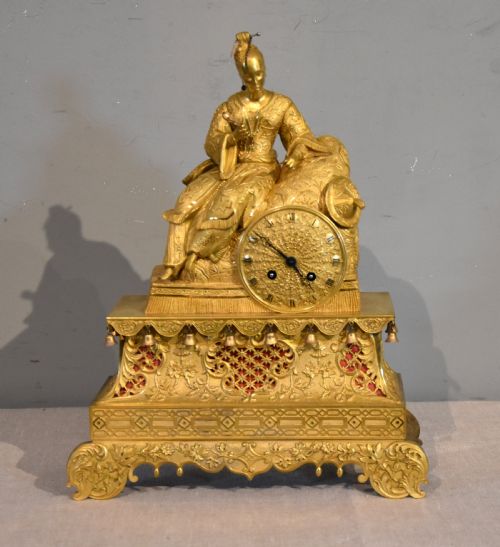


Ornate Gilt Figural Clock
These ornate gilt figural clocks bring sculptural presence and precision timekeeping into a room, combining cast metalwork with figurative detail.

Ornate Gilt Figural Clock
An ornate gilt figural clock combines timekeeping with sculptural figures, often drawing on French Rococo Revival, Louis XVI Revival, and Victorian styles. The pieces found here span the nineteenth century, including the eighteen-fifties, eighteen-sixties, eighteen-eighties, and nineteen-hundred.
The forms range from individual mantel clocks and boudoir clocks to three-piece clock sets that include garnitures, frequently protected beneath glass domes. Figures such as cherubs often take centre stage alongside architectural and decorative mounts.
Most examples originate from French workshops or Victorian makers, leaning heavily on decorative mantel formats designed to command attention on a shelf or sideboard. Buyers encounter variations from restrained neoclassical designs to flowing Art Nouveau curves.
How they were made
Maker's workshops built these clocks using cast metals including ormolu, gilt bronze, and gilt metal, often combined with marble bases and porcelain panels. Enamel dials and glass components completed the structural assembly.
The mechanical movements drove eight-day striking systems and bell-striking functions, housed within ornate metal bodies that required skilled chasing and gilding. Porcelain elements, such as Sevres-style panels, were hand-painted and integrated into the gilt framework.
Listings feature pieces from the Victorian era and the nineteenth century, utilising materials such as ormolu, porcelain, marble, and gilt metal.
What varies in quality
The refinement of the casting and the crispness of the chasing separate standard production from exceptional work. Finer examples show deeper relief in the figural sculpture and superior hand-finishing on the gilt surfaces.
The integration of materials also defines the tier of the piece, where harmonious placement of porcelain panels, enamel dials, and glass domes elevates the overall sculptural impact.
The Ornate Gilt Figural Clock Glossary
- Ormolu
- A finely ground high-carat gold amalgam applied to bronze, popular in French furniture and clockmaking. It provides a warm, lasting lustre that distinguishes higher-end nineteenth-century pieces.
- Garniture
- A set of matching decorative ornaments, typically a clock flanked by two matching vases or candelabra. These sets create a balanced display on a mantelpiece.
- Chasing
- The art of manually refining and detailing metal castings with hammers and punches. Skilled chasing brings out the texture and expression in figural clock cases.
- Enamel dial
- A clock face made by fusing powdered glass to a metal substrate at high temperatures. These dials offer a smooth, durable surface for painted numerals.
- Bell striking
- A movement mechanism that uses a small hammer to strike a tuned metal bell on the hour or half-hour. This traditional acoustic feature adds an auditory dimension to the clock.
Ornate Gilt Figural Clock: Frequently Asked Questions
Where should I place a clock garniture?
Clock garnitures suit stable mantelpieces, deep sideboards, or console tables where the central clock and matching side pieces sit securely together. Keep them away from direct sunlight and damp walls to protect the gilding and enamel.
Allow enough clearance around the piece if it sits beneath a glass dome so the delicate base remains undisturbed during cleaning.
How do I date a nineteenth-century clock?
Dating relies on stylistic clues, such as the flowing asymmetry of Rococo Revival or the organic lines of Art Nouveau. Maker marks on the movement backplate and dial signatures also help narrow down the period of manufacture.
Materials provide further evidence, as specific combinations of ormolu, porcelain panels, and marble bases gained popularity during distinct decades like the eighteen-sixties and eighteen-eighties.
Do glass domes protect these clocks?
Original glass domes shield the gilt surfaces and delicate figural details from household dust and accidental knocks. They preserve the finish on softer metals like ormolu and gilt bronze over decades.
Lifting a heavy glass dome requires two people and a firm grip on the base to avoid chipping the glass or damaging the clock beneath.