






Gold Metal Mantel Clock
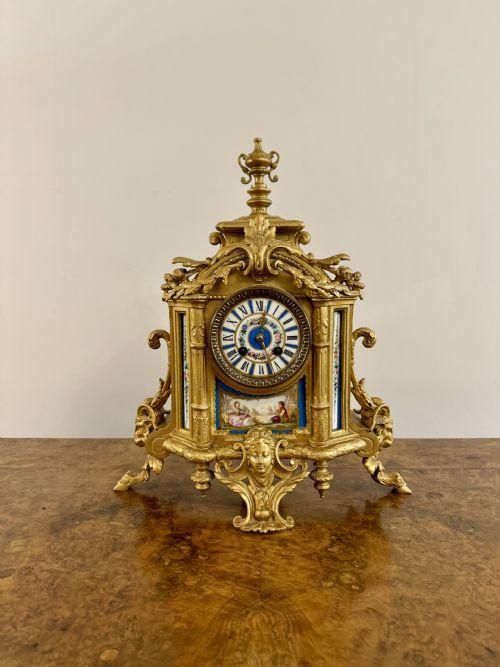
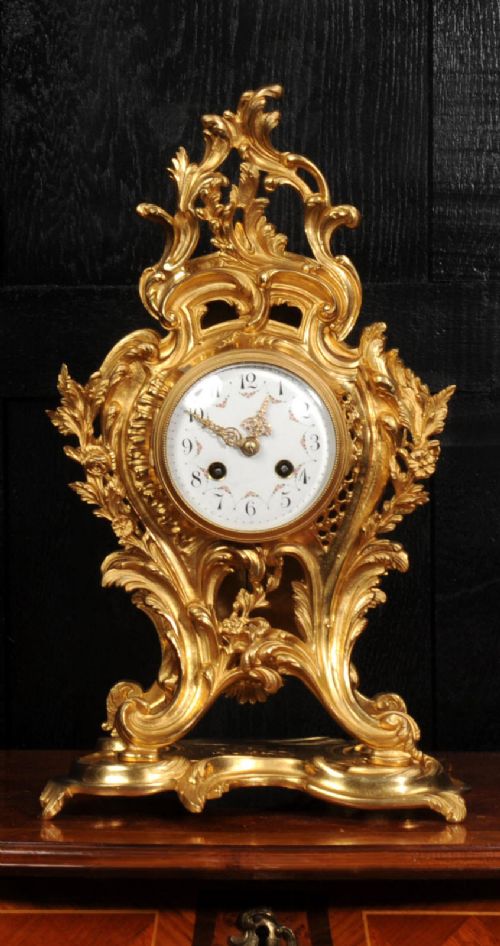
A gold metal mantel clock brings a bright metallic finish and historical weight to a room, led here by French Rococo Revival and Victorian designs.

Gold Metal Mantel Clock
A gold metal mantel clock sits on a chimney piece or side table, combining timekeeping with ornate sculptural forms. When searching for a gold metal mantel clock, buyers meet mostly French and English examples spanning the nineteenth century, alongside carriage clocks and clock garnitures.
The selection ranges from elaborate French Rococo and Baroque gilt bronze pieces to restrained Regency fusee clocks and Victorian brass carriage timepieces. Makers and retailers such as Japy Frères and London clockmakers appear across the nineteenth-century inventory.
Cases combine gilt metal, ormolu, brass, and bronze with white enamel dials, painted porcelain panels, and occasionally marble or onyx bases. Some pieces incorporate figural subjects, such as Diana the Hunter or William Shakespeare, alongside cherubs and architectural motifs.
How they were made
Clock movements utilise brass wheel trains, escapements, and either pendulum regulation or fusee spring drives for timekeeping. Porcelain plaque inserts, painted with floral or figural scenes, are mounted directly into the metal cases alongside marble and onyx plinths.
William Shakespeare makes a bronze appearance on one nineteenth-century clock base, perhaps ensuring the hours are marked with literary gravitas.
What varies in quality
The standard of a gold metal mantel clock depends upon the crispness of the bronze casting and the depth of the original gilding. Finer pieces display hand-chased surface detail on foliage and figures rather than smooth, factory-cast uniformity.
Movement sophistication also divides the tier, separating standard striking mechanisms from fusee movements or complex grande-sonnerie carriage clocks by recognised makers. The integration of hand-painted porcelain panels and undamaged enamel dials further separates high-grade examples from simpler production.
Japy Frères·John Barwise of London·Leon Message·Leroy & Fils·Jaeger LeCoultre·Bently & Beck London
The Gold Metal Mantel Clock Glossary
- Ormolu
- Gilded bronze, where finely ground gold is amalgamated with mercury and applied to a bronze base before the mercury is driven off by heat. This technique creates a durable, warm gold finish seen on French nineteenth-century clock cases.
- Fusee
- A conical pulley used in better quality clocks to maintain equal force on the gear train as the mainspring unwinds. English Regency bracket and mantel clocks frequently utilise this mechanism.
- Carriage clock
- A portable spring-driven timepiece designed for travel, typically fitted with a carrying handle and glass panels that reveal the escapement. Examples from makers like Bourdin show fine French engineering.
- Clock garniture
- A set comprising a central clock flanked by matching decorative objects such as urns or candelabra. These matched arrangements were designed to sit symmetrically on a mantelpiece.
- Grande-sonnerie
- A striking mechanism that sounds both the hours and the quarters automatically on every quarter hour. It represents a high level of horological complication in carriage clocks.
Gold Metal Mantel Clock: Frequently Asked Questions
How do I wind a mantel clock?
Use the correct key on the winding arbors found on the enamel dial, turning gently until resistance increases. Avoid over-winding to protect the mainspring.
Most nineteenth-century movements require a weekly wind, while carriage clocks often run for eight days between attention.
What is a fusee movement?
A fusee is a conical drum connected to the mainspring by a fine chain or cord. It ensures the clock delivers even power to the escapement as the spring relaxes.
This system improves timekeeping accuracy across the duration of the wind.
Where should I place a gilt metal clock?
Position the clock on a stable, level surface away from direct sunlight and damp environments. Mantelpieces and sturdy sideboards offer ideal support.
Keeping the clock away from draughts helps protect the delicate escapement and prevents dust accumulation on the gilding.
How do I identify French Rococo Revival style?
Look for asymmetrical scrolls, naturalistic shell motifs, and flowing botanical forms cast in gilt metal. These designs abandon straight architectural lines in favour of dynamic curves.
Nineteenth-century French makers frequently combined these ornate gilt cases with painted porcelain panels and white enamel dials.