
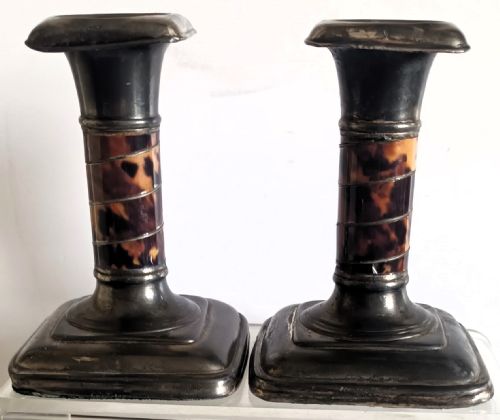


Pewter Taper Holders
These pewter taper holders are small, practical lighting pieces spanning the seventeenth century to the twentieth century, valued for their tactile metal and varied decorative styles.
Pewter Taper Holders
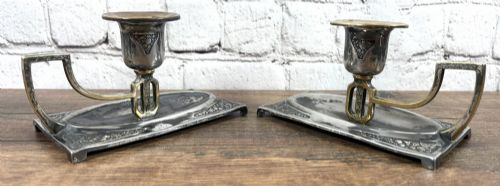
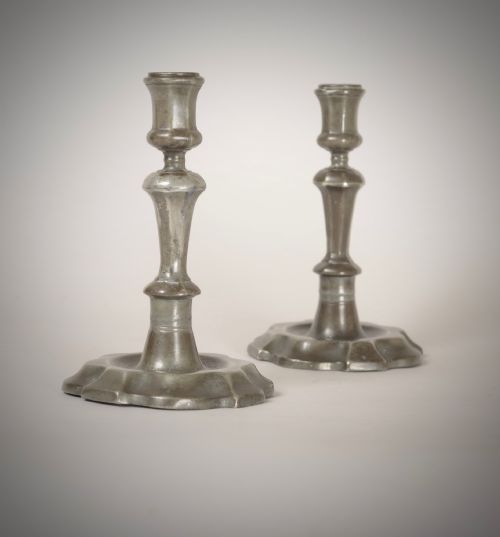
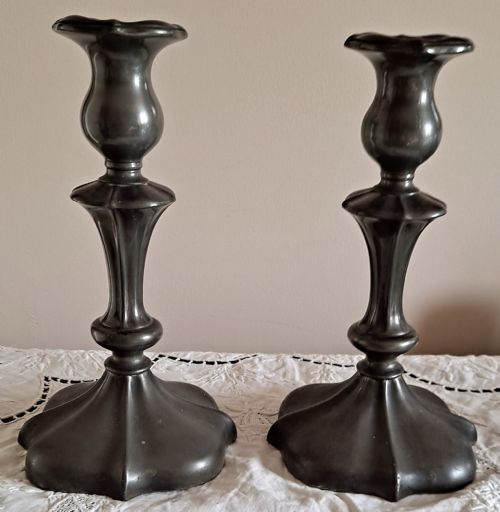
Pewter taper holders provide a compact base for small candles, appearing across the seventeenth, eighteenth, nineteenth, and twentieth centuries in forms ranging from simple sticks to paired sets. Buyers seeking pewter taper holders encounter items styled in the Stuart, Georgian, Victorian, Arts and Crafts, Art Nouveau, and Art Deco manners.
The selection includes mixed materials, combining pewter with tortoiseshell, brass, or enamel alongside standard metal examples. Most items survive as pairs, designed for domestic illumination before the widespread adoption of electric light.
Origins stretch from English workshops to continental makers such as WMF, offering a chronological sweep of design movements from early plain forms to patterned Arts and Crafts productions.
How they were made
Makers shaped pewter through casting and working, creating durable candle holders that often received decorative surface treatments. Alloy composition varied to achieve the desired rigidity and finish for domestic items.
Selected pieces incorporate secondary materials like tortoiseshell inserts, brass accents, or enamel cabochons, particularly within the Arts and Crafts and Art Nouveau movements. These additions required specialised fitting to secure dissimilar substances to the metal body.
Designers utilised stylistic hallmarks of their respective eras, from Stuart plainness to Art Deco geometry, applying surface patination or polish to enhance the appearance of the metal.
Materials in these listings span pewter, tortoiseshell, brass, and enamel across six distinct centuries.
What varies in quality
Quality rests in the crispness of the casting and the integrity of any applied decorative elements such as enamel or tortoiseshell panels. Finer examples display deliberate proportion and careful integration of mixed materials without clumsy joints.
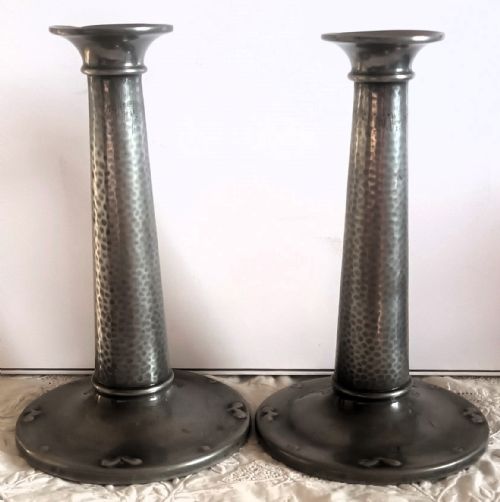
The distinction between standard domestic production and high-design studio work lies in the execution of the style, whether in the flowing lines of Art Nouveau or the hammered textures of the Arts and Crafts movement.
WMF·Archibald Knox for Liberty and Co
The Pewter Taper Holders Glossary
- Pewter
- A malleable metal alloy composed principally of tin, historically used for domestic tableware and lighting. It develops a muted grey patina with age.
- Taper
- A slender candle designed for lighting fires or sealing letters, requiring a smaller holder than standard household candles. These holders accommodate such narrow dimensions.
- Arts and Crafts
- A design movement emphasising handcraftsmanship and simple forms, frequently utilising hammered metal surfaces and natural motifs. This style appears on several examples from the early twentieth century.
- Art Nouveau
- A decorative style characterised by organic, flowing lines and asymmetrical plant-inspired motifs. Pieces from this period integrate these fluid shapes into the metal body.
Pewter Taper Holders: Frequently Asked Questions
What periods do pewter taper holders cover?
The pieces span from the seventeenth century through the eighteenth, nineteenth, and early twentieth centuries, including 1900, 1910, and 1930.
Each era contributes distinct stylistic markers, moving from early Stuart designs to Art Deco forms.
Are these candle holders sold individually?
The available selection consists entirely of pairs, designed for symmetrical placement on tables or mantelpieces.
This pairing is typical for domestic lighting of the period.
What materials are combined with pewter?
Certain examples incorporate tortoiseshell, brass, or enamel alongside the primary metal body.
These mixed media pieces are particularly associated with Arts and Crafts and Victorian styles.
How do I identify an Art Nouveau piece?
Art Nouveau examples feature fluid, organic lines and plant-inspired motifs typical of the turn of the twentieth century.
They often appear alongside Arts and Crafts productions from the same era.