






Persian Herati Rug
A persian herati rug brings centuries of woven artistry into a room through its characteristic repeated floral trellis pattern.
Persian Herati Rug
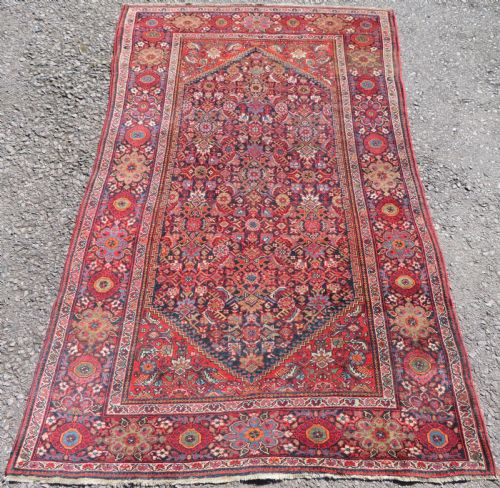
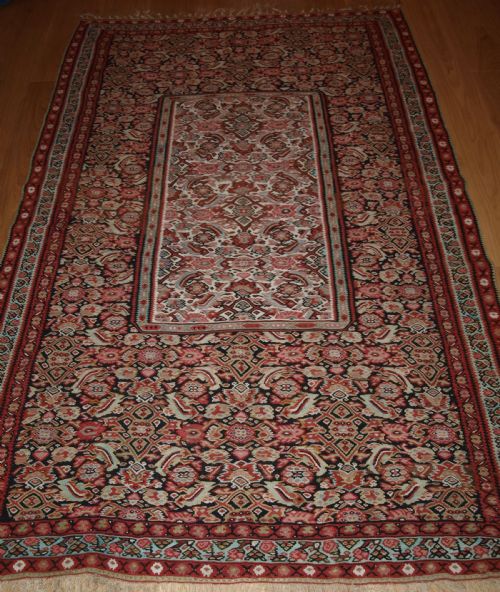
A persian herati rug centres on a dense, repeating motif of a fish and flower lattice pattern that covers the field. These floor coverings emerge from various weaving traditions across nineteenth and early twentieth century Persia, spanning village, tribal and town workshops.
Buyers encounter numerous regional variations on this page, including pieces attributed to Fereghan, Malayer, Senneh, Bidjar and Afshar. The format ranges from small scatter rugs and long runners to substantial carpets and kellehs.
Most examples date from the late nineteenth century up to the 1920s, employing traditional hand-knotting techniques. Each regional group adapts the repeating herati design with distinct colour palettes and border structures.
Materials and Construction
The foundation relies on a sturdy cotton or wool warp and weft, providing the structural grid for the dense pile. Artisans knot soft wool onto this foundation by hand, creating a dense and resilient surface designed for enduring use.
Natural dyes yield the characteristic deep blues, madder reds and ivory tones seen across these pieces. The interplay of hand-spun wool and traditional dyestuffs allows the pile to age with a rich, mellow patina.
Persian Herati Rug Retail Price Guide 2026
Typical asking prices for persian herati rug among the pieces listed under this phrase on Sellingantiques today, from the lower quarter to the upper quarter. They describe what is for sale here now, not the wider market.
Listings feature pieces dated across the nineteenth century and into the 1920s, constructed from wool and cotton.
Evaluating Quality and Execution
Quality rests in the precision of the knotting and the crispness of the drawing within the herati lattice. Finer weaves allow for sharper definition in the intricate floral motifs, separating ordinary village pieces from master-woven examples.
The integrity of the wool and the depth of the dye saturation dictate the long-term character of the surface. Balanced proportions and careful handling of the border guards distinguish superior town and village carpets.
The Persian Herati Rug Glossary
- Herati
- A repeating ornamentation composed of a central rosette framed by two curved leaves, often resembling fish. This botanical motif forms the primary all-over pattern of the genre.
- Kelleh
- A long, narrow carpet format traditionally used in Persian domestic interiors. These pieces typically display elongated proportions suited for hallways or gallery spaces.
- Pushti
- A small scatter rug or mat format, usually intended for small spaces or seating areas. These compact pieces often feature concentrated village designs.
- Kilim
- A flat-woven carpet or rug made without a pile by tightly interweaving warp and weft strands. This technique produces a lightweight, reversible textile with a smooth surface.
- Warp
- The vertical threads stretched tightly on the loom that form the structural skeleton of the rug. The knots of the pile are tied directly around these parallel strands.
Persian Herati Rug: Frequently Asked Questions
What is a herati design?
The herati pattern is an all-over repeating motif featuring a central flower surrounded by curved leaves. It appears frequently in traditional Persian weaving across various regional groups.
This intricate lattice creates a balanced, continuous visual rhythm across the field of the rug.
How do I care for an antique rug?
Regular gentle vacuuming without a beater bar helps remove dust and grit from the wool pile. Professional cleaning by a specialist in antique textiles ensures the natural dyes remain stable.
Keeping the rug out of direct, harsh sunlight prevents the vegetable dyes from fading prematurely over the years.
Where were these rugs made?
These textiles originate from various towns, villages and tribal regions across Persia, including Fereghan, Senneh, Malayer and Bidjar. Each area developed distinctive local interpretations of the classic herati layout.
Local water sources, regional wool types and specific tribal traditions shaped the final character of each weaving centre.
How can I tell the age of a rug?
Age is determined by examining the materials, knot structure, dye palette and regional style characteristics. Hand-spun wool and natural dye variations typically point to nineteenth or early twentieth-century production.
Slight irregularities in the symmetry and structure often indicate traditional hand-made village or tribal origins prior to commercial standardisation.