
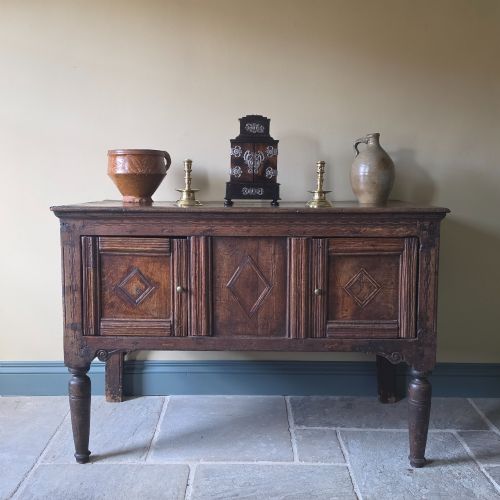

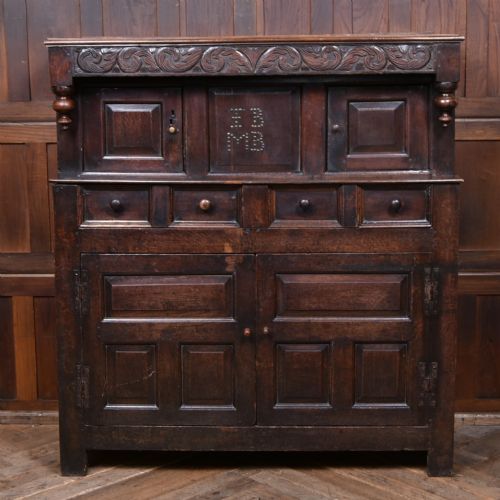


Period Oak Buffet
A period oak buffet anchors a room with timber that darkens gracefully over centuries.
Period Oak Buffet
A period oak buffet represents heavy timber storage forms spanning several centuries of British and continental woodworking. When searching for a period oak buffet, buyers encounter robust storage furniture that evolved from utilitarian food hutches into grand display cabinets.
The pieces listed here lean heavily towards the seventeenth century, alongside Victorian revivals, eighteenth-century examples, and continental stylistic influences like the Louis XV period oak buffet. Forms range from court cupboards and dressers to food hutches and sideboards.
Early examples show the heavy influence of Elizabethan, Jacobean, and Charles II designs, constructed to hold provisions or display plate. Later interpretations from the nineteenth century draw directly on these earlier centuries with applied carvings and panel work.
How they were made
Construction relies primarily on solid oak, worked using traditional frame and panel techniques to allow the timber to move naturally without splitting. Secondary woods such as pine appear in internal or structural locations on specific regional pieces.
Metal components are restricted to functional or decorative elements in brass and iron, securing heavy doors and drawers. Surface decoration often includes carved motifs, mouldings, and applied geometric shapes characteristic of seventeenth-century joinery.
Early food hutches were built well-ventilated to keep the cheese safe from the household cat.
What varies in quality
Quality separates along the line of original timber selection, the depth and crispness of the hand-carved details, and the integrity of the joinery. Pieces retaining their original brass hardware and untouched surface patination sit firmly at the upper end.
Later Victorian interpretations and provincial pieces vary according to how closely the maker adhered to traditional joinery methods rather than relying purely on applied decorative elements.
Liberty & Co.
The Period Oak Buffet Glossary
- Court cupboard
- A heavy enclosed storage piece with upper and lower sections, often featuring recessed upper tiers supported by turned columns. This form dominates the early centuries of the inventory.
- Jacobean
- The style prevalent during the early seventeenth century, characterised by rigid symmetry, geometric mouldings, and strapwork carving. It appears frequently across the listed items.
- Frame and panel
- A method of construction where a central flat or raised panel floats within a grooved frame to accommodate seasonal timber movement. This technique defines genuine period casework.
- Patina
- The deep, lustrous surface sheen developed by oak over centuries of handling, polishing, and exposure to light. It is a key indicator of age.
Period Oak Buffet: Frequently Asked Questions
What is a period oak buffet?
A period oak buffet is a heavy wooden storage piece originating from early European centuries, used historically for serving food and displaying plate.
These items range from seventeenth-century court cupboards to later nineteenth-century revivals built from solid timber.
How do I identify a seventeenth-century piece?
Seventeenth-century pieces display authentic joinery techniques such as pegged mortise and tenon joints, alongside hand-carved Jacobean or Elizabethan motifs.
Examination of the timber reveals tool marks and a natural patination that modern reproductions cannot replicate.
Where were these pieces used?
They originated in domestic halls, dining rooms, and farmhouses as functional furniture for storing provisions, linens, and dining implements.
Today they function effectively as statement storage pieces in traditional or contemporary living spaces.
What materials are used alongside oak?
Oak forms the primary structural and visible timber across the inventory, supplemented by pine in hidden areas on specific items.
Hardware consists of hand-forged iron or brass for hinges, handles, and locking mechanisms.