


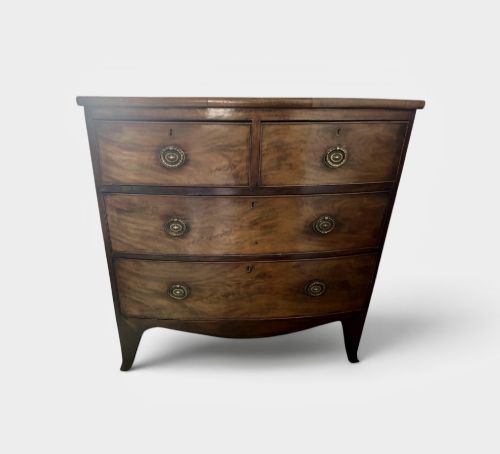
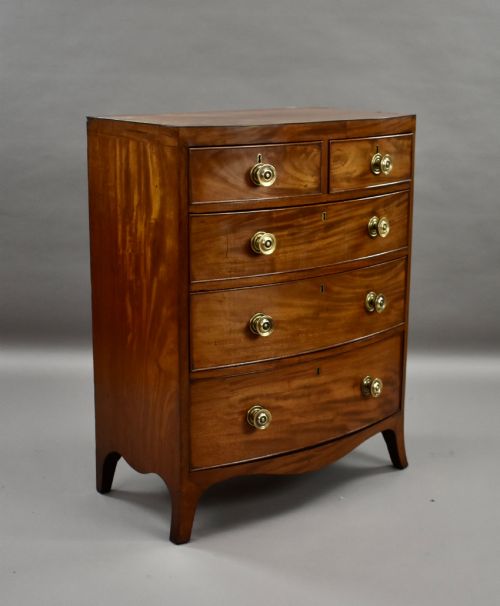

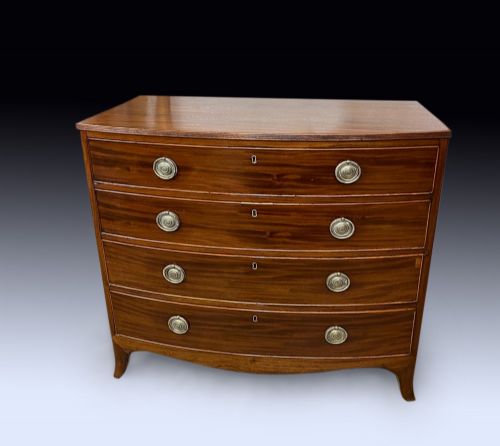


Period Bowfront Chest Drawers
A period bowfront chest drawers brings sculptural curves and deep timber tones to a room.
Period Bowfront Chest Drawers
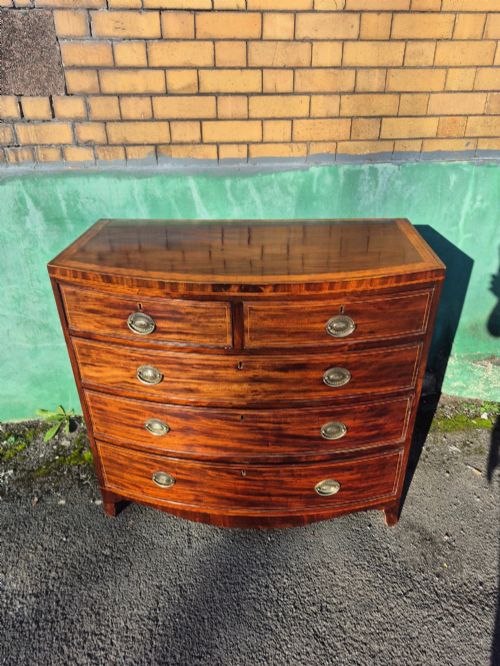
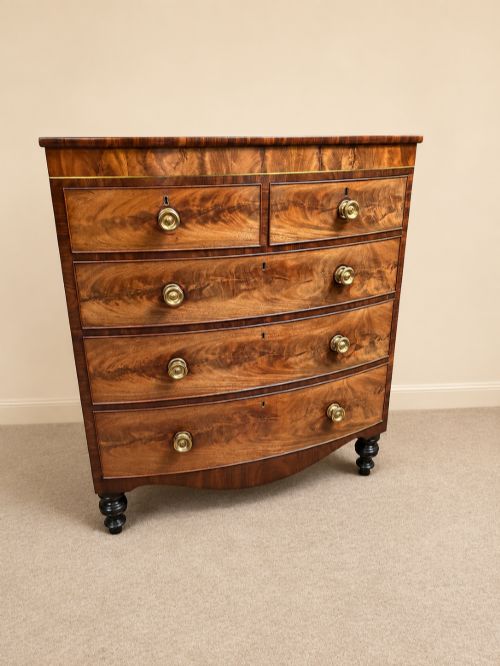
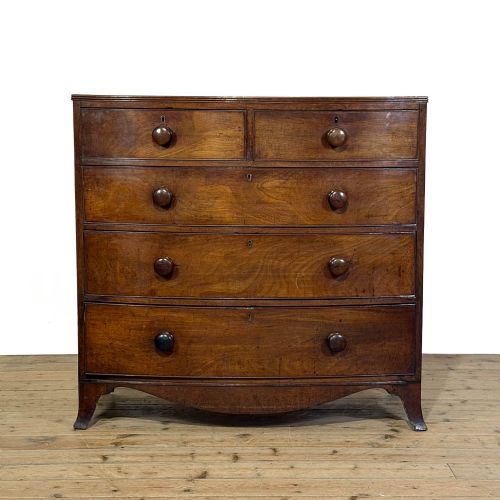
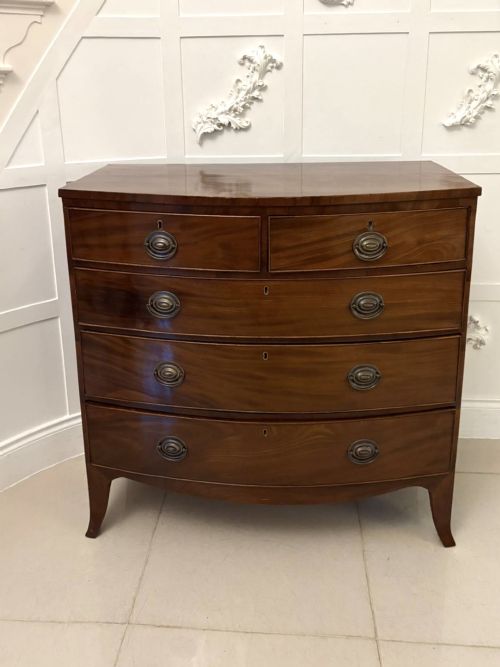
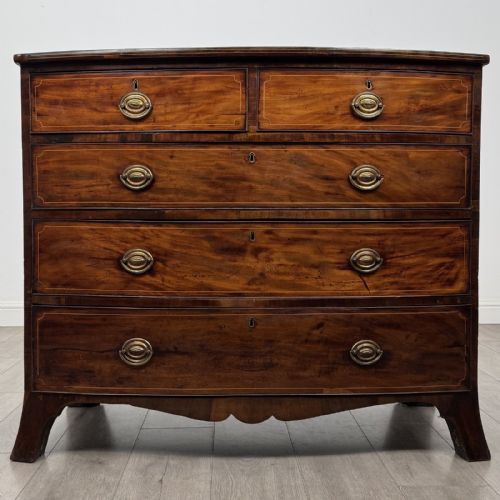
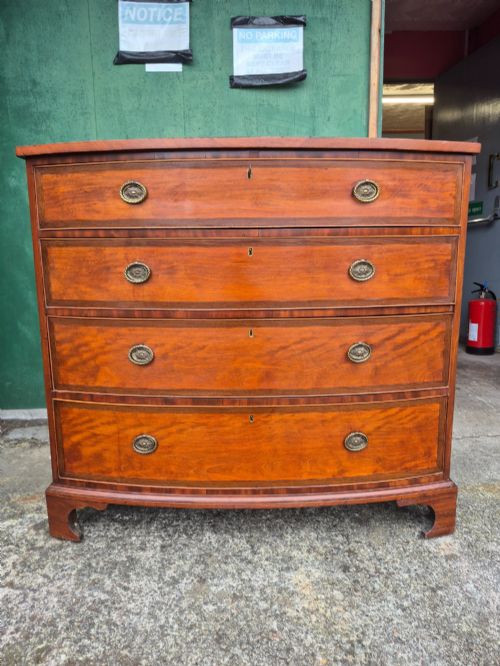
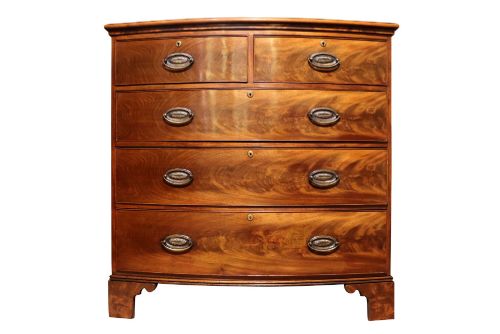
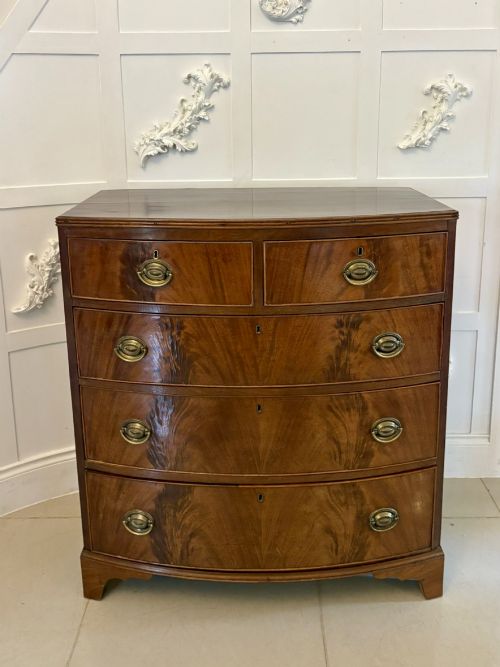
A period bowfront chest drawers is a storage piece defined by its outward-curving front, designed to soften room corners while offering deep drawer capacity. These items emerge frequently in mahogany and satinwood across this selection.
Most examples found here date from the Georgian and Regency eras, with George III and Regency pieces dominating the styles. Makers of these periods favoured figured timbers and subtle proportions.
The inventory ranges from tallboys and commodes to small miniatures and large proportions, though standard chests of drawers remain the most common form.
How they were made
Cabinet makers built these pieces using solid woods and wood veneers laid over pine or oak carcases. Mahogany and satinwood provide the primary visible surfaces.
Decorative details rely on boxwood inlay and contrasting timber borders to frame the curved drawer fronts. Brass handles and escutcheons complete the structural assembly.
Period Bowfront Chest Drawers Retail Price Guide 2026
Typical asking prices for period bowfront chest drawers among the pieces listed under this phrase on Sellingantiques today, from the lower quarter to the upper quarter. They describe what is for sale here now, not the wider market.
One miniature chest waits patiently to hold your smallest secrets.
What varies in quality
Quality rests in the choice of timber figure, such as highly grained mahogany or rich satinwood, and the crispness of the boxwood inlay. Superior pieces display careful matching of wood grain across the curved drawer fronts.
Construction standards show in the thickness of the secondary woods like oak or pine used for drawer linings and carcase backs. Patina and surface preservation distinguish the best preserved survivors.
Gillows
The Period Bowfront Chest Drawers Glossary
- Bowfront
- A convex, outward-curving front profile designed to give cabinet furniture a softer visual line than flat alternatives.
- Tallboy
- A tall storage unit constructed as a chest on chest, providing significant vertical drawer space.
- Commode
- A decorative low chest or cabinet, often finished in fine veneers and delicate inlay work.
- Patina
- The surface sheen and colour depth developed by aged timber through decades of handling and wax polishing.
- Veneer
- A thin layer of figured wood applied over a secondary timber carcase to display decorative grain patterns.
Period Bowfront Chest Drawers: Frequently Asked Questions
Where should I place a bowfront chest?
These pieces suit bedrooms, hallways or living rooms where a curved front softens straight architectural lines. Their depth requires careful measuring against available floor space.
Ensure the drawers have sufficient clearance to pull open fully without obstruction from nearby furniture.
How do I care for antique mahogany?
Maintain the timber by applying a traditional beeswax polish sparingly and buffing with a soft cloth. Avoid placing the furniture in direct sunlight or near heat sources.
Keep room humidity stable to prevent the wood veneers from drying out or lifting over time.
How do I tell Georgian from Regency?
Georgian pieces, particularly from the George III period, often feature understated classical lines and rich dark mahogany tones. Regency furniture tends towards bolder contrasting woods, ebonised details and architectural influences.
Cabinet construction methods and handle styles also help distinguish the transition from eighteenth to nineteenth century work.
What is a miniature chest used for?
Miniature furniture pieces served as apprentice showpieces, salesman samples or delicate table-top storage items. They replicate the exact proportions and construction methods of full-sized chests.
Collectors prize these smaller versions for their intricate detail and ability to fit into compact spaces.