




Pegged Trestle Dining Table
A pegged trestle dining table delivers solid timber construction and honest rustic character, anchoring a room with enduring utility.
Pegged Trestle Dining Table
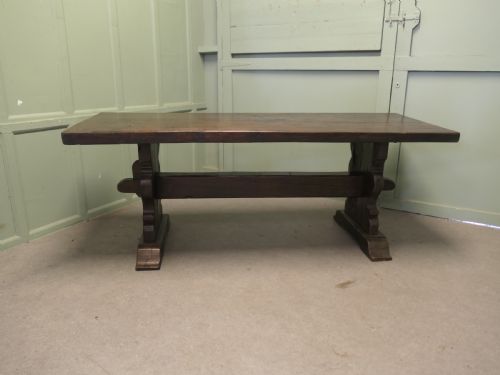
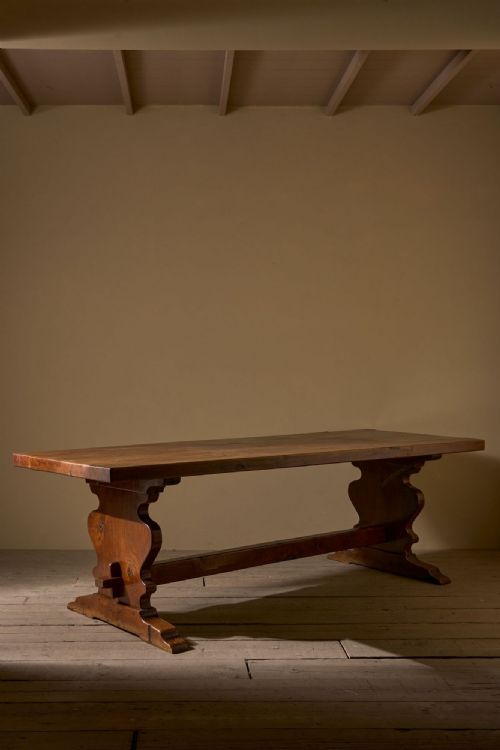
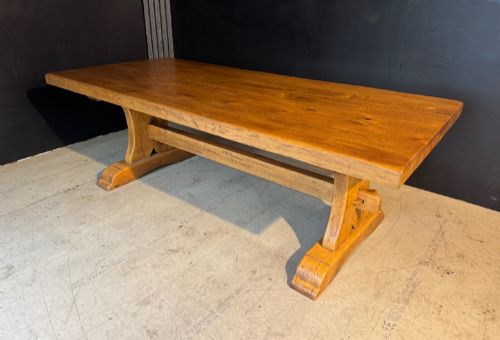
A pegged trestle dining table brings robust timber construction to the dining room, providing a large surface designed for communal meals. These pieces span from seventeenth-century origins through nineteenth-century revivals and early twentieth-century farmhouse interpretations.
The versions most commonly met on this page include French farmhouse refectory forms and traditional English country kitchen tables. Oak dominates the selection, appearing in solid plank top formats supported by heavy trestle bases.
How they were made
Makers built these tables using solid oak timbers, joining large boards to form thick plank tops. Joinery relied on pegged construction, securing the trestle bases and structural supports with wooden dowels rather than modern hardware.
Surfaces received hand-finishing treatments, resulting in textures that range from deep natural oak tones to bleached finishes. The construction method ensures high structural stability while accommodating natural timber movement over centuries.
Listings for pegged trestle dining table span the seventeenth, nineteenth, and early twentieth centuries, utilising solid oak almost exclusively.
What varies in quality
The quality of a pegged trestle dining table rests in the integrity of its timber selection and the precision of its joinery. Superior examples feature thick, unwarped oak plank tops that sit true on substantial trestle bases.
Proportion and execution define the hierarchy between standard country utility pieces and exceptional examples. Finer tables display harmonious scaling between the heavy top and the structural base, utilising traditional pegging that remains tight and undisturbed.
The Pegged Trestle Dining Table Glossary
- Refectory table
- A long dining table traditionally used in monastic dining halls. This form provides substantial length and sturdy construction suitable for large gatherings.
- Trestle base
- A structural support system consisting of two or more vertical frames connected by a horizontal stretcher. It offers maximum legroom along the length of the table.
- Plank top
- A table surface constructed from multiple parallel boards joined edge to edge. Solid timber planks often show natural grain patterns and historical patina.
- Pegged joinery
- A method of securing wood joints using wooden pins instead of metal nails or screws. This technique allows the timber to expand and contract naturally with seasonal humidity changes.
Pegged Trestle Dining Table: Frequently Asked Questions
What is a pegged trestle dining table?
A pegged trestle dining table is a heavy timber dining surface supported by vertical end frames connected by a stretcher. These pieces utilise traditional wooden pegs to secure the structural joinery.
Most examples discovered here date from the seventeenth, nineteenth, and early twentieth centuries, constructed entirely from solid oak.
How do I care for an antique oak table?
Solid oak surfaces respond best to regular dusting with a dry cloth and prompt cleanup of liquid spills. Avoiding harsh chemical cleaners preserves the historical finish and natural timber patina.
Maintaining stable indoor humidity prevents excessive drying or movement in the solid wood top and pegged joints.
How do I identify the period of these tables?
Period identification relies on examining the construction marks, timber characteristics, and style conventions of the base and top. Seventeenth-century examples display distinct hand-carved details and heavy structural timbers, while nineteenth-century pieces often reflect rustic farmhouse or refectory revivals.
Comparing the peg placement and edge profiles helps distinguish authentic early construction from later traditional interpretations.