




Patinated Bronze Garniture
These patinated bronze garniture sets bring heavy nineteenth-century presence to a mantelpiece, pairing dark metal surfaces with ormolu and marble.

Patinated Bronze Garniture
A patinated bronze garniture typically comprises a central clock flanked by matching urns, candelabra, or cassolettes designed to sit together on a mantelpiece. These decorative groupings span the nineteenth century, drawing heavily on Neoclassical, French Empire, Louis XVI, and Rococo Revival idioms.
Most examples found here originate from French workshops and utilise contrasting patinated and gilt surfaces, often mounted on white, black, or siena marble bases. The surviving sets frequently combine timepieces with sculptural urns or candelabra to create a balanced decorative scheme.
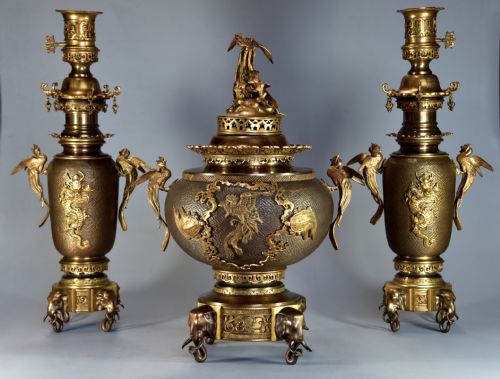
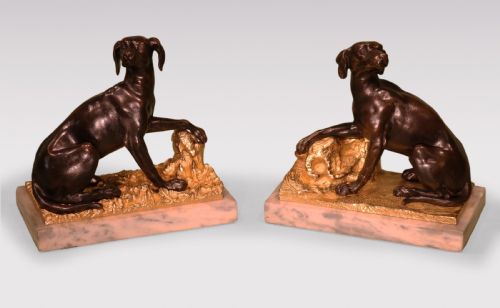
Buyers encounter everything from grand architectural clock sets to pairs of decorative pitchers, incense burners, and animal bronzes. The forms range from strict classical revival to occasional Japonisme and Meiji period Japanese influences.
How they were made
The manufacture of these pieces relied on traditional sand casting or lost-wax casting of bronze, producing robust figures and vessel bodies that were subsequently finished by hand. Artisans applied chemical patination to darken the bronze surface, creating a deep, subdued contrast against brightly polished ormolu and gilt elements.
Many garnitures incorporate architectural plinths and column sections carved from marble, slate, or glass, joined to the metal components with threaded pins and nuts. Ormolu mounts, cast separately and fire-gilt with mercury, were pinned or screwed directly onto the bronze bodies and stone bases.
Watch for nineteenth-century hunting garnitures featuring bronze hounds standing guard over remarkably detailed pheasants.
What varies in quality
The refinement of the chasing separates standard production pieces from the finest workshop outputs, visible in the crispness of acanthus leaves, hair, and drapery folds. Superior examples retain the original variation in their fire-gilt ormolu and deep chemical patination without messy surface repairs.
The choice and execution of secondary materials dictate the tier of a set, distinguishing simple slate bases from richly figured siena or white marble plinths. Cohesiveness across the entire garniture, where urns and candelabra match the central clock in weight, style, and casting quality, marks the superior grade.
Raingo Fres, Paris·Deniere, Paris
The Patinated Bronze Garniture Glossary
- Patinated bronze
- Bronze that has been treated with chemical solutions to alter its surface colour from bright golden-brown to dark brown, green, or near black. This dark finish provides visual contrast against bright ormolu mounts.
- Ormolu
- Finely chopped or ground gold amalgamated with mercury, applied to bronze and heated until the mercury vapourised, leaving a durable gold coating. It is also known as gilt bronze.
- Garniture set
- A coordinated group of ornamental objects, typically a mantel clock paired with matching urns, vases, or candelabra, designed to display together on a fireplace mantel.
- Cassolette
- A decorative vessel, often in bronze or marble, designed with a reversible lid that functions either as an urn or as a candle holder. They are frequently found as the flanking pieces in a garniture.
- Neoclassical
- A style spanning the late eighteenth and nineteenth centuries that revives classical Greek and Roman motifs such as urns, fluted columns, and classical deities. It heavily influences French Empire and Louis XVI design.
Patinated Bronze Garniture: Frequently Asked Questions
Where were these bronze sets made?
The vast majority of nineteenth-century garniture sets originate from Parisian workshops and foundries, which dominated the production of gilt and patinated bronze ornamental work. Makers in Paris supplied wealthy European and international households with high-end decorative art.
Other examples stem from regional European makers, including Italian workshops producing classical revival urns, alongside Japanese bronze items imported during the later nineteenth-century taste for Japonisme.
How do I care for patinated bronze?
Patinated bronze requires minimal intervention; dusting with a soft, dry cloth is sufficient to keep the surface clean. Avoid using metal polishes, abrasive cloths, or chemical cleaners, which can strip away the original dark chemical patination and damage adjacent ormolu.
Marble bases can be wiped gently with a damp cloth and dried immediately. Keeping the pieces away from direct heat sources helps preserve the stability of the stone and metal joins.
How do I tell Empire style from Louis XVI style?
Louis XVI style pieces, dating largely to the nineteenth-century revival periods as well as the eighteenth century, favour restrained classical symmetry, ribbon ties, floral garlands, and slender fluted columns. The overall impression is lighter and more overtly academic.
Empire style draws on heavier Roman, Greek, and Egyptian military motifs, featuring bolder architectural masses, patinated figures with strong profiles, and gilt paw feet or sphinxes. The presence of dense ormolu laurel wreaths and military trophies is typical of the Empire aesthetic.