
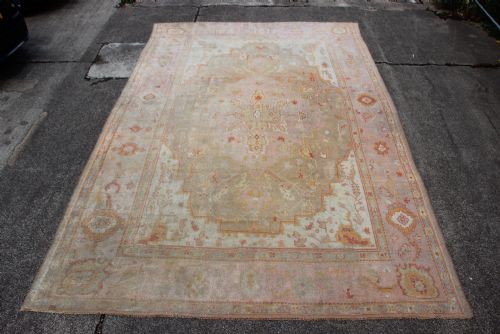
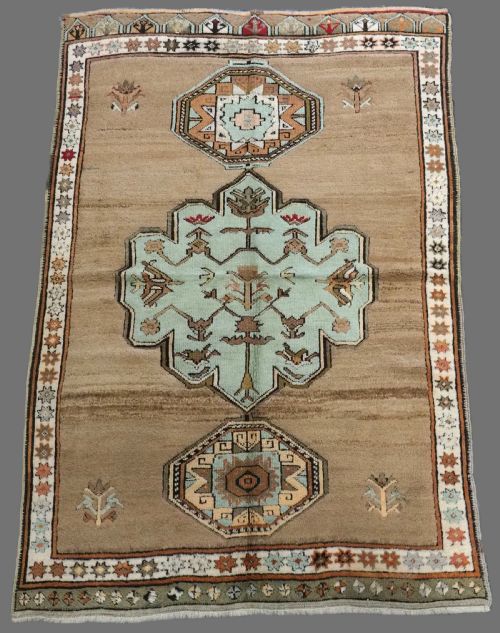


Pastel Wool Area Rug
These pastel wool area rug selections bring muted tones and traditional craftsmanship straight to the floor.
Pastel Wool Area Rug
A pastel wool area rug brings together soft colour palettes and traditional floor coverings from various historical periods. The listings here predominantly feature antique Turkish carpets alongside pieces from Bessarabia, Portugal, and France.
Buyers will encounter large carpets as well as specific regional forms like prayer rugs, kelims, and needlepoints. Dating spans from the mid-nineteenth century through to the mid-twentieth century, dominated by pieces originating around nineteen twenty.
These textiles serve to anchor a room while offering muted pinks, pistachios, and aquamarines rather than saturated primary hues. Each piece reflects the specific regional weaving traditions of its origin, from Oushak to Aubusson.
How they were made
Construction relies primarily on wool, occasionally paired with cotton foundations or camel wool fields depending on the regional workshop. Weavers utilised traditional hand-knotting and flatweaving techniques passed down through generations.
Needlepoint and flatweave variants such as kilims demonstrate distinct textile construction methods separate from piled carpets. Natural dye processes achieved the soft pastel colours seen across the nineteenth and twentieth-century examples.
Camel wool brings a naturally resilient texture to the field, proving that camels make surprisingly good interior designers.
What varies in quality
The refinement of the design execution and the density of the weave set individual pieces apart. Greater precision in the medallion or repeat patterns indicates a higher standard of workshop production.
The stability of the wool and the subtlety of the colour fading determine the enduring appeal of each textile. Superior examples maintain structural integrity while displaying harmonious integration of soft tones across the field.
The Pastel Wool Area Rug Glossary
- Medallion
- A central ornamental motif found in the middle of a carpet field. It usually dictates the symmetrical balance of the entire design.
- Kilim
- A flatwoven carpet or rug produced without a pile. These pieces offer a lighter weight and distinct geometric patterns.
- Prayer rug
- A small textile featuring a mihrab or niche design historically used for kneeling during daily prayers. Their compact dimensions suit specific placement.
- Needlepoint
- Embroidery stitched onto a canvas mesh ground rather than knotted onto a loom. The Portuguese examples utilise this specific technique.
Pastel Wool Area Rug: Frequently Asked Questions
Where should I place a pastel wool area rug?
These rugs suit low-traffic living spaces or bedrooms where the softer pile and muted tones can remain protected from heavy wear.
Their restrained palettes complement neutral interiors without overwhelming surrounding furniture.
How do I care for an antique wool rug?
Regular gentle vacuuming without a rotating brush helps remove embedded dust from the wool fibres.
Professional cleaning is essential for addressing deeper soiling to preserve the historical materials.
What defines an Oushak carpet?
Oushak carpets originate from the historic weaving town in Turkey and typically feature looser knots and larger-scale floral motifs.
They are particularly recognised for their muted, luminous pastel colour schemes.
Are flatweave kilims durable?
Kilims are constructed without piles, making them thinner and lighter than traditional knotted carpets.
They function well in dining areas or hallways when paired with a quality rug underlay.