
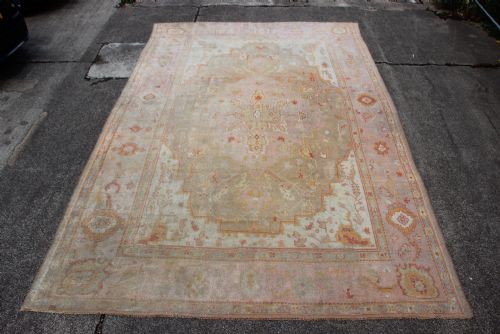


Faded Pink Oriental Rug
These faded pink oriental rugs bring softened pastel tones and grand proportions from nineteenth and early twentieth century looms directly into modern interiors.
Faded Pink Oriental Rug
A faded pink oriental rug represents a grand tradition of weaving originating from Persian and Ottoman workshops. When searching for a faded pink oriental rug, buyers encounter substantial room-sized carpets and smaller floor coverings originating from Turkey and Persia.
The inventory on this page spans distinct periods including the nineteenth century alongside the 1880s, 1890s, 1900s, and 1920s. These pieces include large Oushak, Meshed, Kirman, Bandirma, and Sarouk carpets showing distressed patination and pastel colour palettes.
Most examples found here measure generously, functioning as large area rugs and carpets for principal reception rooms. Their worn surfaces and muted rose hues deliver the distinct aesthetic that collectors seek for domestic spaces.
Materials and construction
These floor coverings are constructed primarily using wool pile knotted onto cotton foundations. The natural resilience of wool allows the pile to wear down gracefully over decades of use, creating the characteristic distressed surface texture.
Weavers in traditional Anatolian and Persian centres utilised natural dyes that soften over time into muted pinks and pastel shades. The density of the knots and the quality of the spinning determine how the foundation holds together as the wool thins.
Listings feature pieces from the 1880s through to the 1920s, constructed entirely from wool and cotton.
Assessing quality and character
Quality in these carpets rests upon the balance between structural integrity and the natural softening of the design. The finest examples maintain a stable cotton foundation even as the wool pile achieves a low, faded patina.
The finesse of the regional design, whether an Oushak medallion or a Sarouk floral layout, dictates the artistic merit of the piece. The uniformity of the distressing across the field separates superior decorative pieces from unevenly worn textiles.
The Faded Pink Oriental Rug Glossary
- Oushak
- A traditional style of Turkish carpet known for large-scale geometric or floral motifs and a softer, lighter colour palette. These originate from the town of Usak in western Anatolia.
- Sarouk
- A type of Persian carpet traditionally woven in the village of Sarouk in west Persia. They are celebrated for dense floral designs and robust wool construction.
- Meshed
- A style originating from the major weaving centre of Mashhad in north-eastern Iran. These large carpets often feature intricate central medallions and detailed floral borders.
- Distressed
- A descriptive term for rugs and carpets showing significant wear and low pile. This condition is prized for its muted appearance and soft integration into contemporary interiors.
- Foundation
- The underlying structure of a woven rug, consisting of warp and weft threads usually made of cotton in these examples. The foundation supports the knotted wool pile.
Faded Pink Oriental Rug: Frequently Asked Questions
Where were these rugs made?
The pieces originate from traditional weaving regions across Turkey and Persia, including Anatolia, Istanbul, and western Iran. Major centres like Oushak and Sarouk developed distinctive local styles that persist in these antique floor coverings.
Different towns utilised specific knotting techniques and local wool varieties that give each rug its regional character. This geographic diversity explains the varied aesthetic between Turkish Oushaks and Persian Sarouks.
How do I date an old rug?
Dating relies on examining structural materials, dye technology, stylistic motifs, and the specific wear patterns accumulated over time. Nineteenth and early twentieth century pieces display characteristic handling of wool and natural colour fading that differs from later reproductions.
Comparing the knot density and design symmetry with documented examples from periods like the 1880s or 1920s helps establish an accurate timeframe. Subtle shifts in regional design traditions also serve as reliable chronological indicators.
Are these carpets suitable for heavy traffic?
Many of these room-sized carpets were built for durability using robust wool and cotton materials, making them well-suited for living spaces. Even with a distressed surface and low pile, traditional construction methods provide lasting structural strength.
Using a quality underlay helps absorb foot impact and prevents the rug from slipping on hard floors. This simple addition significantly extends the active lifespan of older textiles in busy rooms.