
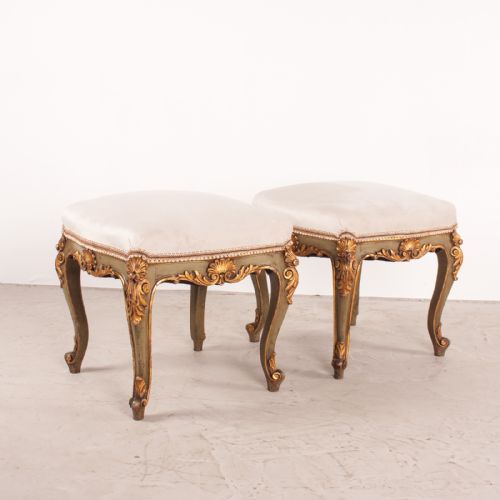
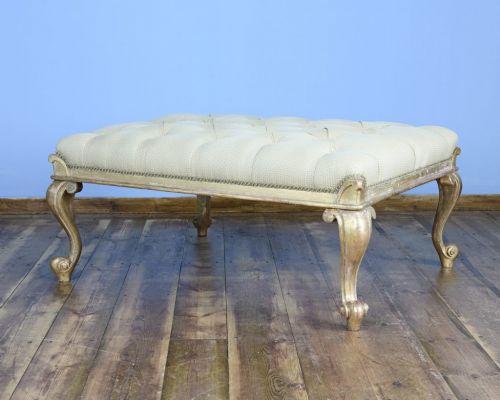


Parcel Gilt Stool
A parcel gilt stool brings a flash of metallic warmth to a room, catching the light against painted or dark wood surfaces.
Parcel Gilt Stool
A parcel gilt stool combines exposed wood with selective gilding, highlighting carved details against a painted, ebonised or polished ground. When you search for a parcel gilt stool, you encounter low footstools, longer window seats and substantial X-frame forms spanning the Regency, Victorian and later nineteenth-century periods.
The surviving pieces demonstrate a range of continental and British influences, from Gustavian white-painted Swedish seats to Italian Rococo and Empire creations. Footstools and dressing stools appear frequently, alongside pairs of window seats designed to sit beneath large apertures.
How they were made
Carved wood forms provide the structural foundation, utilising timber such as walnut, mahogany, satinwood or beech. Artisans applied gold leaf selectively to raised mouldings, leaf motifs and structural joints, leaving the underlying painted or polished grain visible elsewhere.
Upholstery completes the construction, historic examples arriving with silk, velvet or woven fabric stretched over traditional webbing and stuffing. Paintwork ranges from solid ebonising to polychrome decoration and pale Swedish finishes.
Listings feature walnut, mahogany, satinwood and beech timbers alongside painted and ebonised finishes across nineteenth-century styles.
What varies in quality
Quality rests in the crispness of the timber carving and the precision of the gilding application. Superior examples display sharp relief work where the gold leaf catches the eye, set against well-balanced proportions in frame architecture like the X-frame or curule shape.
The integrity of the underlying wood and the restraint of the decorative scheme distinguish finer salon and dressing pieces from simpler utilitarian seating. Original painted or gilded surfaces hold greater visual harmony than later re-finishes.
Miles & Edwards
The Parcel Gilt Stool Glossary
- Parcel Gilt
- A method of gilding only specified parts of an object rather than the whole surface. This technique highlights carved details, mouldings and edges against a contrasting wood or painted background.
- Giltwood
- Timber that has been entirely covered with a thin layer of gold leaf or powder. It provides a rich, reflective finish seen on frames from the eighteenth century onwards.
- X Frame
- A structural chair or stool base formed by intersecting diagonal legs resembling the letter X. Ancient Roman curule chairs inspired this enduring profile.
- Gustavian
- The Swedish interpretation of French neoclassical style, characterised by pale painted finishes and restrained carving. These pieces often feature soft grey, cream or white tones.
- Ebonised
- Wood treated with a chemical stain, dye or black paint to imitate expensive ebony. It creates a stark, dark contrast when paired with parcel gilt highlights.
Parcel Gilt Stool: Frequently Asked Questions
Where should I put a parcel gilt stool?
These stools work well placed at the end of a bed, beneath a window seat, or pulled up to a dressing table. Their metallic highlights suit rooms with traditional or eclectic interior schemes.
Because many examples are compact footstools or long benches, they tuck easily into alcoves or serve as flexible extra seating when guests arrive.
How do I care for the gilded surface?
Gold leaf is delicate and requires gentle treatment to preserve its metallic sheen. Dust the carved areas lightly with a soft, dry brush rather than wiping them with damp cloths.
Keep gilded furniture away from direct sunlight and heat sources to prevent the underlying wood and gesso from drying out or cracking.
Are these stools comfortable to sit on?
Comfort depends entirely on the upholstery padding and the original purpose of the specific piece. Dressing stools and window seats were built for sitting, whereas low footstools are designed to support feet rather than body weight.
Many antique examples retain period upholstery, while others have been recovered in silk or velvet to suit modern interiors.
How can I tell the period of a stool?
Dating relies on stylistic clues, such as the curved X-frames of the Regency era or the dark ebonised finishes favoured during the Victorian period. Swedish Gustavian pieces display characteristic pale painted woodwork from the nineteenth century.
Examining the construction methods, joinery and timber types beneath the upholstery provides further evidence of age.