


Paper Watercolour Harbour Scene
A paper watercolour harbour scene captures coastal life and maritime activity through fluid pigment on paper.
Paper Watercolour Harbour Scene
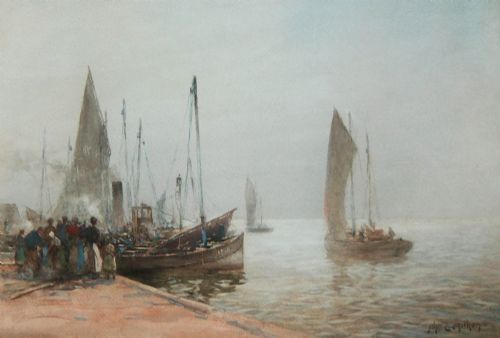
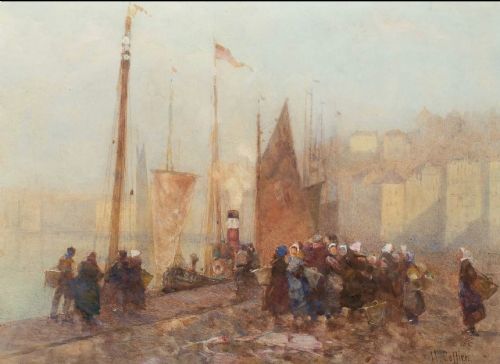
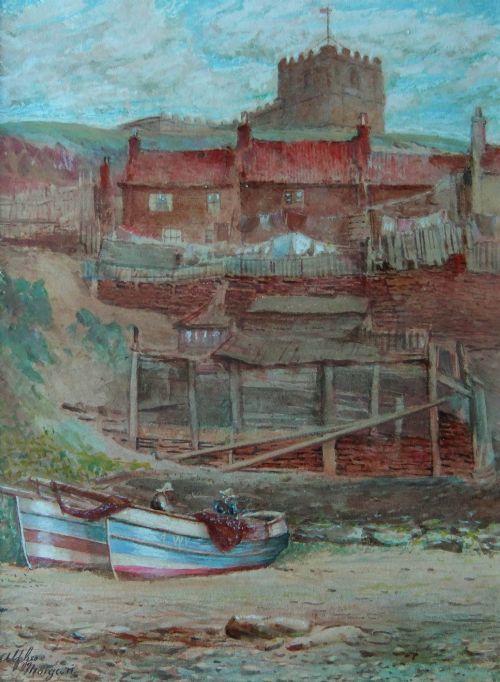
A paper watercolour harbour scene presents coastal views, fishing ports, and maritime activity recorded directly from British and European locations. These works range from late Victorian and Edwardian depictions to mid twentieth century interpretations.
The most common examples on this page depict specific fishing ports and coastal towns such as Whitby, St Ives, and Mousehole. Painters observed local docks, moored boats, and returning fleets with descriptive precision.
The selection encompasses paintings and framed artwork spanning the nineteenth century through the nineteen fifties. Artists utilised traditional watercolour pigments on paper, frequently supplemented by ink and woodblock elements.
Materials and Technique
Watercolour pigment applied to paper forms the primary medium for these coastal and marine views. Painters utilised the absorbent qualities of paper to create luminous washes that represent water, sky, and atmospheric weather.
Many works incorporate ink lines and pigment variations to define architectural details of harbour buildings and the rigging of boats. Framing behind glass protects the delicate paper surface from atmospheric moisture and handling.
Wood frames enclose the majority of these watercolours, often complementing the palette of the painting within. The combination of pigment, paper, and protective glass reflects standard framing practices of the nineteenth and twentieth centuries.
Materials documented across these entries include paper, watercolour pigment, ink, wood, and glass.
Distinction in Quality
Quality rests upon the artist's command of the watercolour medium and the precision of perspective within a harbour scene. Superior works display confident brushwork that captures the movement of water and the play of light on docked vessels.
The clarity of the topographical recording and the preservation of pigment vibrancy distinguish finer examples. Works that retain their original colour saturation without excessive fading demonstrate superior storage conditions over decades.
James E Aitken·Hector Caffieri·Alfred G Morgan·George F Pennington·Paul Delvaux·Fred Lawson·William Tuck·James Thomas Watts·Kate E Booth·Ernest F Hill·Frederick Stuart Richardson·Percy Brooke·Ralph Todd·Rowland Henry Hill·Frank W Scarborough·Harry Wanless·Thomas Clavering Alder·Walter Sweet·Frank Rousse·William Collins·Robert Leslie Howey·R Goodhind
The Paper Watercolour Harbour Scene Glossary
- Watercolour pigment
- Finely ground colour particles mixed with a water-soluble binder for painting on paper. This medium allows for transparent washes that capture light and atmosphere.
- Marine watercolour
- A painting executed in watercolour that focuses on the sea, ships, or coastal subjects. These works frequently document historical ports and maritime vessels.
- Woodblock print
- An image printed from a carved block of wood, sometimes found alongside watercolour paintings in early twentieth century portfolios. This technique allows for graphic pattern work within a composition.
- Edwardian maritime
- A stylistic designation for works produced during the reign of King Edward VII that depict coastal and shipping subjects. These paintings often emphasise tonal harmony and naturalistic light.
Paper Watercolour Harbour Scene: Frequently Asked Questions
What subjects appear in a paper watercolour harbour scene?
These works depict coastal views, fishing docks, moored boats, and architectural landmarks in seaside towns. Common locations include Whitby, St Ives, and Mousehole.
Artists recorded the daily routines of fishermen, returning fleets, and tidal changes along the British coast and European shores.
How do I care for a watercolour on paper?
Watercolour paintings require protection from direct sunlight to prevent pigment fading and paper degradation. Displaying them behind glass in a stable environment safeguards the surface.
Avoid hanging these works in areas with high humidity to protect both the paper support and the framing materials.
How can I date a marine watercolour?
Dating relies on stylistic markers, artist signatures, framing materials, and inscribed location notes on the mount or reverse. Victorian works often show tighter detail, while twentieth century examples display looser brushwork.
Signatures and dates written by the artist provide the most direct evidence of the creation period.
What is British Impressionism in these watercolours?
British Impressionism involves looser brushwork and a focus on natural light and atmospheric effects rather than rigid academic detail. Painters used these techniques to capture shifting weather over harbours.
This style emerged strongly in the late nineteenth and early twentieth centuries among coastal artist colonies.