
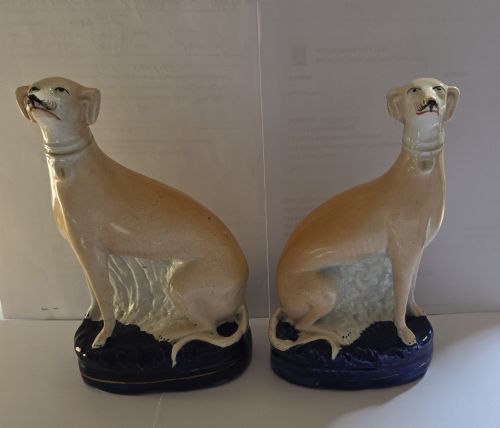


Pair Seated Figurines
Pair seated figurines bring character to a room, offering matched domestic dogs, musical figures, and carved wood studies from the nineteenth and early twentieth centuries.
Pair Seated Figurines
When you search for pair seated figurines, you encounter matched groupings of two distinct pieces designed to balance a mantelpiece, shelf, or table. The evidence on this page is dominated by nineteenth-century Staffordshire spaniels and whippet dogs sitting upright, alongside musical figures, putti bookends, piano babies, and carved Yoruba wood figures of seated men and women.
Most examples you meet here are Victorian ceramics, particularly earthenware and bisque porcelain, though you also find carved wood and metal elements. These objects span from the 1870s through to the 1940s, reflecting both British pottery traditions and international sculptural forms such as Victorian orientalism and Yoruba tribal art.
Materials and manufacture
Potters shaped these earthenware and porcelain pieces using traditional ceramic techniques, applying surface colour through glazes and enamels, often accented with gilt highlights. Bisque porcelain provided a smooth, unglazed matte finish favoured for detailed figures like piano babies and cherubs.
Wood pieces rely on hand carving, as seen in the carved Yoruba figures depicting male and female subjects seated on stools. Metal and ceramic combinations appear in bookends and decorative objects, using the weight of the material to anchor the sculpture.
Stiff ceramic spaniels kept watch over Victorian mantelpieces, occasionally doubling as musical boxes to entertain the parlour.
Assessing quality
In carved wood and bisque porcelain, the depth of the carving and the subtlety of expression dictate the standing of the piece. Stronger examples display balance and proportion across both halves of the pair, maintaining symmetry without feeling rigid.
Royal Doulton
The Pair Seated Figurines Glossary
- Bisque porcelain
- Unglazed fired ceramic that has a matte, biscuit-like surface texture. It allows for fine detail in figurative sculpture.
- Staffordshire
- Pottery manufactured in the Staffordshire region of England. Famous for popular animal figures and Staffordshire spaniels.
- Earthenware
- Porous pottery fired at lower temperatures, commonly used for nineteenth-century domestic figures and dogs.
- Piano baby
- A decorative porcelain figure placed on piano tops during the Victorian and Edwardian eras. They are frequently modelled in reclining or seated poses.
- Gilt
- A thin layer of gold or gold-like material applied to surfaces. Used here to highlight collars, bases, or decorative trims.
Pair Seated Figurines: Frequently Asked Questions
What are pair seated figurines?
These are matching sets of two decorative sculptures depicting people, animals, or mythological figures in sitting poses. They are typically designed to sit symmetrically on either side of a fireplace or shelf.
The listings here feature nineteenth-century Staffordshire dogs, carved wooden figures, and musical porcelain groups from various British and international origins.
How were Staffordshire spaniels displayed?
Staffordshire spaniel pairs were traditionally placed on cottage mantelpieces facing inward toward each other. They often stood guard on either side of the hearth.
Collectors still display them in pairs on shelves and sideboards to recreate this traditional domestic arrangement.
What is a piano baby?
Piano babies are ceramic or bisque figures that Victorian households placed on the polished wood of upright pianos. They were usually unglazed bisque porcelain and depicted children or animals in relaxed poses.
Today, they are collected as decorative cabinet or shelf ornaments rather than functional musical accessories.
How do I date Victorian ceramic figures?
Dating relies on stylistic clues, manufacturing methods, and the type of glaze or enamel used. Mid-nineteenth-century earthenware often shows simpler hand-painting and heavier potting.
Later Victorian and early twentieth-century pieces, such as bisque piano babies, feature finer modelling and different surface textures.