

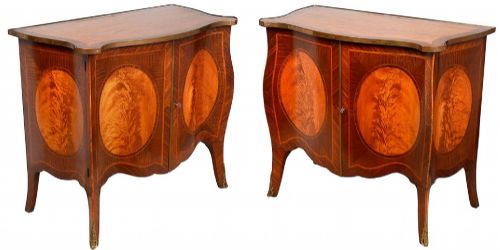


Pair Satinwood Side Cabinets
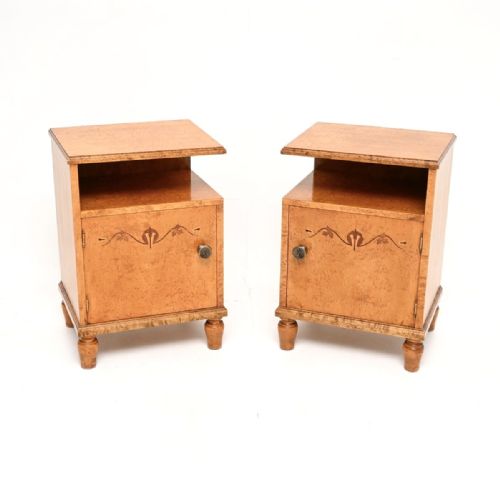
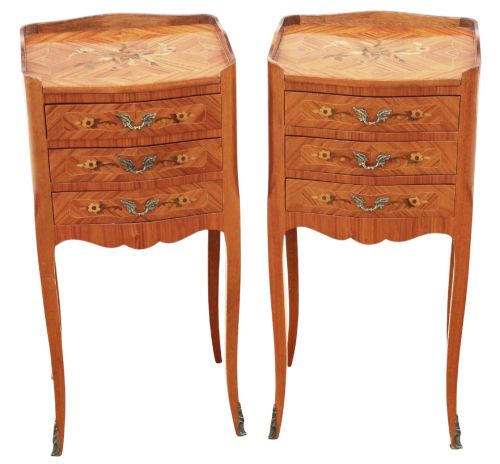
These pair satinwood side cabinets bring light grain and symmetry to a room, offering matched bedside storage rooted in nineteenth and twentieth-century revivals.
Pair Satinwood Side Cabinets
When you search for pair satinwood side cabinets, you encounter matched sets designed for dual bedside or small room placement. The selection spans the nineteenth century through the 1930s, encompassing Edwardian pieces, Victorian examples, and interwar modernism.
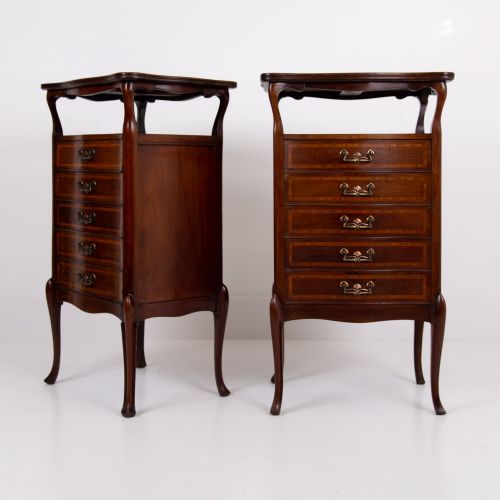
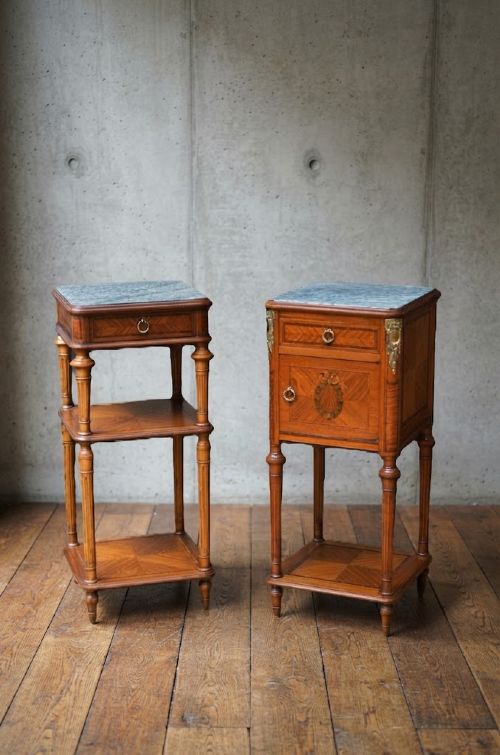
Bedside cabinets and commodes dominate the forms, alongside occasional pier cabinets and bowfront chests. Revival tastes shape much of the stock, drawing on Sheraton, Adam, and Louis XVI idioms for decorative vocabulary.
Proportions remain compact to suit domestic chambers, frequently incorporating cupboards with drawers above. French and English workshops both contribute significantly to the surviving record.
Materials and Construction
Timbers combine satinwood veneers applied over structural carcasses of mahogany, walnut, or birch. Marquetry and crossbanding frequently integrate kingwood, rosewood, and other contrasting veneers into geometric or floral motifs.
Hardware relies on cast brass handles and escutcheons, while select pieces incorporate marble tops for durability. Hand-painted detailing and marquetry add surface ornamentation without altering the underlying cabinetwork.
Listings demonstrate a strong representation of Art Deco designs alongside Edwardian Sheraton revivals.
Quality and Execution
Excellence rests in the crispness of the marquetry and the book-matching of the satinwood grain across both doors. Superior examples maintain exact symmetry between the pair, with consistent fading and colour retention in the timber.
The finesse of the secondary timbers and the precision of the brass mounts distinguish standard production from superior cabinetmaking. Interior construction, dovetail joints, and original drawer linings reveal the standard of workshop execution.
Edmond Poteau·Waring & Gillows·M. Woodburn·Maple & Co
The Pair Satinwood Side Cabinets Glossary
- Satinwood
- A lustrous tropical timber with a fine grain and pale yellow colour, used extensively for veneers and stringing. It forms the primary visual surface on these cabinets.
- Marquetry
- The art of applying pieces of veneer to a structure to form decorative patterns and pictures. It appears frequently on revival pieces.
- Crossbanding
- A border strip of veneer laid around the perimeter of a panel so the grain runs at right angles to the central field. This technique frames the satinwood surfaces.
- Serpentine
- A shape of furniture front or top that curves inward centrally and outward at the sides. It demands skilled woodworking to execute cleanly.
- Pier Cabinet
- A narrow cabinet designed to stand against a wall space between windows. These are often glazed or fitted with fine marquetry doors.
Pair Satinwood Side Cabinets: Frequently Asked Questions
How do I match these cabinets to a modern bedroom?
The pale, reflective quality of the timber allows these cabinets to sit comfortably against neutral walls and contemporary textiles.
Their compact scale means they function well beside modern bed heights without overwhelming the room.
Were these always made as matched pairs?
Cabinetmakers produced matching sets specifically for dual bedside placement, ensuring uniform grain and height.
Finding surviving pairs from the nineteenth and early twentieth centuries remains a significant advantage for symmetry.
How should I care for satinwood surfaces?
Keep the timber away from direct sunlight to prevent the pale yellow grain from darkening unevenly over time.
Apply a traditional wax polish sparingly to maintain the sheen without building up heavy residues.
What is the difference between a commode and a bedside cabinet?
Period commodes typically feature wider proportions and deeper drawer configurations derived from eighteenth-century French forms.
Bedside cabinets are scaled specifically for holding small night items and enclosing chamber storage.