


Pair Painted Chests Drawers
These pair painted chests drawers bring balanced symmetry and decorative surface colour to a room, whether in the form of compact bedside tables or larger bedroom chests.
Pair Painted Chests Drawers
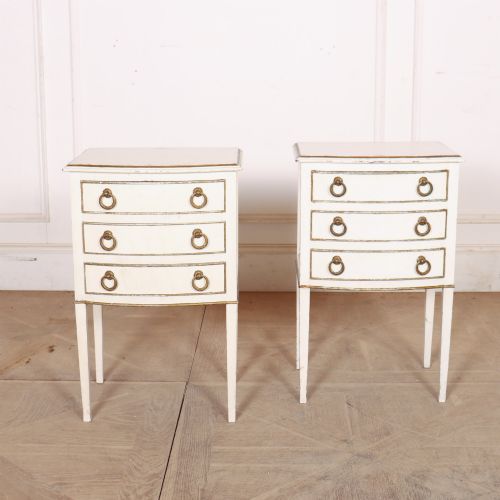
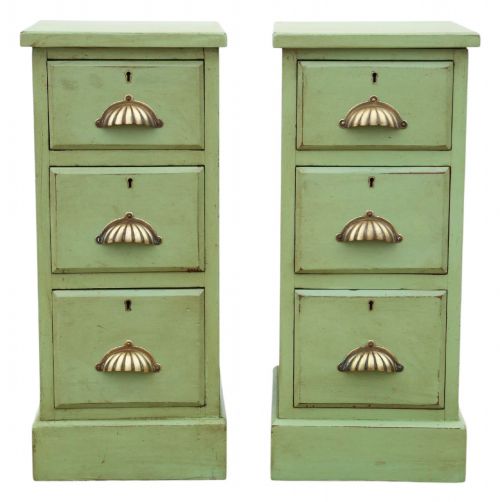
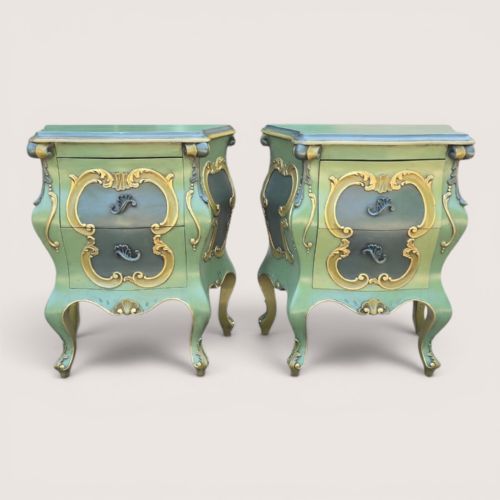
When you search for pair painted chests drawers, you encounter coordinated sets of two storage items finished with pigment rather than exposed grain. These pieces range from substantial nineteenth-century storage to smaller bedside chests and lamp tables.
You will find formats varying from two-drawer commodes to taller five-drawer chests. The most common manifestations on this page are French bedside chests and nineteenth-century Swedish painted commodes.
How they were made
The construction relies primarily on pine and softwood carcasses built to hold multiple drawers. Workshops applied layers of paint over the timber, sometimes utilising gilt moulding, brass handles, or faux marble tops to achieve decorative finishes.
Surface preparation involved hand-painting techniques in colours such as white, green, blue, and black. Cabinetmakers combined traditional joinery with decorative paint applications to create durable bedroom furniture.
The listings span nineteenth-century Swedish commodes, Edwardian country pieces, and 1920s French bedside tables constructed from painted softwood and pine.
What varies in quality
The distinction between standard examples and the finest pieces rests upon the execution of the painted finish and the integrity of the proportions. Superior items display harmonious colour application and refined decorative details such as gilt highlights or fitted marble tops.
Construction standards also set pieces apart, particularly the smoothness of drawer movement and the stability of the timber frame. Original painted surfaces carry more substance than later decorative additions.
The Pair Painted Chests Drawers Glossary
- Commode
- A low chest of drawers or cabinet originating in France. These pieces typically feature multiple drawers and decorative painted surfaces.
- Gustavian
- The Swedish neoclassical style developed during the reign of King Gustav III. It is characterised by restrained classical ornamentation and pale painted finishes.
- Faux marble
- A decorative painting technique used to imitate the appearance of real stone. Artisans apply pigments to wood surfaces to simulate marble graining, often found on tabletops.
- Softwood
- Timber derived from conifers such as pine, used widely for the construction of painted furniture. It provides a stable base for layered paint applications.
Pair Painted Chests Drawers: Frequently Asked Questions
How do I style a pair of painted chests?
Matching chests work effectively when placed symmetrically on either side of a bed or used to anchor opposite walls in a room. Their painted surfaces allow them to introduce a specific accent colour or soften a neutral interior scheme.
Because these sets include two matching items, they create visual balance without requiring heavy dark wood tones. Pairing them with simple accessories lets the painted finish remain the focal point.
What is a Gustavian chest?
A Gustavian chest reflects Swedish neoclassical design from the late eighteenth century, known for lighter proportions and subdued ornamentation. These pieces often feature fluted columns, carved rosettes, and pale grey or white paint.
Later nineteenth-century interpretations continued this aesthetic, combining functional storage with clean, balanced lines. They suit interiors that benefit from bright, reflective painted surfaces.
Are these chests made of solid pine?
Most of the painted chests and commodes use softwood or pine as their primary timber construction. This material was chosen for its accessibility and suitability for receiving paint layers.
Over decades, the underlying timber adapts to indoor environments while the painted surface develops a natural patina. This combination of softwood structure and pigment finish defines country furniture traditions.
What is a faux marble top?
A faux marble top is a painted wooden surface treated to resemble natural stone. Craftspeople used brushwork to replicate the veining and depth of marble on the top boards of chests and commodes.
This technique offered a decorative surface that was lighter and more affordable than genuine stone slabs. It appears frequently on nineteenth-century European storage furniture.