

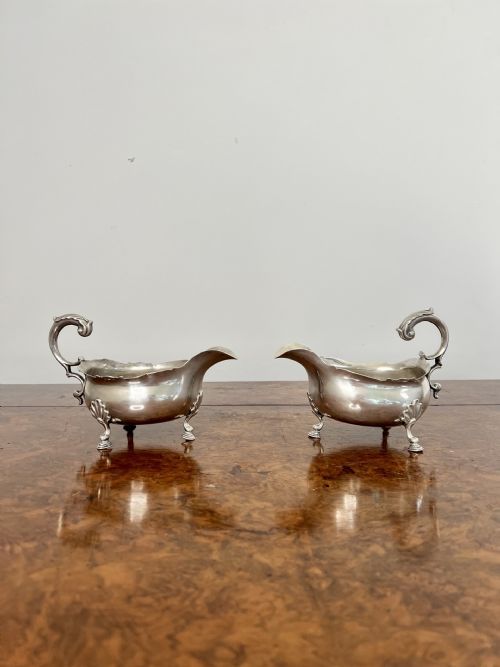


Pair of Silver Boats
These pair of silver boats bring practical elegance to the dining table, offering paired service for sauces, gravies and condiments across several centuries.

Pair of Silver Boats
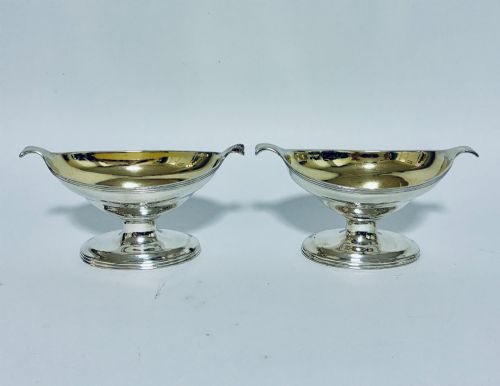
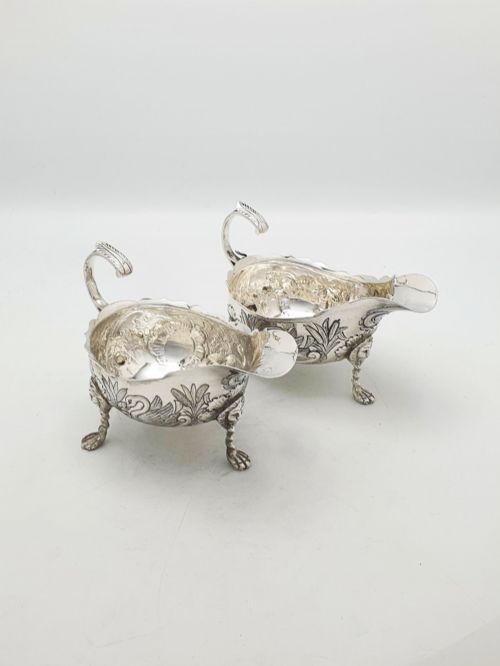
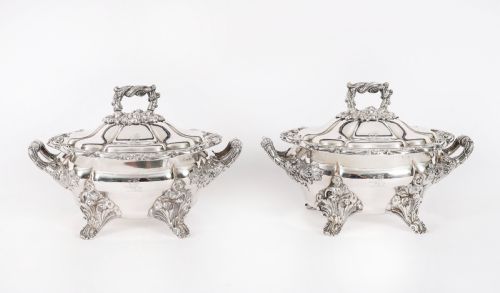
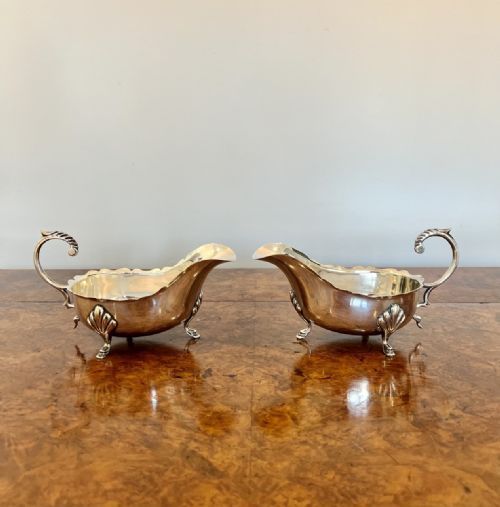
When you search for a pair of silver boats, you enter a domain dominated by sauce boats, gravy boats and salt boats designed for symmetrical table service. The examples you meet on this page range from solid sterling silver pieces produced during the Georgian and Victorian eras to silver plated and Old Sheffield plate variations from the twentieth century.
Makers shaped these vessels into graceful boat forms, often elevating them on pedestals, scroll feet or acanthus claw mounts. Alongside traditional sauce jugs, you find salt cellars equipped with blue glass liners and occasional nautical or decorative variants such as ship's gimbal lights.
The materials span solid silver, sterling silver, silver plate, copper, electroplated nickel silver and gilt finishes. Surviving pieces reflect stylistic shifts from the restraint of George III through Victorian elaboration to Edwardian and Art Deco refinement.
Methods and materials
Silversmiths utilised sterling silver and solid silver for high-status commissions, hammering, casting and soldering metal into distinct hull shapes. Handles were frequently cast separately in scroll or loop configurations and soldered securely to the main body.
Plated alternatives relied on Old Sheffield plate or silver plate over copper, fusing thin layers of silver to base metals before shaping and engraving. Details such as ornamental leaf motifs, shell-shaped bowls and beaded rims were stamped or chased by hand.
Some nineteenth-century makers styled salt boats as miniature sleighs, adding winter charm to formal dining.
Distinctions in quality
Quality rests upon the weight of the metal, the crispness of chased ornament and the balance of the vessel on its feet or pedestal base. Solid sterling silver vessels by recorded makers display heavier gauge metal and more precise hand-formed detailing than standard plated wares.
The integrity of applied borders, handles and cast feet indicates the level of craftsmanship involved. Pieces retaining original components, such as matching blue glass liners in salt boats, demonstrate superior preservation.
William Grundy·Abraham Portal·William Collins·Francis Higgins·Mappin & Webb·Walker & Hall·Marples & Co·William Neale Ltd·Asprey
The Pair of Silver Boats Glossary
- Salt boat
- A small vessel shaped like a boat, designed to hold table salt alongside dining settings. These often feature removable glass liners in cobalt or other colours.
- Old Sheffield plate
- An early plating technique fusing a thin sheet of silver onto a copper core. This method predates modern electroplating and leaves characteristic copper edges visible upon close inspection.
- Sauce boat
- A container with a lip and handle utilised for serving gravies, sauces or melted butter. They appeared in various sizes from the eighteenth century onward.
- Gilt
- A thin layer of gold applied to the interior or surface of silver objects. This technique protected the silver from corrosive food acids.
- Gimbal
- A pivoted ring mounting that allows an object such as a lamp to remain level regardless of movement. These appear in maritime pieces.
Pair of Silver Boats: Frequently Asked Questions
What were pair of silver boats used for?
These vessels served dining tables by holding gravies, sauces, melted butter or salt. Pairs allowed symmetrical placement at opposite ends of a large table or buffet.
Over generations, their function shifted from active dining service to decorative display and collection. They remain versatile receptacles for modern table settings.
How do I identify Georgian examples?
Georgian pieces generally exhibit clean neoclassical lines, cast pedestal feet and plain or lightly chased bodies. Maker's marks and town hallmarks stamped into the base confirm the period.
Later Victorian and Edwardian iterations often introduce heavier ornamentation, such as acanthus leaves, shell motifs and scroll handles.
Are plated versions antique?
Many plated versions date from the nineteenth and early twentieth centuries, utilising Old Sheffield plate or early electroplating techniques. These possess genuine age and historical manufacturing methods.
Makers such as Mappin & Webb and Walker & Hall produced high-quality plated wares that match the elegance of solid silver.
How should I clean silver boats?
Maintain silver surfaces with a soft cloth and a gentle, non-abrasive silver polish formulated for antiques. Avoid harsh chemical dips that strip patination from recessed details.
If the piece includes glass liners, remove them before cleaning the metal frame to prevent moisture damage.