
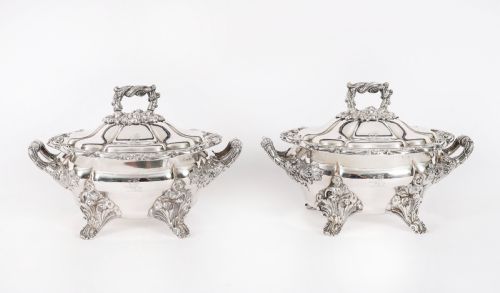


Pair of Tureens
A pair of antique tureens brings symmetry and gravitas to a dining table, offering dual vessels for sauces, soups and entrees.
Pair of Tureens
A pair of antique tureens consists of matched lidded vessels designed for serving food at the dining table, encompassing forms from small sauce tureens to large entrée dishes. These pieces appear across several eras, with the nineteenth century and the Georgian period supplying the majority of examples on this page.
Buyers encounter these matched sets in ceramics such as ironstone, porcelain and faience, alongside metalwork including sterling silver, silver plate and Old Sheffield plate. Forms range from oval lidded sauce tureens with matching ladles to warming dishes and porcelain chestnut baskets with covers.
Origins vary widely across the inventory, spanning English workshops, Scottish makers, and continental European traditions such as Spanish Talavera and French Sèvres style ceramics. Each pair reflects the dining customs of its era, intended to hold heat and present food with elegance.
Materials and construction methods
Metal vessels rely on silversmithing techniques, utilising sterling silver, silver plate, copper bases in Old Sheffield plate, and nickel silver. Makers shaped these metals into oval and pedestal forms, incorporating soldered handles, applied borders, and lidded structures designed to retain heat.
Ceramic examples employ clay bodies such as ironstone and porcelain, shaped through moulding and throwing before receiving hand-painted decoration, polychrome faience, glaze, and occasionally gold leaf highlights. Firing processes fix the pigments and glazes to create durable serving vessels for daily or formal dining.
Listings feature silver plate, ironstone, copper, and sterling silver across eighteenth and nineteenth century periods.
Markers of quality and craftsmanship
Quality rests upon the crispness of the casting in metalwork and the definition of moulded details in ceramics. Superior pairs exhibit finely chased mounts, well-fitted lids that sit flush, and balanced handles that display deliberate proportion rather than heavy, uniform casting.
Decoration dictates value in the ceramic pieces, where hand-painted polychrome enamel work, precise gilding, and clean transfer printing distinguish finer workshop output from standard production. Maker marks, hallmarks, and silversmith signatures further separate standard commercial items from distinguished atelier commissions.
William Grundy·Hamilton & Inches·Edward & John Barnard·Flight Barr & Barr·Walker and Hall·Elkington·Matthew Linwood·Cresswick·Dan Holy·Tiffany & Co
The Pair of Tureens Glossary
- Entree dish
- A shallow, rectangular or oval serving vessel with a fitted lid, often featuring a removable handle to allow the base to function as two separate dishes.
- Old Sheffield plate
- A composite material made by fusing a thin sheet of sterling silver to a thicker copper base before rolling them together into sheets for manufacturing. This technique precedes modern electroplating and leaves characteristic edges where the copper shows.
- Ironstone
- A heavy, durable type of earthenware patented in the nineteenth century to imitate Chinese porcelain. It resists chipping and forms the sturdy body of many utilitarian and decorative dining sets.
- Faience
- Tin-glazed earthenware produced in continental Europe, typically decorated with painted pigments on an opaque white glaze. These pieces often feature vibrant polychrome designs.
- Sauce tureen
- A miniature version of the dining table tureen, specifically scaled for gravies and sauces and frequently accompanied by its own small ladle and fixed underplate.
Pair of Tureens: Frequently Asked Questions
What is the difference between an entree dish and a sauce tureen?
An entree dish is a shallow, wide vessel designed for main course portions or side dishes, usually with a handle that allows the cover to double as a second dish. A sauce tureen is much smaller and deeper, intended specifically for holding gravy or liquid accompaniments at the table.
While both appear in matched pairs, their distinct capacities reflect different roles in historic dining service where liquids and solids required separate containment.
How were silver plated tureens made before modern electroplating?
Earlier metal pieces utilise Old Sheffield plate, a material created by fusing sterling silver to a thick copper ingot and rolling them into sheets. This leaves a subtle line of exposed copper at the cut edges.
Later Victorian pieces rely on electroplating, a chemical process that deposited a thin layer of pure silver over a base metal like nickel silver or brass.
Can antique ceramic tureens still be used for serving food?
Many ironstone and porcelain pieces remain structurally sound for serving dry foods or warmed items, provided they are washed by hand rather than placed in a dishwasher. Historic glazes and painted enamels can degrade with harsh modern detergents.
Buyers should inspect the interior glaze for crazing or staining that might absorb liquids over time before using them for wet dishes.
How do I date a silver plated tureen without hallmarks?
Dating relies on the style of the mounts, the manufacturing technique, and any registry marks stamped into the base. Old Sheffield plate generally points to the late eighteenth or early nineteenth century.
Victorian electroplated items often feature maker ciphers or patent dates that narrow down the decade of production alongside neoclassical or Rococo revival motifs.