

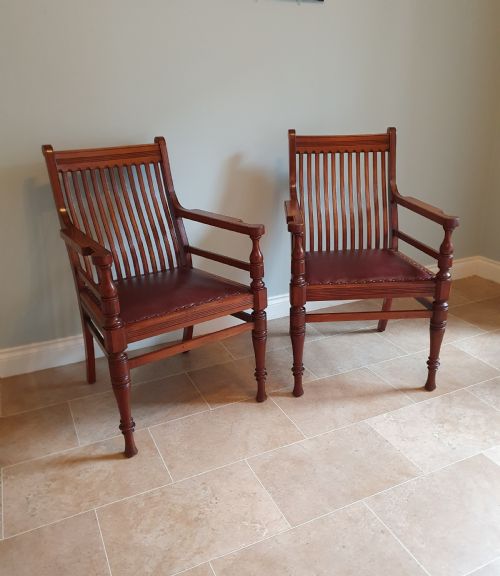


Pair Late Victorian Armchairs
Pair late victorian armchairs bring period seating in matched sets, offering comfortable proportions and distinct nineteenth-century styling for daily sitting.
Pair Late Victorian Armchairs
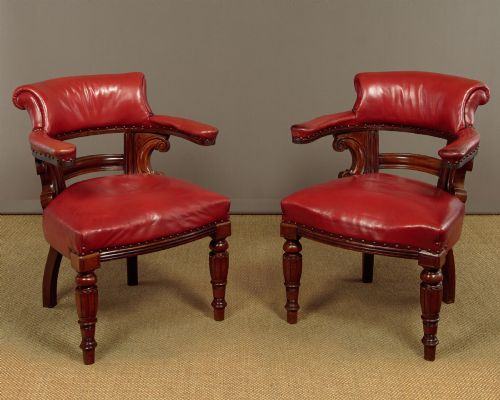
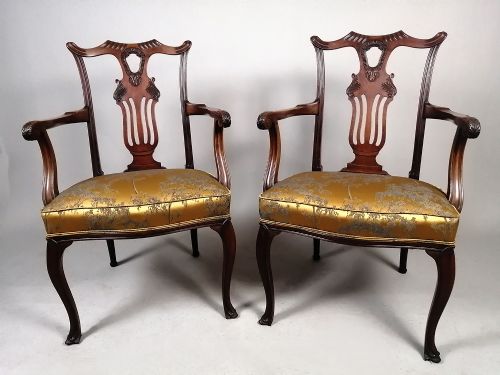
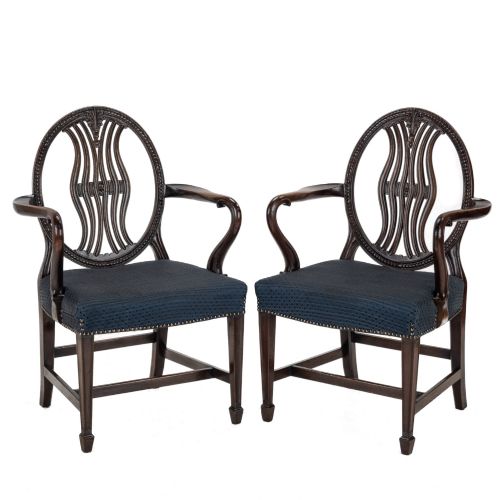
Pair late victorian armchairs comprise matched seating pieces produced primarily during the late nineteenth century, spanning various revival aesthetics and domestic uses. Buyers encounter diverse timber frames, from mahogany and walnut to oak, configured as open armchairs, library seats, and upholstered club versions.
The selection frequently includes salon suites, corner chairs, and specific 'his' and 'hers' pairings designed for nineteenth-century parlours and drawing rooms. These items reflect the era's preference for both comfortable upholstered lounging and formal revival designs rooted in earlier centuries.
How they were made
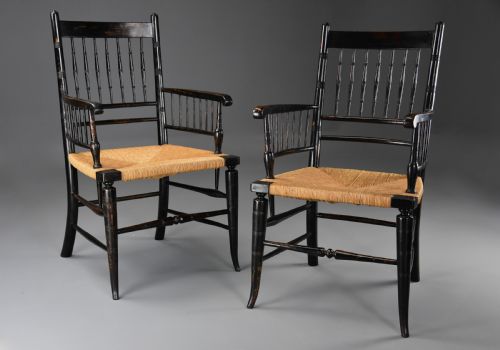
Frames are constructed predominantly from solid hardwoods such as mahogany, walnut, and oak, occasionally finished in ebonised wood or giltwood. Joinery relies on traditional methods to support weight across structural arms and legs.
Upholstered elements incorporate leather, velvet, and various decorative fabrics, fixed over supportive interior stuffing and secured with brass detailing where appropriate. Timber surfaces often display carved ornamentation, delicate inlay work, or revival stylistic motifs.
His and hers chairs ensure nobody argues over who gets the comfortable seat by the fire.
What varies in quality
Distinctions in quality arise from the crispness of timber carving, the precision of inlaid details, and the integrity of the underlying frame construction. Superior examples maintain structural rigidity and balanced proportions across both matched chairs.
Finer items exhibit select timber grains and sophisticated upholstery execution, aligning with known workshop standards of the period. Lesser examples show simpler joinery and more utilitarian material selection suited to secondary rooms.
Morris and Co·Edwards and Roberts·Maple and Co
The Pair Late Victorian Armchairs Glossary
- Carver
- An armchair designed with arms, typically made to match a set of dining chairs without arms. They often occupied the ends of a dining table.
- Ebonised
- Wood treated with a dark finish to imitate expensive ebony. This technique was popular in Victorian furniture to create high-contrast decorative effects.
- Fauteuil
- An open-framed upholstered armchair originating in France, featuring exposed wooden arms and upholstered elbow pads. They became popular in revival drawing rooms.
- Smokers bow
- A sturdy, low-backed wooden armchair with a curved top rail and turned spindles, frequently found in studies and smoking rooms.
- Tub armchair
- A comfortable chair featuring a rounded, enclosed back and sides that form a continuous curve. The design wraps around the sitter for added support.
Pair Late Victorian Armchairs: Frequently Asked Questions
What rooms suit pair late victorian armchairs?
These chairs fit well in sitting rooms, studies, and bedrooms where matched seating adds symmetry and character. Their varied forms accommodate both formal reception spaces and relaxing domestic corners.
Placing them opposite a fireplace or flanking a window creates a balanced arrangement while providing practical seating options for daily use.
How do you distinguish gents and ladies chairs?
Gentlemen's chairs are typically built with broader proportions and higher backs to accommodate male sitters of the period. Ladies chairs feature more compact dimensions and lower seats designed for the heavier skirts worn at the time.
Both pieces maintain matching stylistic details when sold together as a matched pair or suite.
Were these chairs used as office seating?
Certain designated examples include oak-framed desk armchairs and library armchairs built for reading and study environments. These variants prioritise sturdy wooden frames and supportive arm heights.
Other styles, such as salon and club armchairs, were intended purely for relaxation and social entertaining in domestic reception rooms.
How do revival styles affect the design?
Revival designs draw direct inspiration from earlier historical periods, incorporating Chippendale, Hepplewhite, and Gothic motifs into late-nineteenth-century frames. Makers reinterpreted these classic lines using contemporary Victorian manufacturing techniques.
This blending results in pieces that combine historic aesthetic elements with the sturdiness of nineteenth-century cabinetmaking.