


Pair Glass Spirit Bottles
Pair glass spirit bottles are matched drinking vessels designed for the sideboard, bringing symmetry and practical elegance to home entertaining.
Pair Glass Spirit Bottles
Pair glass spirit bottles are matched drinking vessels designed for the sideboard, bringing symmetry and practical elegance to home entertaining. When searching this phrase, a buyer encounters matching pairs of decanters, carafes, and spirit containers spanning the Georgian, Victorian, and Edwardian periods.
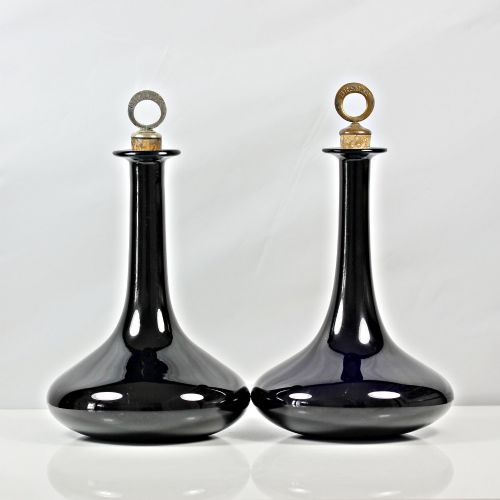
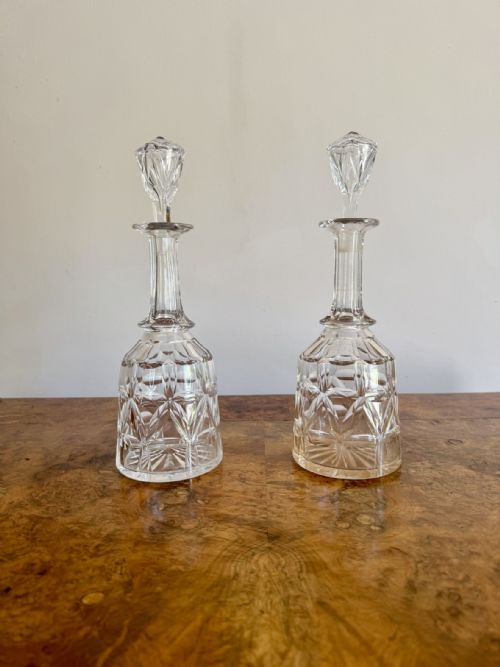
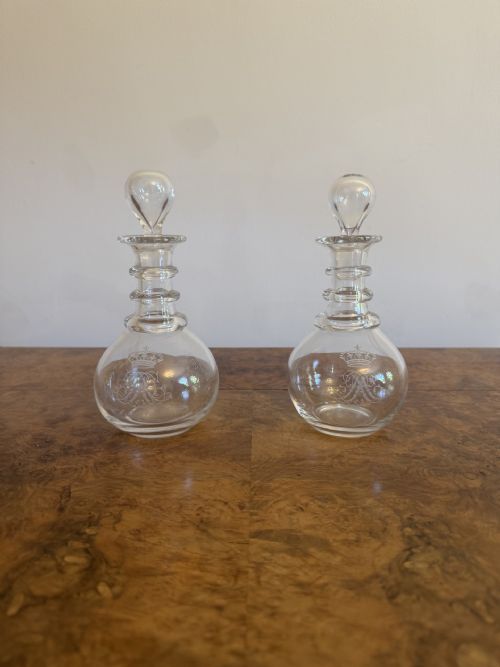
The most common examples on this page are Victorian and Edwardian cut glass and crystal decanters, often found with their original stoppers. These pieces range from clear lead crystal to richly coloured ruby, green, and Bristol blue glass.
Historical examples also include Georgian apothecary bottles, tincture jars, and Regency half-bottle decanters. Mid-century silver-mounted spirit vessels and silver whisky noggins represent the later end of the timeline.
Materials and construction
Glassmaking traditions relied on heavy lead crystal and clear glass, shaped by blowing into moulds or forming optical patterns. Many vessels incorporate deep wheel-cutting, facet-cutting, and delicate hand engraving to catch the light.
Coloured glass variations such as ruby, cranberry, amethyst, and Bristol blue were achieved by adding metallic oxides to the molten batch. Finer examples integrate applied silver mounts, collars, and engraved labels specifying spirits like brandy and whisky.
The listings span from the 18th century through the Victorian and Edwardian eras, utilising cut glass, lead crystal, and coloured glass.
Assessing quality and character
Quality rests in the crispness of the glass-cutting and the weight of the material, with heavy lead crystal offering superior refractive brilliance compared to lighter pressed glass. The clarity of the metal and the presence of hand-engraved detailing elevate individual pairs.
The matching of the stoppers holds significant importance, as original paired stoppers that fit securely indicate a cohesive and well-preserved set. Subtle variations in colour saturation and the precision of optic-blown ribs distinguish standard production from finer workshop output.
James Powell·Mappin & Webb
The Pair Glass Spirit Bottles Glossary
- Decanter
- A vessel used for holding and serving spirits or wine, typically fitted with a stopper. These pieces form the primary focus of this category.
- Lead crystal
- Glass containing lead oxide, which increases weight, brilliance, and clarity. It allows for deep, sharp wheel-cutting.
- Stopper
- The glass or crystal plug fitted into the neck of a bottle to seal the contents. Finding a matched pair with original stoppers is desirable.
- Optic blown
- A technique where glass is blown into a ribbed mould to create subtle internal patterns. This method adds texture without heavy surface cutting.
- Tincture bottle
- A small apothecary jar used historically for storing medicinal liquids. These appear in Georgian collections alongside spirit bottles.
- Noggin
- A small vessel or mug used for serving a measure of spirits. Matched silver-mounted versions represent a distinct drinking tradition.
Pair Glass Spirit Bottles: Frequently Asked Questions
How do I date a pair of glass spirit bottles?
Dating relies on stylistic clues, cutting techniques, and the shape of the bottle neck and body. Georgian and Regency examples often feature heavy kick-up bases and simple mallet or shaft forms.
Victorian and Edwardian pieces show more elaborate wheel-cutting, distinct coloured glass variations, and occasional silver mounts that carry hallmarks for precise dating.
Are original stoppers important?
Original matched stoppers contribute significantly to the integrity and visual symmetry of a pair. Because stoppers were easily broken and replaced over time, finding a set with period-correct, matching stoppers is valued by collectors.
Examining the ground glass fit helps determine whether the stoppers belong to the bottles from their original manufacture.
What is the difference between a decanter and a carafe?
Decanters generally feature heavier glass construction, geometric cutting, and fitted stoppers designed for storing and serving spirits over longer periods. They often include engraved labels identifying specific contents like whisky or brandy.
Carafes tend to have simpler, more fluid lines without stoppers, serving water or wine directly at the table.
How should I clean antique glass spirit bottles?
Cleaning requires lukewarm water and mild soap, avoiding sudden temperature changes that can crack historic glass. Stubborn internal residue responds to specialised cleaning beads rather than harsh abrasive tools.
Silver mounts require careful polishing with a soft cloth to prevent tarnishing while protecting the surrounding glass surface.