



Pair Georgian Glass Decanters
Pair georgian glass decanters bring symmetry and sparkling weight to a sideboard, formed in lead crystal or clear glass with matching stoppers.
Pair Georgian Glass Decanters
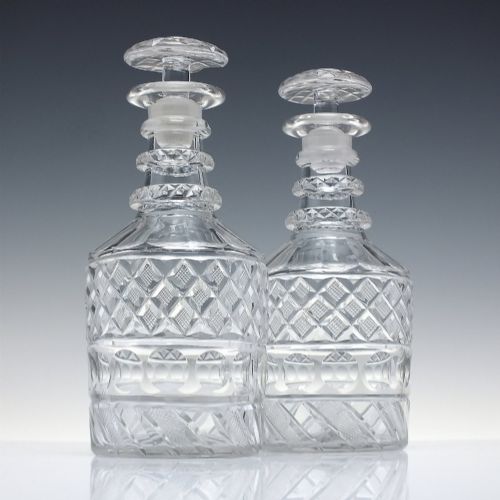
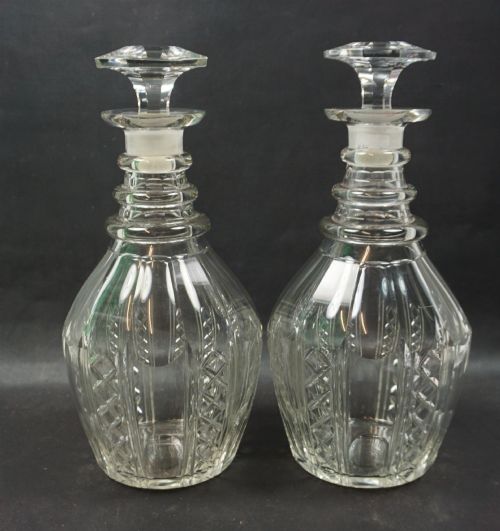
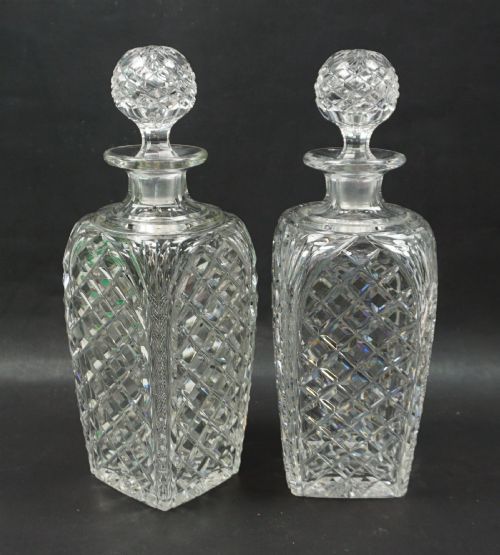
A pair georgian glass decanters represents matched drinking vessels designed for the dining table, most frequently encountered in clear lead crystal from the Georgian, Regency, and William IV eras. These items arrive in ovoid, square section tapered, and Prussian forms, sometimes accompanied by matching stoppers.
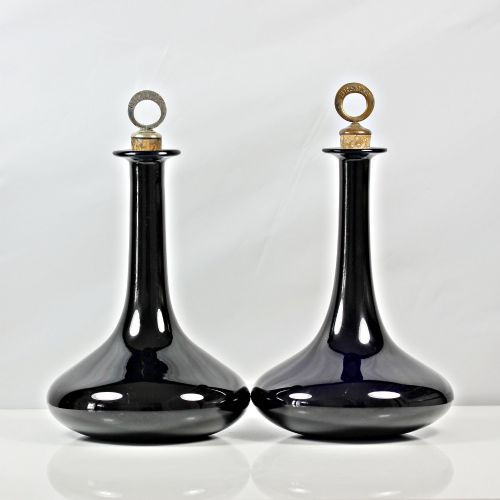
Beyond standard wine vessels, the selection encompasses apothecary jars and tincture bottles in Bristol blue glass, alongside Nelson style decanters that reflect early nineteenth-century taste. These pieces span periods from the Georgian era through to later Victorian, Edwardian, and twentieth-century interpretations.
How they were made
Makers formed these decanters using heavy lead crystal and clear glass, shaping them through blowing and cutting techniques. The resulting bodies often display three-ring necks and pillar cutting, combined with etched decoration.
Interiors and closures rely on fitted cork stoppers to seal the vessel. Craftspeople utilised deep cutting on glass and crystal surfaces to catch the candlelight of the period.
Pair Georgian Glass Decanters Retail Price Guide 2026
Typical asking prices for pair georgian glass decanters among the pieces listed under this phrase on Sellingantiques today, from the lower quarter to the upper quarter. They describe what is for sale here now, not the wider market.
The listings show decanters spanning the Georgian, Regency, William IV, Victorian, and Edwardian periods, utilising lead crystal, clear glass, and Bristol blue glass.
What varies in quality
The standard of cutting and the depth of the lead crystal define the distinction between ordinary vessels and superior examples. Crisp pillar cutting and well-defined three-ring necks demonstrate greater skill by the glassblower.
Clarity of the glass and the matching nature of the stoppers alter the visual balance of the set. Pieces retaining their original stoppers and clear, unclouded metal command more attention.
The Pair Georgian Glass Decanters Glossary
- Prussian style decanters
- A shape characterised by a tapering body and three neck rings, designed to prevent the bottle from slipping from the hand during pouring. This form is common in Georgian examples.
- Lead crystal
- A heavy variety of glass containing lead oxide, which increases brilliance and makes the material softer for deep cutting. It provides the characteristic weight found in these decanters.
- Pillar cut
- A linear cutting technique creating vertical facets that run down the body of the vessel. It reflects light effectively across the surface of the glass.
- Mell decanters
- A mallet-shaped bottle form with a wide base, stable on a dining table during a sea voyage or a bustling dinner party. They appear in deep Bristol blue glass.
- Ovoid
- An egg-shaped profile used for the body of the decanter, offering a balanced proportion between the shoulder and the base.
Pair Georgian Glass Decanters: Frequently Asked Questions
How do I clean old decanters safely?
Wash the glass by hand using warm water and mild detergent, avoiding sudden temperature changes that can crack the material.
Dry the interior thoroughly and store the decanters with their stoppers resting loosely to allow air circulation.
Were these decanters used for wine?
These vessels held port, sherry, and other wines on the dining table, serving both to decant sediment and to present the spirit attractively.
Some variants served specific roles as apothecary jars and tincture bottles for medicinal storage.
How can I tell the period?
Examine the weight of the lead crystal, the presence of neck rings, and the style of the cutting, which shifts from Georgian pillar cuts to later Edwardian etching.
The shape of the base and the formation of the pontil mark also indicate the manufacturing era.
Do matching stoppers matter?
Original matching stoppers complete the pair and maintain the historical integrity of the decanters.
Replacements are common, so inspecting the fit and the glass tone ensures consistency across the set.