




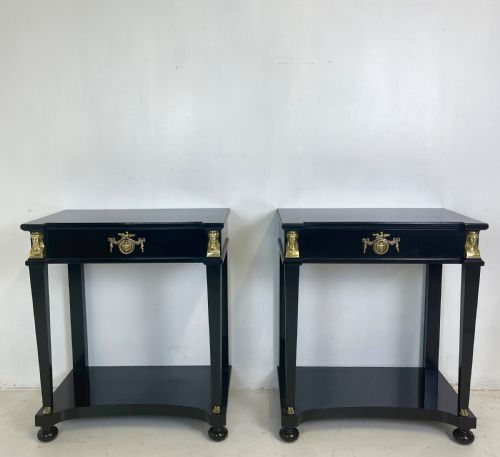

Pair Empire Side Tables
Pair empire side tables bring classical symmetry to a room, offering matched surfaces rooted in nineteenth-century design.
Pair Empire Side Tables
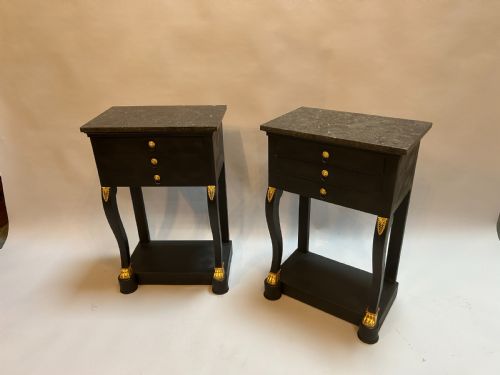
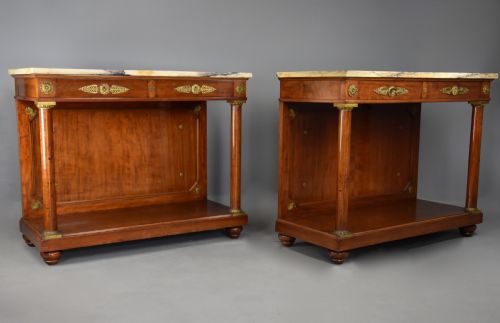
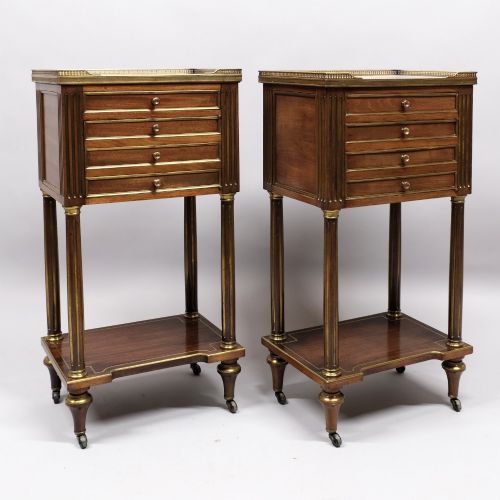
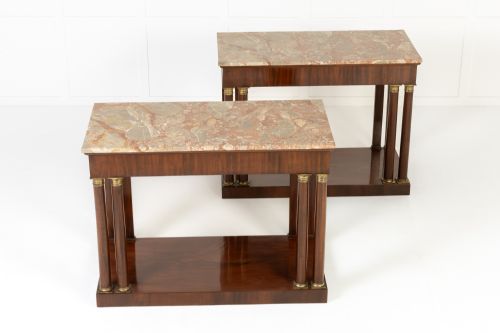
Pair empire side tables span bedside cabinets, console tables and lamp stands, drawing primarily on nineteenth-century French and Regency aesthetics. These dual pieces often display classical proportions and dark timber surfaces topped with stone.
The selection here encompasses antique originals alongside revival pieces from the early twentieth century. Cabinets and consoles dominate the forms, frequently integrating brass mounts or marble slabs into the design.
Materials and construction methods
Cabinetmakers utilised mahogany and walnut as the primary timber foundations, building sturdy frames to support heavy stone elements. Marble tops provide a cool, durable surface that contrasts with the warm grain of the wood.
Metalwork played a defining role, with ormolu, bronze, brass and gilt metal applied as mounts, handles and structural details. These cast components reflect the classical vocabulary of the style through crisp chased decoration.
Listings feature mahogany, walnut and pine timbers paired with marble tops, cast bronze, brass and ormolu mounts.
Distinctions in craftsmanship
Quality rests in the precision of the bronze or ormolu mounts and the selection of timber veneers. Finer examples display sharp, hand-chased metalwork and well-figured mahogany or walnut matched across both pieces of the pair.
Construction details such as drawer lining, jointing and the thickness of the marble slab separate standard production from master workshops. The weight and integration of the mounts indicate the level of labour invested in the creation.
Krieger Paris·Jean Joseph Chapuis
The Pair Empire Side Tables Glossary
- Ormolu
- Gilded bronze used extensively for decorative mounts on furniture and lighting. The technique involves applying a gold amalgam to a bronze base and firing it.
- Neoclassical
- The dominant style of the late eighteenth and nineteenth centuries that revived classical Greek and Roman motifs. It informs the clean lines and symmetrical composition of these tables.
- Console table
- A wall-mounted or freestanding table designed to sit against a vertical surface, frequently topped with marble. These pieces often anchor the proportions of a hallway or principal room.
- Bedside cabinet
- A small enclosed storage unit positioned beside a bed, combining a cupboard or drawers with a display surface. In empire styling, these frequently feature column supports and metal mounts.
Pair Empire Side Tables: Frequently Asked Questions
How do I use a pair empire side tables in a modern interior?
These pieces work effectively as symmetrical bedside tables or flanking surfaces beneath mirrors and artwork. Their classical geometry anchors contemporary neutral spaces while providing functional tabletop and storage areas.
Matching the wood tones and metal mounts to existing hardware creates a cohesive scheme without requiring a period setting.
What is the difference between empire and regency styles?
Empire style originates from Napoleonic France, favouring heavy classical symmetry, dark timbers and rich ormolu mounts. Regency style develops concurrently in Britain, sharing classical roots but often introducing lighter painted finishes and canework.
Both aesthetics share a reliance on ancient Roman and Greek archetypes, leading to similar proportions in console and bedside tables.
Are marble tops original to these tables?
Marble slabs are a defining feature of many nineteenth-century console and bedside cabinets, selected for durability and classical appearance. Most quality examples retain their fitted stone surfaces.
When inspecting a piece, check the seating of the marble within the timber frame to ensure it aligns with the period of the base.
How should I care for the bronze and ormolu mounts?
Gilded and bronze mounts require gentle dusting with a soft, dry brush to prevent the accumulation of grime in the recesses. Avoid abrasive cleaners or metal polishes that can strip the original gilding.
Stable indoor humidity levels protect both the timber substrate and the integrity of the metalwork over time.