

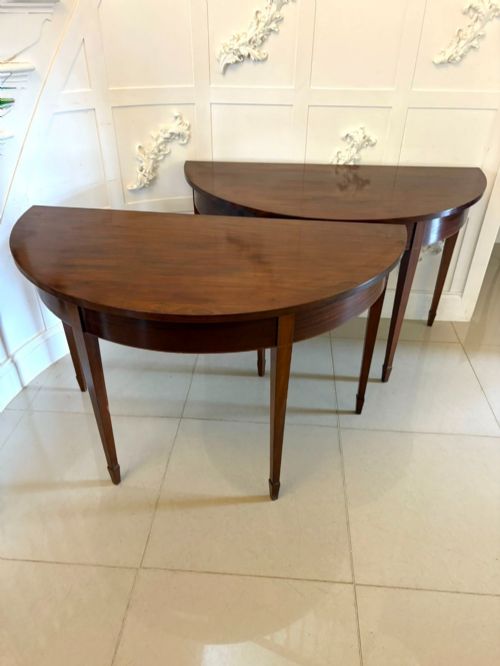
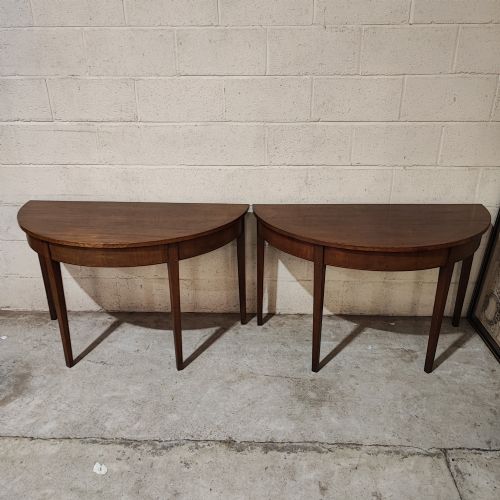
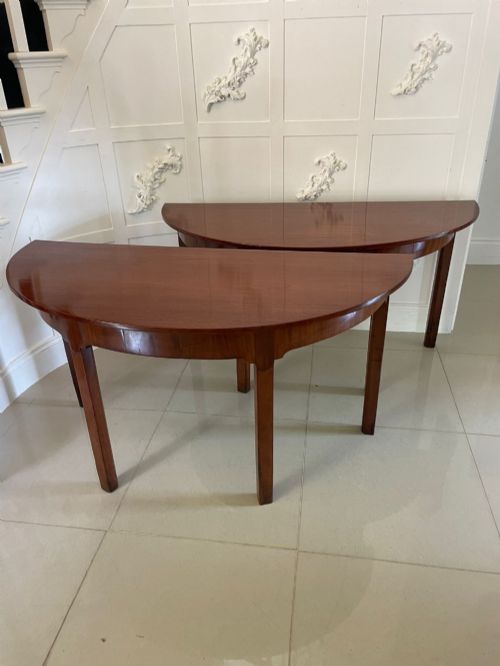
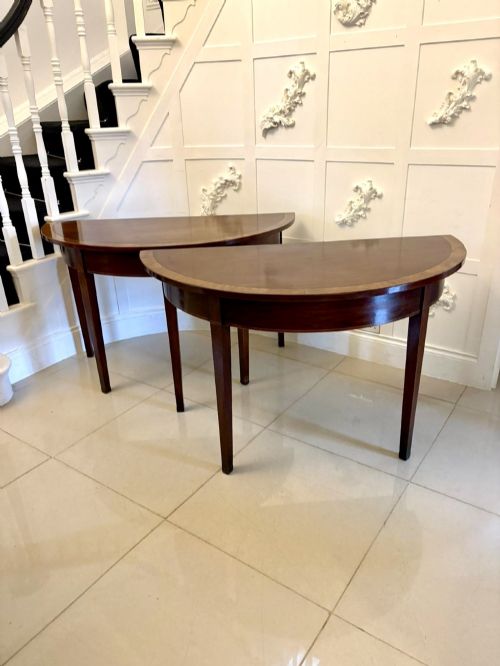
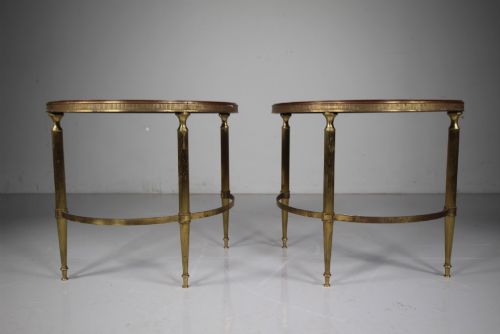
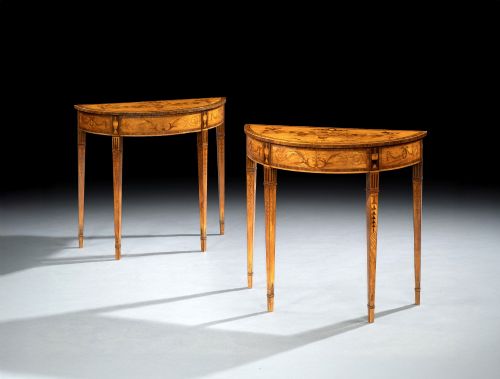


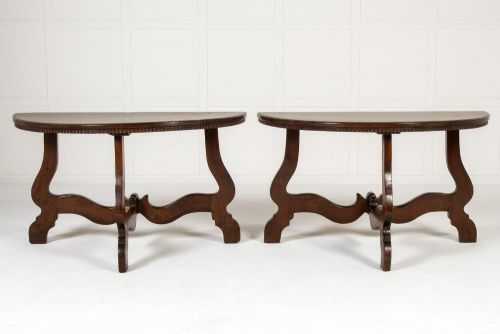


Pair Demi Lune Consoles
Pair demi lune consoles bring symmetrical grace to a hall or drawing room, offering flat-backed half-circle tables designed to stand against a wall.
Pair Demi Lune Consoles
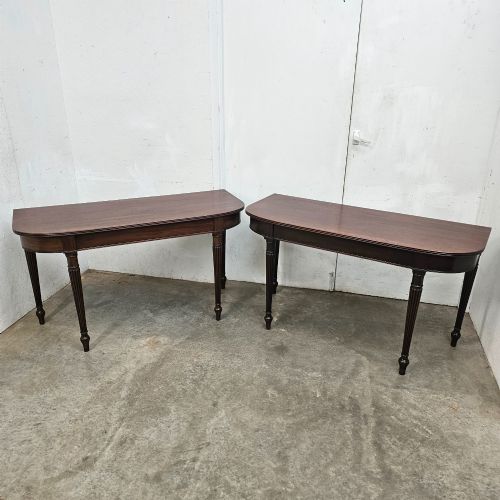
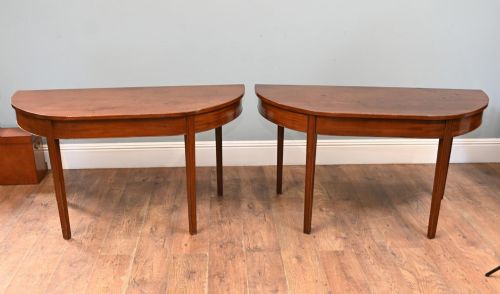
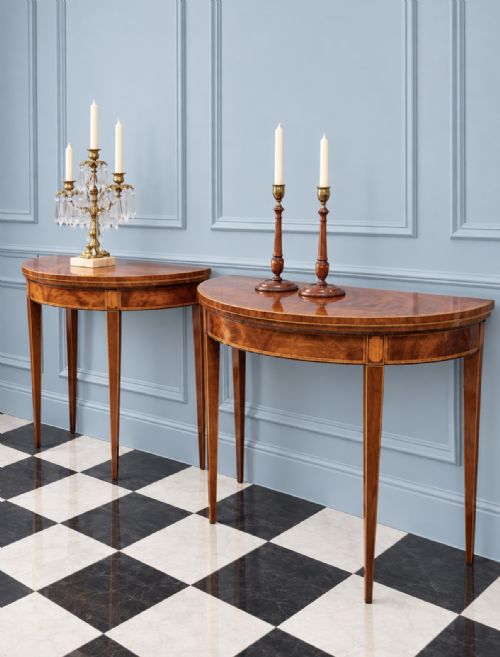
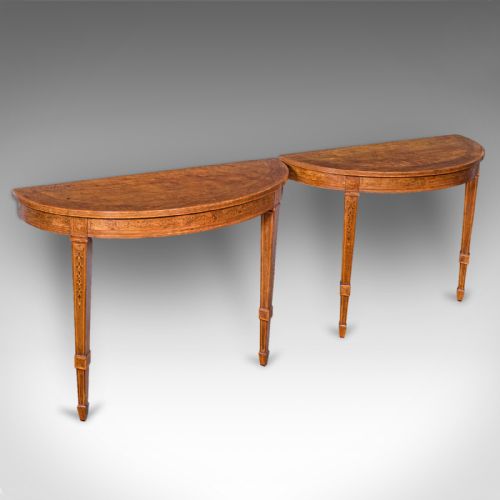
Pair demi lune consoles comprise two matching half-circle tables designed to sit flush against a wall, frequently serving as an imposing pair in formal rooms. The listings show these half-moon forms spanning several periods, with Georgian mahogany examples sitting alongside painted Swedish pine and satinwood revival pieces.
Makers shaped these items primarily as console tables, card tables, and side cabinets, often splitting a circular table in half or building them specifically for perimeters. Buyers frequently encounter George III figured mahogany alongside later 19th-century painted finishes and continental styles.
Materials and construction
Cabinetmakers built these tables using timber frames of mahogany, walnut, oak, and pine, frequently applying veneers of figured mahogany or satinwood across the semicircular top. Marquetry inlay, brass mounts, and red lacquer surface treatments appear on select examples to elevate the visual detail.
The construction relies on stable leg arrangements, often four or five legs per table, ensuring the flat edge rests securely against the wall panel. Joinery techniques connect the apron to the tapered or square legs, supporting the folding tops found on the card table variants.
Pair Demi Lune Consoles Retail Price Guide 2026
Typical asking prices for pair demi lune consoles among the pieces listed under this phrase on Sellingantiques today, from the lower quarter to the upper quarter. They describe what is for sale here now, not the wider market.
Card table versions hide folding tops that wait quietly to turn a hallway console into an impromptu gaming den.
Assessing quality
Quality rests in the choice of timber figure, such as highly figured mahogany or carefully matched satinwood veneers, which dictate the visual depth of the top. Finer execution shows in crisp marquetry, subtle inlay work, and the precision with which the half-circle shape meets the wall.
The distinction between standard utility items and exceptional pieces lies in the harmony of the matched pair and the integrity of the original painted or polished surface. Heavier structural stability and refined edge mouldings separate workshop pieces intended for grand interiors from simpler regional furniture.
Pietro Ferrario
The Pair Demi Lune Consoles Glossary
- Demi-lune
- French for half-moon, describing furniture built with a flat back and a semicircular front. This silhouette allows the table to occupy minimal floor space against a wall.
- Console table
- A table supported by wall brackets or legs, traditionally designed to stand against a vertical surface rather than float in the middle of a room.
- Marquetry
- Decorative patterns formed by fitting together thin slices of wood veneer and other materials onto a structural carcass.
- Satinwood
- A durable timber yielding a lustrous, yellowish surface that takes a fine polish, frequently utilised in late 18th-century and revival furniture.
Pair Demi Lune Consoles: Frequently Asked Questions
Where should I place pair demi lune consoles?
These tables find their traditional home in entrance halls, flanking a fireplace, or beneath a large mirror where a matched pair creates visual balance.
Because of their flat backs, they hug the wall closely, making them useful in narrower corridors where standard round tables obstruct movement.
How do I use a demi lune card table?
Many demi lune tables feature hinged tops that unfold to reveal a baize-lined playing surface for cards or games.
When closed, the table functions as a standard console, transforming into a larger gaming surface when guests arrive.
What is the difference between Georgian and revival pieces?
Georgian pieces date from the 18th or early 19th centuries, utilising solid construction methods and period timber selections characteristic of that era.
Revival pieces, such as those from the Sheraton Revival period, echo those earlier proportions and decorative motifs using late 19th or 20th-century workshop methods.
How do I care for antique mahogany and satinwood?
Protect the polished wood surfaces from direct sunlight and excessive moisture to prevent the veneer from fading or lifting over time.
Apply a traditional wax polish occasionally and buff gently with a soft cloth to maintain the natural lustre of the timber.