
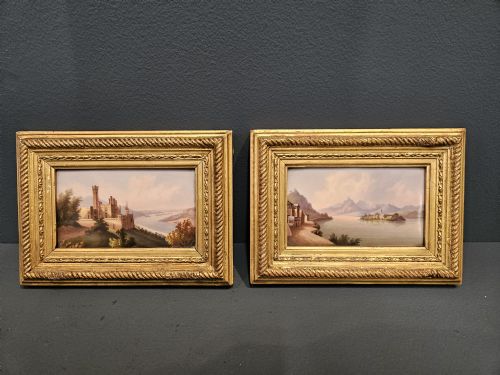
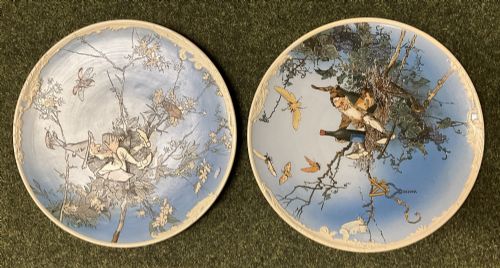


Pair Ceramic Wall Plaques
Pair ceramic wall plaques bring immediate colour and narrative to a room, offering matched symmetry through hand-painted scenes and relief modelling.
Pair Ceramic Wall Plaques
When buyers search for pair ceramic wall plaques, they find matched duals intended for balanced interior display. These objects take the form of framed tiles, porcelain roundels, and decorative plates designed specifically for hanging on walls.
The selections span various eras from the Victorian and Edwardian periods into the twentieth century, encompassing Arts and Crafts, Art Nouveau, and Art Deco aesthetics. Most examples encountered here originate from European factories and Asian kilns, presenting distinct regional ornamentation.
Makers ranged from large industrial potteries to individual artists working in porcelain and earthenware. The format almost invariably relies on symmetry, presenting mirror-image compositions or paired thematic subjects.
Materials and construction
The primary bodies utilise porcelain and earthenware, shaped into flat planes or curved plates before firing. Kiln techniques fix the initial structure, providing a stable canvas for subsequent surface treatment.
Glaze and enamel pigments deliver colour, frequently augmented by gold leaf, giltwood frames, and glass elements. Relief plaques achieve their dimension through moulded clay applied before the final glaze application.
Several plaques stubbornly refuse to depict serious history, preferring children wrestling with goats instead.
Assessing quality and execution
Superior examples demonstrate meticulous hand-painting, particularly in facial expressions and fine botanical details, whereas lesser pieces rely on transfer printing or repetitive stencilling. The crispness of relief modelling distinguishes master workshops from standard commercial production.
The depth and consistency of the glaze layer determine surface durability and visual richness. Signatures from recognised artists or established factory marks elevate the standing of a piece within any collection.
Mettlach·Richard Ginori·Royal Worcester·Minton·KPM
The Pair Ceramic Wall Plaques Glossary
- Bisque
- Unglazed ceramic fired once, presenting a matte, porous surface resembling smooth stone. It is frequently employed for detailed relief work.
- Earthenware
- Porous pottery fired at lower temperatures, requiring an opaque glaze to become watertight. It forms the base for many traditional wall tiles.
- Imari
- Japanese decorative style utilising cobalt blue, iron red, and gold on a white porcelain ground. This aesthetic influenced numerous European factories.
- Relief
- Sculptural projection from a flat background surface, creating three-dimensional depth. It is common on Arts and Crafts plaques.
- Polychrome
- Decoration employing multiple distinct colours across the painted surface. It defines the vibrant palette seen on nineteenth-century porcelain.
Pair Ceramic Wall Plaques: Frequently Asked Questions
How do I hang heavy ceramic wall plaques?
Heavy plaques require secure wall anchors and sturdy picture wire attached directly to the frame or backing. Ensure the hanging hardware matches the combined weight of the ceramic and its housing.
Avoid hanging these items in areas subject to heavy vibration or direct moisture. Periodic checks of the wire and wall fixing ensure safe long-term display.
Are these plaques meant for indoor display only?
Most ceramic and porcelain plaques are intended strictly for interior environments. Changes in temperature and frost can crack the glaze or body of earthenware if placed outdoors.
Keep them away from direct, prolonged sunlight to prevent fading in hand-painted enamels. Gentle interior placement preserves both the ceramic body and any accompanying giltwood frames.
How can I tell the period of a plaque?
Dating relies on factory backstamps, stylistic markers such as Art Nouveau curves, and the physical characteristics of the ceramic body. Examining the framing style and mounting materials also provides chronological clues.
Comparing known artist signatures or registry marks helps narrow the date of manufacture. Construction techniques often reveal whether a piece originates from the Victorian era or later decades.