




Pair Maritime Pictures
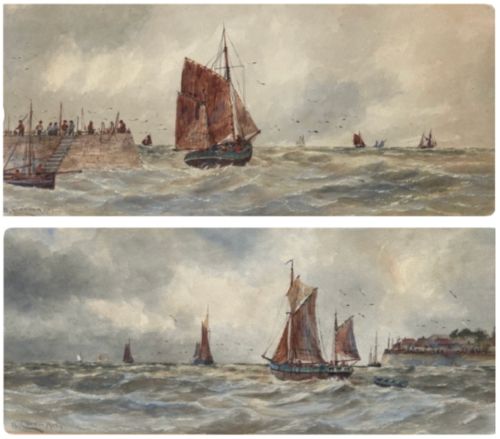
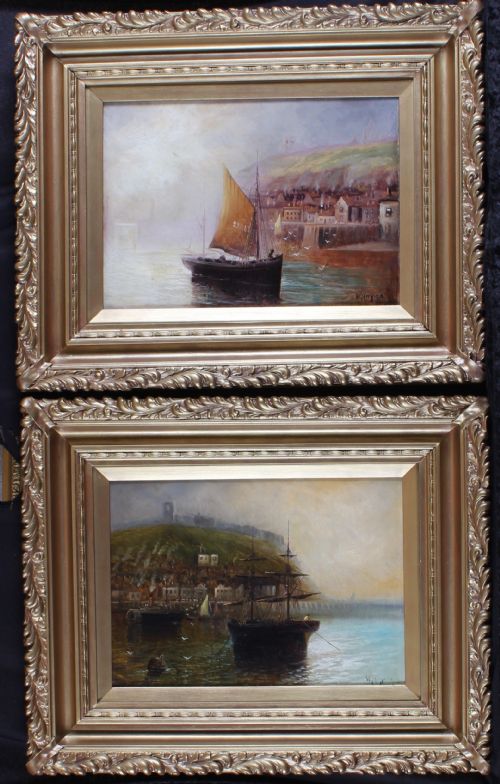
Pair antique maritime pictures bring the power and movement of the sea directly onto the wall, captured in oils and watercolours.
Pair Maritime Pictures
When you search for pair antique maritime pictures, you encounter matched sets of works focusing on coastal views, shipping, and the open sea. These works span the nineteenth century and the early twentieth century, taking the form of framed paintings, watercolours, and enamel plaques.
The pairs you meet on this page most frequently present complementary coastal scenes, such as paired depictions of different ports or opposing weather conditions on the water. Artists often produced these works as matched companions to hang side by side in a room.
The subjects range from busy harbour scenes with fishing boats and barques to dramatic open seascapes pounded by the channel waves. You find works originating from the Victorian and Edwardian periods, alongside earlier Georgian pieces.
Materials and construction
Makers utilised canvas and paper as the primary grounds for these works, applying oil paint or watercolour pigment to build the maritime scenes. Enamel serves as a durable surface for specific decorative plaques depicting nautical themes.
Framing typically involves wood and giltwood enclosures designed to protect the fragile paper or canvas surfaces while complementing the aesthetic of the period. Glazing frequently protects delicate watercolours under glass.
Periods represented across the available pieces span from the Georgian era through Victorian marine art to the Edwardian period.
Factors determining quality
The skill of the brushwork and the accuracy in depicting maritime architecture, rigging, and coastal topography separate standard works from superior examples. Master painters capture the atmospheric light and movement of water with distinct confidence.
The integrity of the matched pair as a unified set preserves the historical and visual balance intended by the creator. Original frames and good preservation of the pigment enhance the standing of the piece.
William Cannon·Gustave De Bréanski·Leslie Rackham·Thomas Bush Hardy·Ebeneezer Colls·John James Wilson·Walter Meegan·Gordon Meadows
The Pair Maritime Pictures Glossary
- Barque
- A sailing vessel with three or more masts. This type of ship frequently appears in maritime art from the nineteenth and early twentieth centuries.
- Giltwood
- Wood carved and covered with a thin layer of gold leaf. This material appears commonly on the frames surrounding Victorian and Edwardian paintings.
- Neapolitan School
- A group of artists working in Naples who produced coastal views for travellers on the Grand Tour. These paintings often feature bright Mediterranean light and local shipping.
- Seascape
- A work of art depicting the sea, coastal views, and marine vessels. This genre forms the core subject matter for maritime pictures.
Pair Maritime Pictures: Frequently Asked Questions
How should I hang a matched pair?
Hang the pair at eye level with adequate spacing to allow each picture to be viewed independently while maintaining their visual relationship as a set.
Keep them away from direct sunlight and damp environments to protect the canvas, paper, and giltwood frames.
What subjects do these pictures show?
These works depict fishing boats, barques, coastal cliffs, harbour entrances, and rough channel seas.
Many capture specific British and international ports, recording the maritime commerce and coastal life of the period.
How do I care for antique watercolours?
Watercolours require protection behind glass to shield the delicate pigments from dust and atmospheric moisture.
Ensure they hang away from direct heat sources to prevent the paper from drying out and warping over time.
Can I separate a pair of paintings?
Separating a matched pair diminishes their historical context and the visual balance intended by the artist or original owner.
Keeping them together preserves the integrity of the set as they were created and framed to hang side by side.