


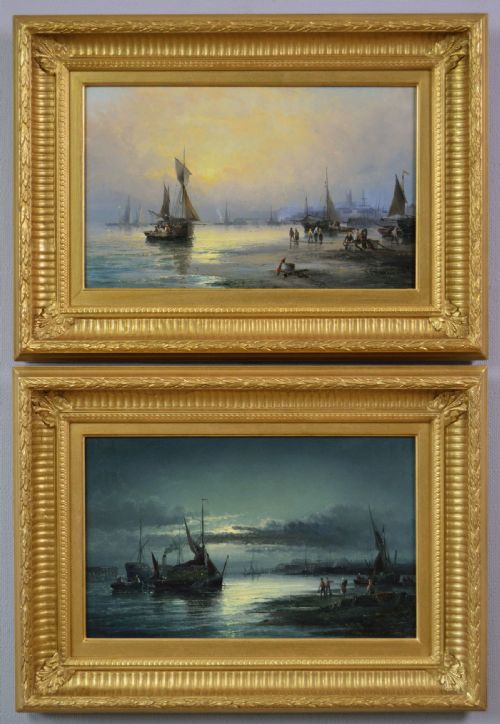

Pair Maritime Oil Paintings
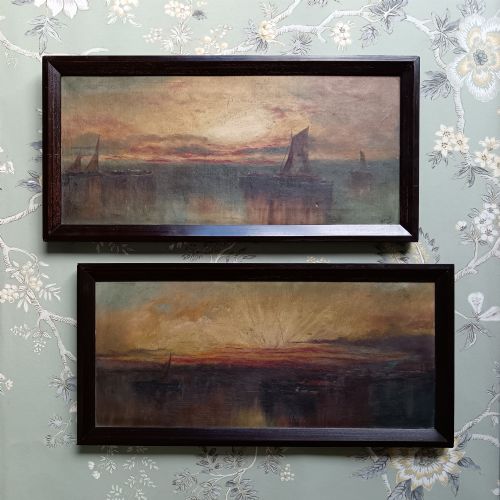
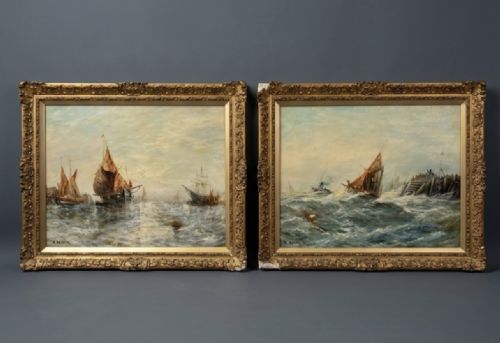
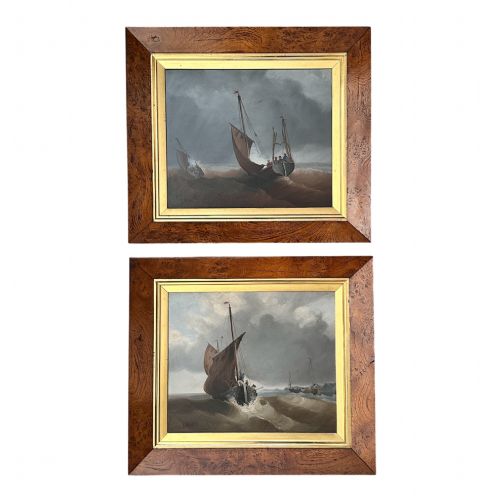
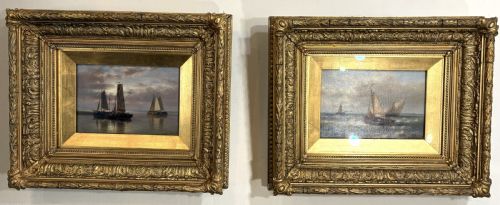
Pair maritime oil paintings capture nineteenth-century and Edwardian coastal shipping, fishing boats and stormy channel scenes.
Pair Maritime Oil Paintings
Pair maritime oil paintings encompass nineteenth-century and Edwardian works depicting coastal views, barques, fishing boats and shipping harbours. Buyers seeking matching dual compositions encounter Victorian marine art across canvas and board.
The selections frequently feature named coastal locations such as Scarborough, Portsmouth, Whitby, Rochester on the Medway, and the Thames at London. Artists utilise matched canvases to portray contrasting marine conditions like sunrise and sunset or calm waters and rough channel seas.
Materials and construction
These works are painted in oil media upon stretched canvas or wooden boards. The support provides a stable ground for pigment application by marine painters.
Many surviving examples retain their original giltwood, gesso and gold leaf frames, which complement the marine subjects.
Listings feature nineteenth-century and Edwardian works on canvas and board, housed in giltwood and gesso frames.
Distinctions in quality
Superior execution shows in the handling of water, atmospheric light and rigging detail on vessels. Works by known marine specialists demonstrate precise draftsmanship in depicting hull forms and coastal architecture.
Condition of the painted surface, stability of the canvas or board, and preservation of the original gilt frames influence the integrity of the paired pieces.
John Moore of Ipswich·Abraham Hulk I·Gustave De Bréanski·Pieter Cornelis Dommersen·Adrian Van Porten·George Dodgson Callow·Ebeneezer Colls·Hubert Thornley·John James Wilson·Walter Meegan·Thomas Rose Miles·John Mc Ghie·Francis Moltino·Walter Williams·B. Nash
The Pair Maritime Oil Paintings Glossary
- Marine oil painting
- A fine art work executed in oil paints on canvas or board, focusing on ships, the sea or coastal views. These pieces often document historical vessels and maritime locations.
- Giltwood
- Timber frame coated with gold leaf or metallic powder, commonly found on nineteenth-century paintings. This traditional framing enhances the visual depth of marine scenes.
- Barque
- A sailing vessel with three or more masts, frequently depicted in Edwardian and nineteenth-century coastal art. Such ships feature square sails on the fore and main masts.
- Board
- A rigid wooden or panel support used instead of stretched canvas for oil painting. Many smaller nineteenth-century maritime works utilise board supports.
Pair Maritime Oil Paintings: Frequently Asked Questions
What periods do these paintings date from?
The works span the nineteenth century and the Edwardian era, with dates recorded from the eighteen-sixties through to nineteen-ten.
Victorian examples predominate, reflecting the period's strong interest in maritime trade and coastal scenery.
How were these pairs displayed?
Pairs were traditionally hung together in domestic interiors to balance wall spaces, often depicting complementary subjects such as sunrise and sunset.
The matching gilt frames unify the two distinct canvases into a single decorative scheme.
Which subjects appear most often?
Common subjects include fishing boats near shores, commercial shipping in harbours, and coastal landmarks around Britain and the Netherlands.
Artists frequently recorded specific locations such as Portsmouth Harbour, the Medway at Rochester, and the Thames at London.
Are all the paintings signed?
Several works bear signatures or attributions to recognised nineteenth-century marine painters, whilst others remain attributed to specific artists based on style and subject matter.
Signatures help verify the authorship of individual pieces within a pair.