
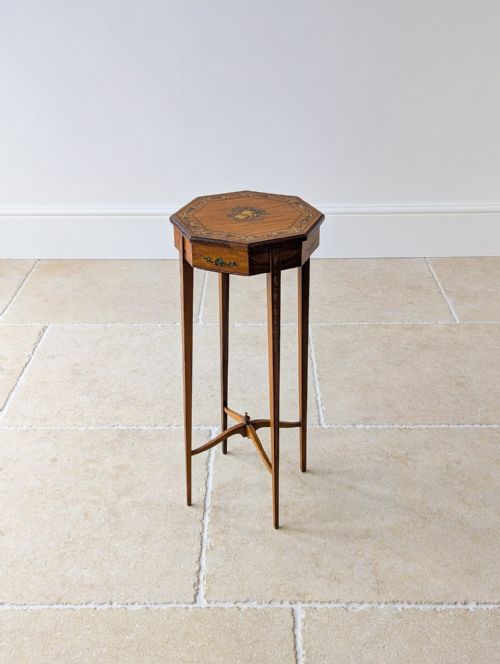
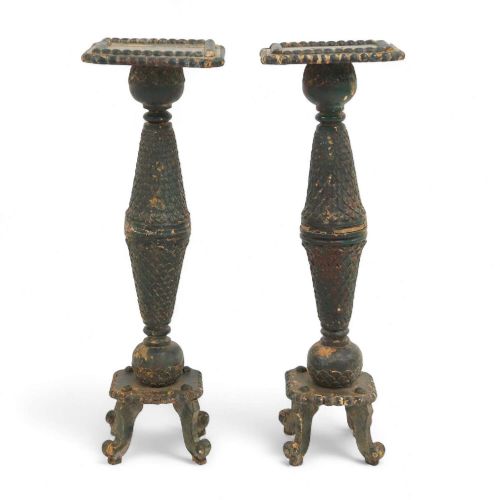


Painted Wooden Torchere
These painted wooden torchere pieces bring vertical presence and rich surface colour to a room.
Painted Wooden Torchere
A painted wooden torchere is a tall, slender stand designed to elevate a light source, plant or decorative figure. The form originates from European lighting stands and evolved into decorative pedestals through the eighteenth and nineteenth centuries.
The pieces on this page span several distinct stylistic revivals, including Edwardian Sheraton Revival, Venetian Baroque, and Queen Anne period revival. They arrive in forms ranging from simple columns to carved figures holding trays.
Makers utilised various regional aesthetics, producing Venetian polychrome examples alongside simpler pine columns finished with simulated marble paint. Buyers encounter both single stands and matched pairs across the nineteenth and early twentieth centuries.
How they were made
Carved wood forms the structural core of these stands, often layered with gesso to create smooth surfaces for decoration. Craftsmen applied multiple coats of paint, frequently finishing the woodwork with gold leaf or parcel-gilt details.
Surface finishes include original green paint, polychrome schemes, and black lacquer decoration over satinwood or pine. Certain pieces simulate higher-value materials like marble through careful paintwork applied to timber.
Listings feature items spanning the eighteenth century through to the 1920s, utilising materials such as satinwood, gesso, and polychrome paint.
What varies in quality
Quality rests in the depth and preservation of the original surface finish, whether polychrome paint or gold leaf. Finer examples retain their untouched decorative schemes rather than later overpainting.
The crispness of the wood carving separates standard turned shafts from detailed figural and baroque stands. Proportions and the stability of the central column also define the standard of the piece.
The Painted Wooden Torchere Glossary
- Torchere
- A tall stand or pedestal originally intended to hold a candle or torch. The form later accommodated lamps, vases, and decorative figures.
- Gesso
- A plaster-like mixture applied to wood surfaces as a base for paint and gilding. It allows for sharp carved details and smooth finishes.
- Parcel-gilt
- Partially gilded woodwork where gold leaf highlights specific carved areas against a painted background. This technique accentuates the three-dimensional ornament of the piece.
- Polychrome paint
- Decoration executed in multiple colours across the surface of the wood. It is characteristic of Venetian and Baroque revival pieces.
Painted Wooden Torchere: Frequently Asked Questions
What is a torchere used for?
These tall stands were traditionally used to elevate candles or lighting fixtures to illuminate a room.
Today, they function primarily as decorative pedestals for displaying plants, vases, or sculptural figures in corners and hallways.
How do I date a painted torchere?
Dating relies on stylistic revival cues, such as Edwardian Sheraton details, Queen Anne lacquer work, or Venetian Baroque carving motifs.
The underlying wood and paint preparation also offer clues to the period of manufacture.
Are painted wooden torcheres sturdy?
Most stands are designed with weighted or wide bases to support lamps and decorative objects safely.
Heavier figural stands provide extra stability, though tall and slender forms still require careful placement away from high-traffic areas.
How do I care for painted wood?
Protect the original paint and gesso surfaces by keeping them away from direct sunlight and excessive moisture.
Dust gently with a dry, soft cloth and avoid chemical polishes that can damage historic finishes.