
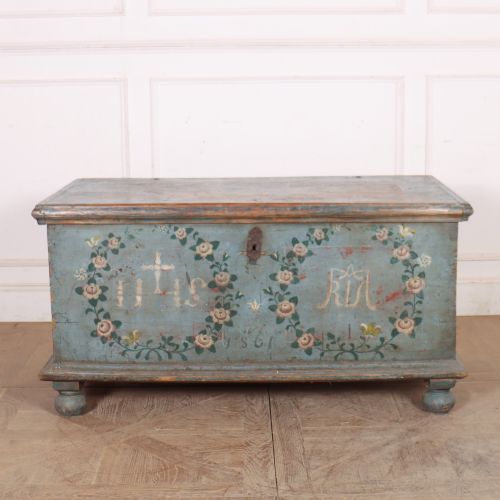


Painted Wooden Marriage Trunk
A painted wooden marriage trunk brings rustic colour and regional folk tradition directly into a room.
Painted Wooden Marriage Trunk
A painted wooden marriage trunk is a substantial storage piece commissioned for weddings, most frequently encountered here in nineteenth century Swedish and Hungarian examples. These items take the form of blanket boxes, coffers, and dome top chests created for domestic utility.
The inventory spans several centuries, reaching back through Georgian and Victorian pieces to seventeenth century Italian walnut cassone chests and Spanish blanket chests with Moorish style decoration. Scandinavian country and Alpine folk art traditions dominate the regional origins on offer.
Buyers commonly select these boxes for their decorative painted surfaces and large internal capacity. They serve equally as functional storage furniture and as striking focal points displaying traditional European folk art.
How they were made
Construction relies predominantly on solid pine and oak, joined to form heavy rectangular or dome top bodies designed to withstand long-term household use. Wrought iron fittings, including hinges, straps and carrying handles, reinforce the heavy timber structures.
Makers applied layers of mineral pigment and paint directly to the wood, often finishing the exteriors with floral motifs and regional folk art patterns. Certain early pieces incorporate carved details or gilt Gothic decoration upon walnut.
Several trunks bear preserved dates and initials from nineteenth century weddings, recording past celebrations directly upon the pine lid.
What varies in quality
Quality rests in the survival and execution of the original surface decoration, distinguishing authentic regional folk art from later re-painting. Pieces retaining their early pigment and distinct brushwork display greater artistic merit.
The integrity of the timber construction and the presence of period wrought iron hardware also differentiate the pieces. Substantial proportions combined with well-preserved structural joinery elevate certain examples above standard domestic boxes.
The Painted Wooden Marriage Trunk Glossary
- Cassone
- A large Italian chest historically used for holding a bride's trousseau. These pieces often feature carved wood or gilt decoration.
- Coffer
- A robust wooden box with a lid, traditionally utilised for safekeeping valuables and textiles. Many examples feature hinged lids and iron reinforcement.
- Mule chest
- A storage chest combining a drawer in the base with a blanket box compartment above. This form bridge the gap between traditional coffers and modern chests of drawers.
- Folk art
- Artistic work created within a traditional culture by self-taught or local artisans. This style defines the painted floral and geometric motifs seen on Scandinavian and Hungarian pieces.
Painted Wooden Marriage Trunk: Frequently Asked Questions
What is a painted wooden marriage trunk used for?
These pieces served historically to transport and store a bride's dowry, linens, and personal possessions. In contemporary interiors, they function primarily as blanket boxes, coffee tables, or statement storage furniture.
Their generous internal capacity accommodates heavy household items while the decorative exterior enhances the room.
How do I identify a Swedish folk art chest?
Swedish chests frequently exhibit distinct nineteenth century characteristics, including dome tops, pine construction, and hand-painted floral or geometric motifs. The palette often relies on regional mineral pigments.
Many examples incorporate wrought iron hinges and carry specific dates or maker initials integrated into the painted decoration.
Are these trunks suitable for daily use?
The solid pine and oak construction makes these chests exceptionally sturdy and practical for regular household storage. The heavy timber and durable painted finishes withstand everyday opening and closing.
Care should be taken to protect the historic pigment from excessive moisture and direct sunlight.
How do I distinguish regional styles?
Regional origins declare themselves through specific decorative palettes and structural silhouettes, such as the dome tops typical of Swedish coffers versus the flat lids of Hungarian boxes. Spanish and Italian pieces introduce walnut and Moorish influences.
Examining the brushwork and pigment type reveals the distinct traditions of Alpine, Scandinavian, or Continental workshops.