
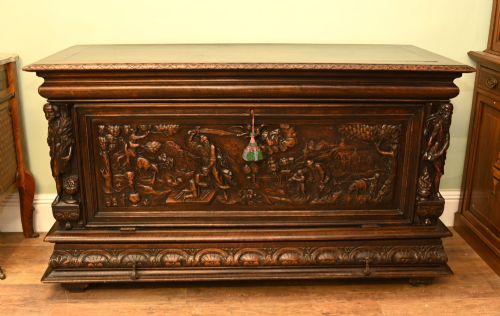
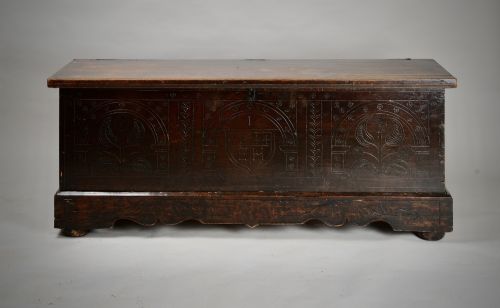
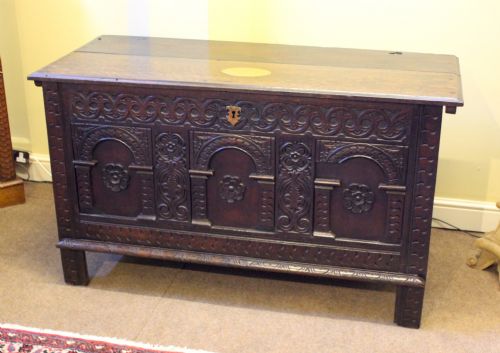


Carved Marriage Chest
A carved marriage chest is a sturdy timber receptacle commissioned to hold a bride's household linens and valuables.
Carved Marriage Chest
A carved marriage chest serves as a robust wooden depository for domestic belongings, often commissioned for a wedding or dowry. These functional pieces appear in various forms across multiple regions, functioning as coffers, mule chests, and cassones.
The pieces on this page span the seventeenth, eighteenth, and nineteenth centuries, alongside specific dates such as seventeen hundred, seventeen fifty, and eighteen hundred. They originate from English, Italian, Spanish, Hungarian, Indian, Chinese, and French traditions.
Forms range from simple oak coffers to elaborate Italian cassones in walnut and beech, alongside painted folk examples in pine and mineral pigments. Buyers encounter both carved timber surfaces and decorated panels featuring traditional motifs.
Materials and construction
Timbers dictate the primary structure of these pieces, with English and European examples relying heavily on oak, walnut, chestnut, and beech, while Asian pieces utilise elm. Pine appears frequently as a secondary timber or as the main body for painted folk variations.
Joinery and surface treatment define the manufacture, combining traditional panel construction with hand-carved ornamentation. Many continental and folk variants employ tempera paint, mineral pigment, and gilding over the wood surface.
Listings span centuries from the seventeenth to the nineteenth, utilising oak, pine, walnut, chestnut, beech, and elm alongside iron and brass hardware.
Quality variations
Quality rests on the depth and execution of the hand-carving and the integrity of the original timber structure. Pieces featuring crisp, deep relief work in oak or walnut stand apart from simpler vernacular carpentry.
The survival of original painted surfaces, gilding, and iron hardware elevates an example above stripped or heavily restored counterparts. Surface patina and regional decorative details distinguish standard utility storage from ceremonial commission pieces.
The Carved Marriage Chest Glossary
- Cassone
- A traditional Italian large chest used for holding a bride's trousseau. These pieces often feature elaborate carving, gilding, or painted decoration.
- Mule chest
- A storage chest featuring one or more drawers beneath the main lift-top compartment. This form bridges the gap between the traditional coffer and the chest of drawers.
- Coffer
- A heavy wooden box with a hinged lid used for safe storage of valuables. Early examples are typically constructed from solid oak with panelled sides.
- Dowry chest
- A receptacle prepared to hold goods and property assembled for a bride upon her marriage. They are found across various global traditions with regional artistic styles.
- Patina
- The surface sheen and coloration developed by timber and finish through age and use. A fine patina indicates genuine period wear and untreated surfaces.
Carved Marriage Chest: Frequently Asked Questions
What was a marriage chest used for?
A marriage chest served to store the household linens, garments, and valuables that a bride brought into a new household.
These pieces acted as secure storage and travelled with the bride to her marital home, often remaining a central piece of family furniture.
How do I tell an Italian cassone from an English coffer?
Italian cassones typically employ walnut or beech with Renaissance carving, gilding, or painted panels. They reflect classical southern European design.
English coffers rely on sturdy oak construction with geometric or floral panels, showcasing a heavier joinery tradition distinct from continental decoration.
Where should I place a large chest in a modern home?
These chests function effectively at the foot of a bed or as a coffee table in a living room. Their flat lids provide usable surface area while the interior offers concealed storage.
Placement should avoid direct sunlight and intense heat sources to protect the aged timber and any painted or gilded surfaces.
What is the difference between a coffer and a mule chest?
A coffer consists of a single compartment accessed exclusively through a lid on top. It represents the older, simpler form of chest storage.
A mule chest incorporates one or more drawers beneath the main lifting compartment, combining box storage with drawer access.