




Painted Ladies Desk
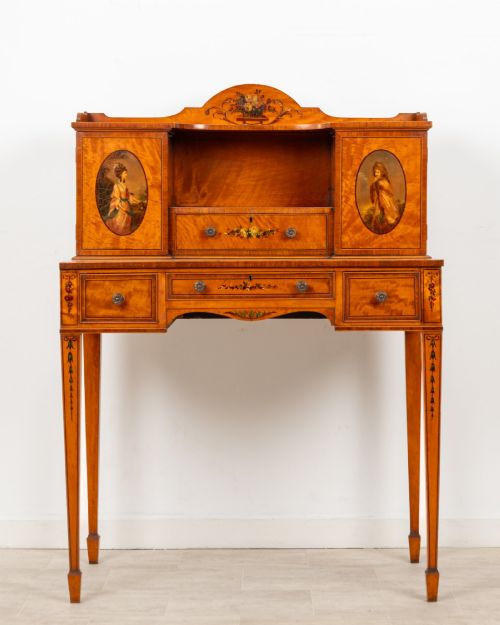
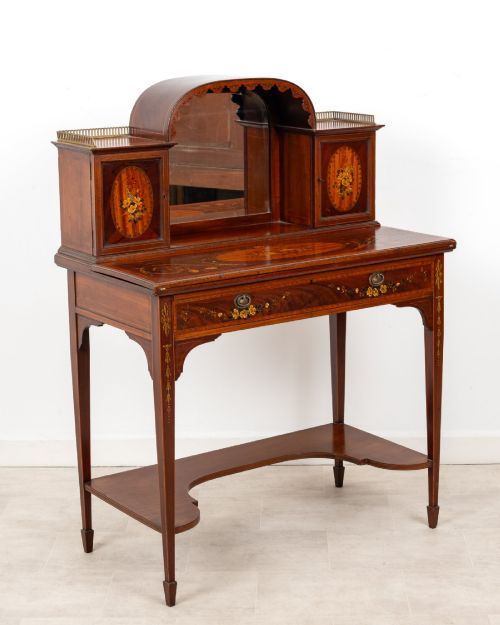
These painted ladies desks span the late nineteenth century and the Edwardian era, bringing delicate painted surfaces and refined writing spaces to domestic rooms.
Painted Ladies Desk
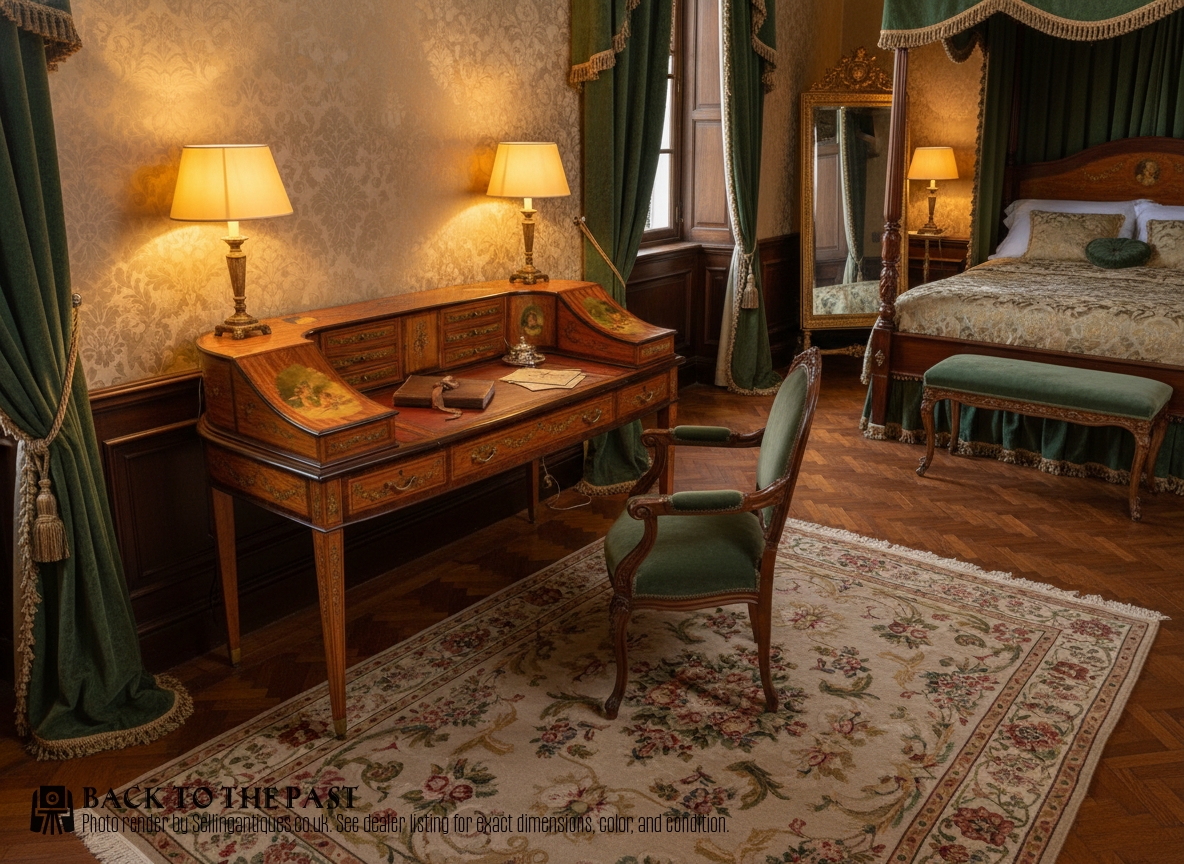
A painted ladies desk combines compact proportions with decorative surface work, serving primarily for correspondence and light administrative tasks in a boudoir or drawing room. Buyers seeking a painted ladies desk encounter a variety of nineteenth century and early twentieth century forms, ranging from satinwood writing tables with mirrored superstructures to kidney shaped desks.
The selection includes Edwardian satinwood pieces decorated with hand painted floral motifs alongside French cabinets featuring Vernis Martin panels. Alongside standard writing tables, the record contains related forms such as the Bonheur du Jour, the Carlton House desk, and the Davenport, all sharing a domestic scale.
Origin and period heavily shape the available examples, with English Sheraton Revival interpretations and French Louis XV style pieces appearing frequently. These writing furniture items rely on lighter woods and decorative finishes rather than the heavy timbers found in larger partner desks.
Materials and construction
Cabinet makers utilised satinwood, mahogany, and walnut as foundational timbers, frequently applying veneers over sturdy core woods. Fine painted ladies desks often incorporate exotic woods such as kingwood, complemented by contrasting stringing and marquetry borders.
Surface decoration distinguishes these pieces, combining hand painted floral details with specialised finishes like Vernis Martin lacquer. Metalwork components, including brass handles, ormolu mounts, and occasional Wedgwood plaques, punctuate the timber and paintwork.
Structural hardware such as secret drawers, leather writing inserts, and mirrored superstructures demand precise joinery to integrate internal compartments within compact writing surfaces.
Recorded forms range from simple writing tables and Davenport desks to elaborate Carlton House desks and mirrored Bonheur du Jour cabinets.
Evaluating craftsmanship
Quality rests upon the crispness of the hand painted decoration and the stability of the timber substrate. Superior examples display fluent brushwork on satinwood panels without later overpainting, preserving the clarity of the original floral or figural designs.
The refinement of the hardware and ormolu mounts separates standard production from exceptional pieces. Cast and chased brass fittings, well fitted secret drawers, and intact leather writing surfaces indicate higher workshop standards during manufacture.
William Henry Knight·Josef Lorenzl·Jennings Brothers·Geo Maxim
The Painted Ladies Desk Glossary
- Bonheur du Jour
- A light lady writing desk featuring a tiered superstructure with small drawers and shelves above the main writing surface. Originating in France during the eighteenth century, the form remained popular through the Victorian and Edwardian revivals.
- Carlton House Desk
- A Davenport style writing desk with a fitted superstructure curving around the back and sides of the writing surface in a continuous row of small drawers and compartments. First produced in the late eighteenth century, these reappeared in satinwood during the Edwardian period.
- Vernis Martin
- A type of simulated Japanese lacquer developed by the Martin brothers in eighteenth century France, utilised for decorative panels on cabinets and desks. This polished resin finish reappeared on nineteenth century revival furniture.
- Satinwood
- A durable tropical hardwood with a lustrous, golden sheen that accepts paintwork and fine inlay exceptionally well. It served as the primary timber for light decorative writing furniture in the Sheraton Revival style.
- Kidney Shaped Desk
- A freestanding writing table constructed with a curved indentation at the front to accommodate the seated user. These pieces often feature painted decoration across the top and are finished on all sides for room placement.
Painted Ladies Desk: Frequently Asked Questions
Where were ladies desks placed?
These compact writing tables typically stood in private sitting rooms, boudoirs, or bedrooms rather than formal libraries. Their finished backs allowed them to sit away from walls in the centre of a room.
Because they occupied domestic living spaces, their designs prioritized visual lightness and decorative painted surfaces to match contemporary interior schemes.
How do I care for painted wood?
Protect painted and polished satinwood surfaces by keeping them away from direct sunlight and maintaining stable room humidity. Gentle dusting with a dry, soft cloth preserves the original painted decoration.
Avoid commercial polishes containing harsh solvents or silicone, which can damage delicate nineteenth century lacquer and paint layers over time.
What is a superstructure?
A superstructure is the tiered arrangement of small drawers, pigeonholes, or mirrors built onto the rear surface of the main writing desk. It provided organised storage for stationery and correspondence without expanding the desk footprint.
In Edwardian examples, these superstructures frequently incorporated small display shelves or pivoting mirrors alongside the stationery compartments.
How do I distinguish Edwardian from Victorian?
Edwardian painted desks generally feature lighter satinwood framing, more restrained neoclassical revival motifs, and brighter painted palettes. Victorian pieces often employ denser timbers, heavier proportions, and darker finishes.
Later Edwardian interpretations lean towards Sheraton Revival elegance, whereas mid Victorian examples emphasise utility or more elaborate Aesthetic Movement decoration.