


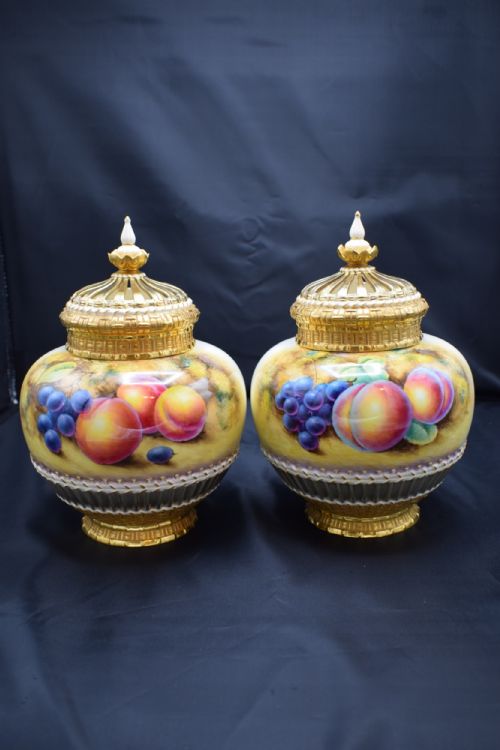


Painted Fruit Porcelain Jar
A painted fruit porcelain jar brings together traditional English porcelain forms and meticulous still life painting, prized for its vibrant palette.
Painted Fruit Porcelain Jar
A painted fruit porcelain jar typically takes the form of a ginger jar, a pot pourri vase, or a covered urn, drawing on traditional English porcelain designs from the nineteenth and twentieth centuries. These decorative pots and jars showcase detailed hand-painted studies of fruit, often set against a shaded background.
The pieces available here lean heavily towards mid-twentieth-century production, notably featuring works from the 1940s through to the 1960s. Buyers will frequently encounter lidded vessels designed for display or aromatic pot pourri.
How they were made
Potters shaped fine bone china and standard porcelain into classic jars and vases before applying a white glaze suitable for detailed painting. Artisans used oil paint and enamel colours to build up realistic depictions of fruit, often finishing the rims and lids with gold leaf, gilt, or gilding.
Many of these decorative jars bear the signatures of known painting artists working within established factories. The combination of delicate ceramic body, layered enamel pigments, and applied gold accents required multiple firings in kilns.
Current listings span the nineteenth century through to 1960, utilising fine bone china, porcelain, oil paint, and gold leaf.
What varies in quality
The distinction between standard production and the finest examples rests largely on the skill of the artist responsible for the fruit painting. Pieces featuring named artists with intricate, lifelike detail command greater attention than simpler decorative treatments.
The presence and condition of applied gilding and gold leaf also influence the overall character of a jar. Furthermore, complete sets featuring matching covers or accompanying secondary vessels demonstrate a higher degree of original craftsmanship.
Royal Worcester·Coalport·John Smith·Freeman·Kitty Blake·Richard Budd·Ayrton
The Painted Fruit Porcelain Jar Glossary
- Porcelain
- A hard, white ceramic material fired at high temperatures, providing a smooth surface for detailed enamel painting.
- Pot Pourri
- A mixture of dried petals and spices placed inside a pierced jar to scent a room, which gave rise to specialised lidded vases.
- Gilt
- A thin layer of gold applied to the ceramic surface or handles, enhancing the decorative appearance of the vessel.
- Fine Bone China
- A type of porcelain incorporating bone ash, known for its high strength, chip resistance, and translucent quality.
Painted Fruit Porcelain Jar: Frequently Asked Questions
What is a painted fruit porcelain jar used for?
These vessels were primarily designed as decorative ornaments, centrepieces, or functional containers for holding dried scented botanicals.
Today, collectors display them on mantelpieces and cabinets to showcase their hand-painted artistic merit.
How do I identify the maker of a jar?
Makers typically applied factory backstamps to the underside of the porcelain base during production.
Individual artists often signed their painted fruit compositions directly onto the body of the ceramic piece near the base.
What periods do these pieces date from?
The selection here spans from the nineteenth century up through the Edwardian era and into the mid-twentieth century, specifically the 1940s, 1950s, and 1960s.
Mid-century examples dominate the current availability of hand-painted fruit ceramics.